Paul Graham
Accelerating Python on GPUs
#1about 1 minute
The evolution of GPU programming with Python
Python has become a first-class citizen in the CUDA ecosystem, making it easier to accelerate software on GPUs.
#2about 2 minutes
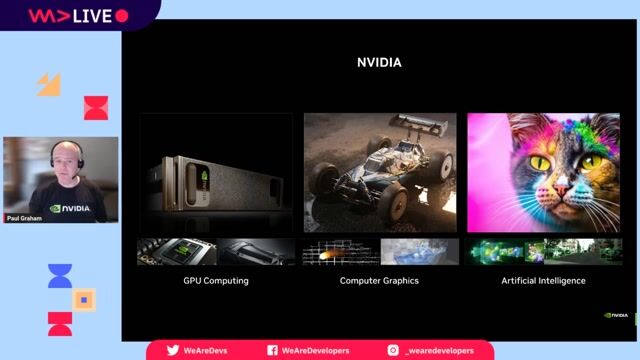
How GPUs evolved from graphics to AI powerhouses
The development of CUDA unlocked general-purpose GPU computing, which was supercharged by the AlexNet breakthrough in AI.
#3about 2 minutes
Understanding modern GPU architecture for parallelism
A look inside a modern data center GPU reveals thousands of cores and specialized hardware like Tensor Cores designed for massive parallelism.
#4about 2 minutes
Navigating the CUDA Python software ecosystem
The CUDA platform provides a layered stack of libraries, frameworks, and tools to access GPU power at your preferred level of abstraction.
#5about 3 minutes
Using high-level frameworks like Rapids for acceleration
Frameworks like Rapids provide GPU-accelerated versions of tools like pandas and scikit-learn, often requiring zero code changes for massive speedups.
#6about 1 minute
Using CuPy as a drop-in replacement for NumPy
CuPy offers a familiar NumPy-like API that allows you to move array computations to the GPU by simply changing the import statement.
#7about 5 minutes
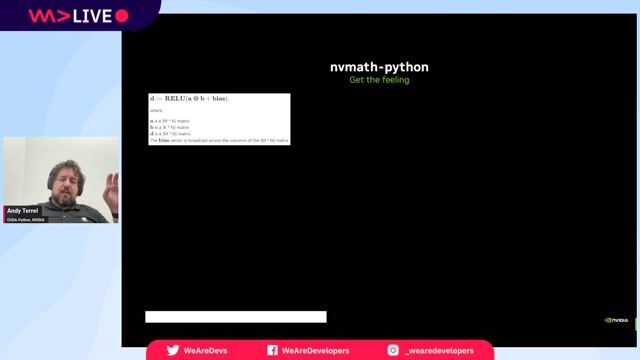
Optimizing code with nvmath-python and a case study
The nvmath-python library enables kernel fusion for significant speedups, as demonstrated by a supernova detection project that went from 45 minutes to one minute.
#8about 2 minutes
A look at upcoming Python GPU programming tools
New tools like CuTe for array-based programming and Python bindings for CUDA Core Compute Libraries are making GPU development even more accessible.
#9about 2 minutes
Strategies for scaling your code to multiple GPUs
Explore various approaches for multi-GPU programming, from high-level libraries like Dask and JAX to lower-level communication libraries like NCCL and NVSHMEM.
#10about 2 minutes
Profiling and debugging your GPU applications
Use essential developer tools like Nsight Systems and Nsight Compute to profile your application, identify bottlenecks, and optimize performance.
#11about 2 minutes
Resources for getting started with GPU programming
Find examples, labs, and free courses through the NVIDIA Accelerated Compute Hub and Developer Program to begin your GPU programming journey.
Related jobs
Jobs that call for the skills explored in this talk.


Matching moments
05:12 MIN
Boosting Python performance with the Nvidia CUDA ecosystem
The weekly developer show: Boosting Python with CUDA, CSS Updates & Navigating New Tech Stacks
Unlock full access
Log in or set up an account to access this feature and more.
10:18 MIN
A progressive approach to programming GPUs in Python
Accelerating Python on GPUs
Unlock full access
Log in or set up an account to access this feature and more.
02:47 MIN
Understanding accelerated computing and GPU parallelism
WWC24 - Ankit Patel - Unlocking the Future Breakthrough Application Performance and Capabilities with NVIDIA
Unlock full access
Log in or set up an account to access this feature and more.
01:40 MIN
A spectrum of approaches for programming GPUs in Python
Accelerating Python on GPUs
Unlock full access
Log in or set up an account to access this feature and more.

05:33 MIN
Understanding the CUDA platform stack for Python developers
CUDA in Python
Unlock full access
Log in or set up an account to access this feature and more.

01:56 MIN
Why GPU acceleration surpasses traditional CPU performance
Accelerating Python on GPUs
Unlock full access
Log in or set up an account to access this feature and more.
01:24 MIN
The evolution of GPUs from graphics to AI computing
Accelerating Python on GPUs
Unlock full access
Log in or set up an account to access this feature and more.
04:05 MIN
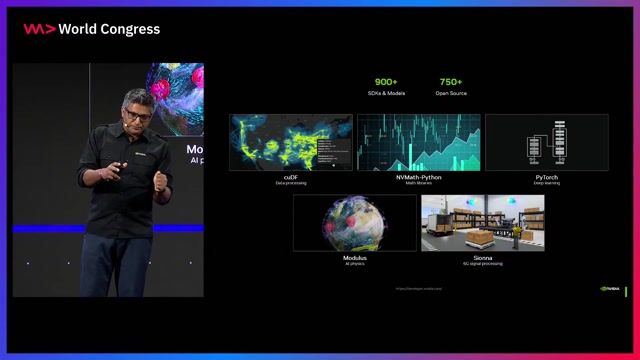
Using NVIDIA libraries to easily accelerate applications
WWC24 - Ankit Patel - Unlocking the Future Breakthrough Application Performance and Capabilities with NVIDIA
Unlock full access
Log in or set up an account to access this feature and more.
Featured Partners
Related Videos
 22:18
22:18Accelerating Python on GPUs
Paul Graham
 59:43
59:43Accelerating Python on GPUs
Paul Graham
 21:02
21:02CUDA in Python
Andy Terrel
 22:07
22:07WWC24 - Ankit Patel - Unlocking the Future Breakthrough Application Performance and Capabilities with NVIDIA
Ankit Patel
 29:52
29:52Your Next AI Needs 10,000 GPUs. Now What?
Anshul Jindal & Martin Piercy
 32:19
32:19A Deep Dive on How To Leverage the NVIDIA GB200 for Ultra-Fast Training and Inference on Kubernetes
Kevin Klues
 37:32
37:32Coffee with Developers - Stephen Jones - NVIDIA
Stephen Jones
 25:29
25:29Python: Behind the Scenes
Diana Gastrin
Related Articles
View all articles


.webp?w=240&auto=compress,format)
From learning to earning
Jobs that call for the skills explored in this talk.


CONTIAMO GMBH
Berlin, Germany
Senior
Python
Docker
TypeScript
PostgreSQL


MedAustron EBG
€46K
GIT
NumPy
Pandas
Data analysis
+1
CERN European Organization for Nuclear Research
CHF75-82K
Intermediate
GIT
BWI GmbH
Senior
Linux
DevOps
Ansible
Terraform
Kubernetes