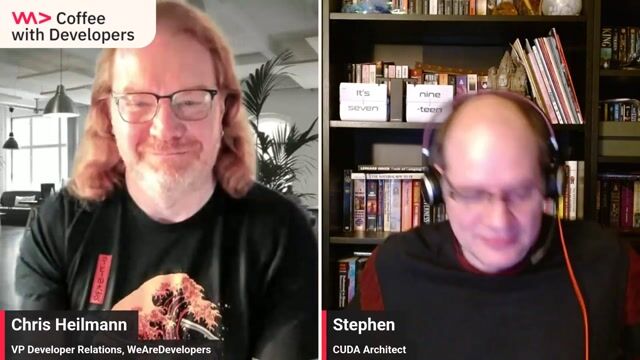
Stephen Jones
Coffee with Developers - Stephen Jones - NVIDIA
#1about 2 minutes
Gaining perspective by using the products you build
Transitioning from a creator to a user of CUDA provides critical insights and humility by revealing the incorrect assumptions made during development.
#2about 3 minutes
Understanding CUDA as a complete computing platform
CUDA has evolved from a low-level language into a comprehensive platform of compilers, libraries, and SDKs that enable GPU access for multiple languages.
#3about 2 minutes
Supporting legacy languages like Fortran for scientific computing
CUDA supports languages like Fortran to accelerate existing codebases in supercomputing for fields such as physics and weather forecasting.
#4about 4 minutes
Why Python became the dominant language for AI
Python's large ecosystem, developer productivity, and vast talent pool made it the de facto language for AI, creating new challenges for parallel computing platforms.
#5about 3 minutes
The challenge of aligning long hardware and short software cycles
Developing new chips takes years of predictive work, creating a challenge to meet the rapidly changing demands of software, especially in the AI space.
#6about 3 minutes
How unexpected user adoption drives technological evolution
Technology evolves organically as users find novel applications for existing tools, such as using gaming GPUs for scientific computing and AI.
#7about 3 minutes
Why AI optimizations increase the demand for compute
Advances that make AI models cheaper or more efficient don't reduce overall compute demand; instead, they enable the creation of even larger and more powerful models.
#8about 3 minutes
The end of Moore's Law is a power consumption problem
While transistor density still doubles, the power per transistor is not halving, creating a thermal and power delivery bottleneck for chip performance.
#9about 6 minutes
The future of computing requires scaling out to data centers
Overcoming power limitations requires moving from single-chip optimization to building large, networked, data-center-scale systems with specialized hardware.
#10about 4 minutes
The rise of neural and quantum computing paradigms
The future of computing will be a hybrid model combining classical, neural, and quantum approaches to solve complex problems using the best tool for each task.
#11about 3 minutes
How developers can contribute to the open source CUDA ecosystem
While low-level drivers are proprietary, the vast majority of CUDA's higher-level libraries like Rapids and Cutlass are open source and welcome community contributions.
Related jobs
Jobs that call for the skills explored in this talk.


Matching moments
05:12 MIN
Boosting Python performance with the Nvidia CUDA ecosystem
The weekly developer show: Boosting Python with CUDA, CSS Updates & Navigating New Tech Stacks
Unlock full access
Log in or set up an account to access this feature and more.
06:37 MIN
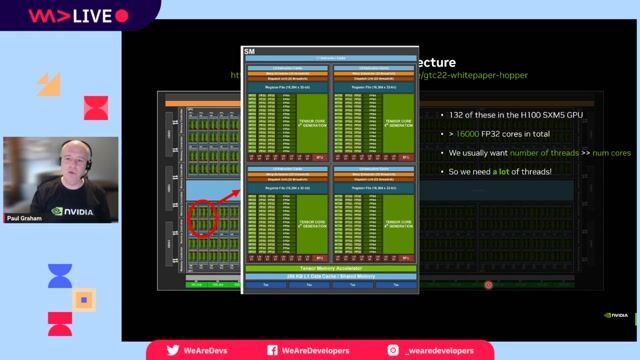
Introducing the CUDA parallel computing platform
Accelerating Python on GPUs
Unlock full access
Log in or set up an account to access this feature and more.
02:21 MIN
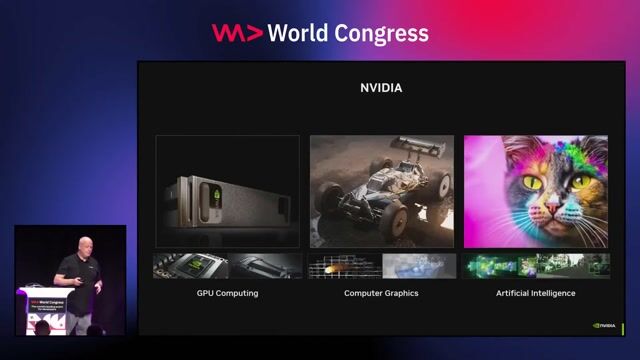
How GPUs evolved from graphics to AI powerhouses
Accelerating Python on GPUs
Unlock full access
Log in or set up an account to access this feature and more.
01:04 MIN
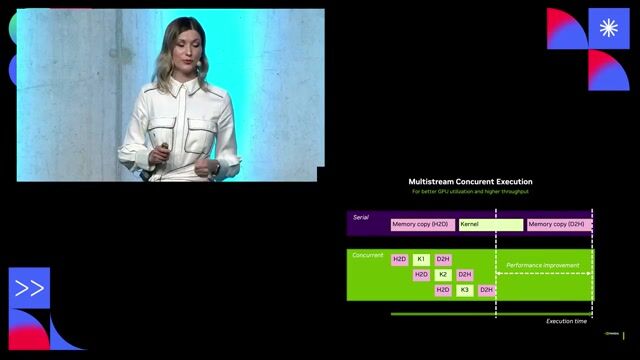
NVIDIA's platform for the end-to-end AI workflow
Trends, Challenges and Best Practices for AI at the Edge
Unlock full access
Log in or set up an account to access this feature and more.

05:33 MIN
Understanding the CUDA platform stack for Python developers
CUDA in Python
Unlock full access
Log in or set up an account to access this feature and more.
01:49 MIN
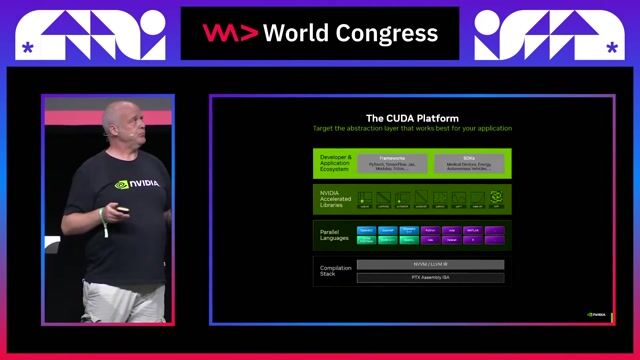
Understanding the CUDA software ecosystem stack
Accelerating Python on GPUs
Unlock full access
Log in or set up an account to access this feature and more.
03:22 MIN
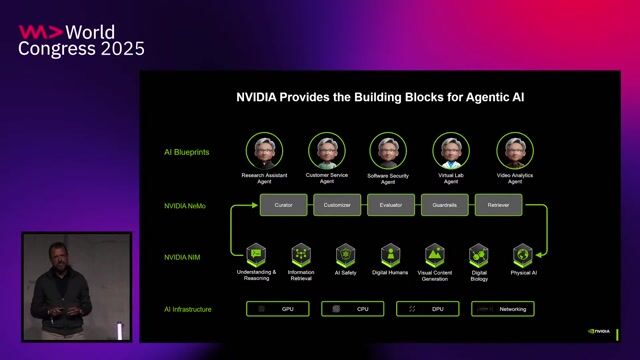
Using NVIDIA's full-stack platform for developers
Pioneering AI Assistants in Banking
Unlock full access
Log in or set up an account to access this feature and more.
01:40 MIN
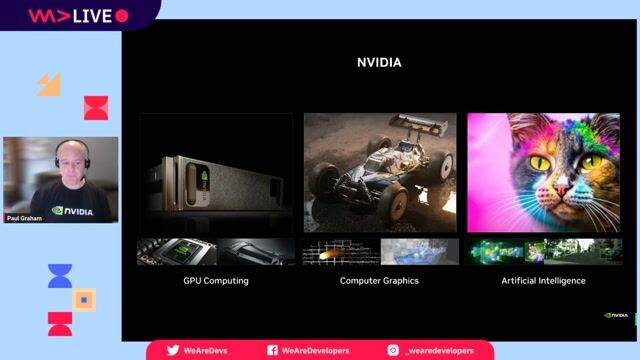
The rise of general-purpose GPU computing
Accelerating Python on GPUs
Unlock full access
Log in or set up an account to access this feature and more.
Featured Partners
Related Videos
 27:01
27:01Tech with Tim at WeAreDevelopers World Congress 2024
Tim Ruscica
 21:02
21:02CUDA in Python
Andy Terrel
 22:07
22:07WWC24 - Ankit Patel - Unlocking the Future Breakthrough Application Performance and Capabilities with NVIDIA
Ankit Patel
 1:09:10
The weekly developer show: Boosting Python with CUDA, CSS Updates & Navigating New Tech Stacks
Chris Heilmann, Daniel Cranney & Nicole Jeschko
 59:43
59:43Accelerating Python on GPUs
Paul Graham
 24:39
24:39Accelerating Python on GPUs
Paul Graham
 22:18
22:18Accelerating Python on GPUs
Paul Graham
 29:52
29:52Your Next AI Needs 10,000 GPUs. Now What?
Anshul Jindal & Martin Piercy
Related Articles
View all articles


From learning to earning
Jobs that call for the skills explored in this talk.


Neural Concept
Lausanne, Switzerland
DevOps
Continuous Integration
NVIDIA Corporation
Remote
Senior
Ruby
Linux
Docker
Kubernetes
+1