
Michele Riva
Writing a full-text search engine in TypeScript
#1about 2 minutes
Why build a full-text search engine from scratch
Building a search engine from scratch is the best way to understand the underlying data structures and algorithms that power it.
#2about 2 minutes
An overview of existing full-text search solutions
Full-text search uses text indexes to quickly find terms, with established solutions like Elasticsearch, Algolia, and newer ones like Meilisearch.
#3about 6 minutes
Preparing text data with tokenization and stemming
Raw text is processed through tokenization, lowercasing, stop-word removal, and stemming to create a clean set of searchable terms.
#4about 6 minutes
Using hash maps to create an inverted index
An inverted index, implemented with a hash map, provides constant-time (O(1)) lookups by mapping search tokens directly to the documents that contain them.
#5about 8 minutes
Optimizing storage space with prefix trees (tries)
Prefix trees, or tries, optimize memory usage by storing common prefixes of words only once, avoiding redundant data storage.
#6about 9 minutes
Implementing typo tolerance with Levenshtein distance
The Levenshtein distance algorithm uses dynamic programming to calculate the "edit distance" between two strings, enabling effective typo tolerance in search queries.
#7about 2 minutes
Introducing Lyra, a fast TypeScript search engine
Lyra is a new, open-source full-text search engine written in TypeScript that achieves microsecond search times by leveraging efficient data structures.
#8about 3 minutes
Q&A on hash functions and memory constraints
The Q&A covers the educational value of custom hash functions, handling acronyms versus stop words, and Lyra's current in-memory architecture.
Related jobs
Jobs that call for the skills explored in this talk.


Matching moments
02:08 MIN
Q&A on TypeScript, clean code, and algorithms
Things I learned while writing high-performance JavaScript applications
Unlock full access
Log in or set up an account to access this feature and more.

04:53 MIN
The four pillars of high-performance JavaScript
Things I learned while writing high-performance JavaScript applications
Unlock full access
Log in or set up an account to access this feature and more.

04:23 MIN
Q&A on performance, interfaces, and advanced learning
Where we're going we don't need JavaScript - Programming with Type Annotations
Unlock full access
Log in or set up an account to access this feature and more.
03:31 MIN
Q&A on indexing, aggregations, and OpenSearch vs Elasticsearch
Search and aggregations made easy with OpenSearch and NodeJS
Unlock full access
Log in or set up an account to access this feature and more.
04:29 MIN
Introducing the core principles of Elasticsearch
Distributed search under the hood
Unlock full access
Log in or set up an account to access this feature and more.
02:37 MIN
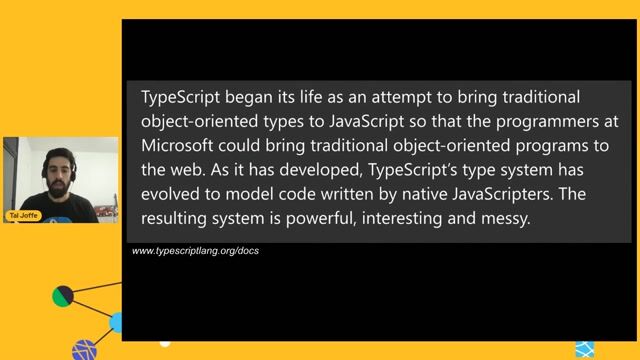
Understanding TypeScript's origins and role in scalability
All you need is types
Unlock full access
Log in or set up an account to access this feature and more.

02:59 MIN
Audience Q&A on patterns, typescript, and frameworks
10 must-know design patterns for JS Devs
Unlock full access
Log in or set up an account to access this feature and more.
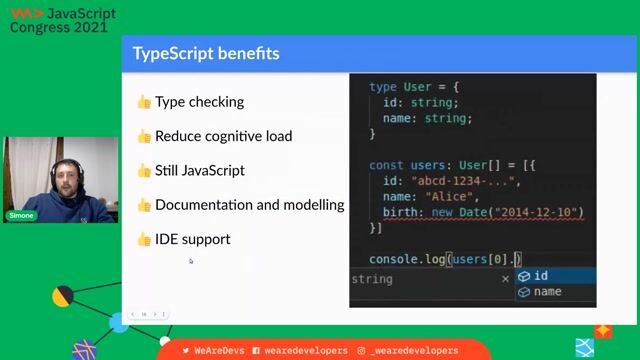
01:56 MIN
Exploring the key benefits of adopting TypeScript
Do TypeScript without TypeScript
Unlock full access
Log in or set up an account to access this feature and more.
Featured Partners
Related Videos
 27:27
27:27Things I learned while writing high-performance JavaScript applications
Michele Riva
 37:18
37:18Building software that scales with Typescript
Tal Joffe
 28:44
28:44Advanced Typing in TypeScript
Lars Hupel
 31:13
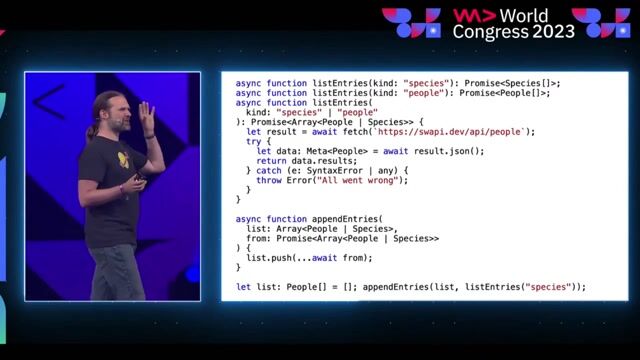
31:13Lies we Tell Ourselves As Developers
Stefan Baumgartner
 29:44
29:44Don't compromise on speedy delivery nor type-safety by choosing TypeScript
Jens Claes
 29:30
29:30Where we're going we don't need JavaScript - Programming with Type Annotations
Peter Kröner
 48:56
48:56All you need is types
Tal Joffe
 45:59
45:59Langium: Design Your Own Language in Node.js and VS Code
Miro Spönemann
Related Articles
View all articles


.webp?w=240&auto=compress,format)
From learning to earning
Jobs that call for the skills explored in this talk.


doinstruct Software GmbH
Berlin, Germany
Senior
GIT
JavaScript
TypeScript


CELUM
Vienna, Austria
Intermediate
Java
RxJS
NoSQL
Angular
TypeScript

AUTO1 Group SE
Berlin, Germany
Intermediate
Senior
ELK
Terraform
Elasticsearch


ELFIN Engineering and Solutions GmbH
€60-68K
Vue.js
Node.js
TypeScript
Software Architecture
+1
RYZE Digital Holding GmbH
Mainz, Germany
GIT
DevOps
Vue.js
Docker
Node.js
+4