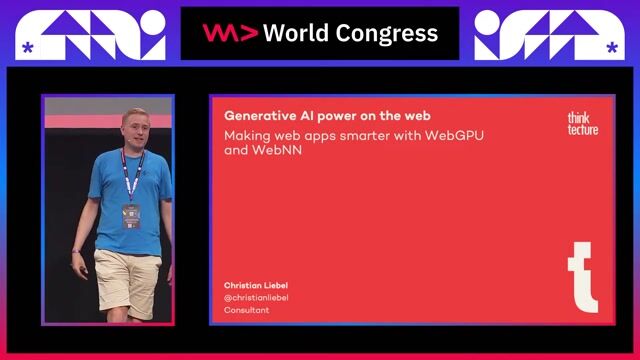
Christian Liebel
Generative AI power on the web: making web apps smarter with WebGPU and WebNN
#1about 1 minute
Generative AI use cases and cloud provider limitations
Cloud-based AI faces challenges like required internet connectivity, data privacy risks, and high costs, creating a need for local alternatives.
#2about 13 minutes
Running large language models locally with Web LLM
Web LLM enables running multi-gigabyte language models like Llama 3 directly in the browser for offline use, despite initial download and initialization times.
#3about 2 minutes
The technology behind in-browser AI execution
In-browser AI performance is accelerated by combining WebAssembly for efficient computation and the new WebGPU API for direct access to the system's GPU.
#4about 4 minutes
Boosting performance with the upcoming WebNN API
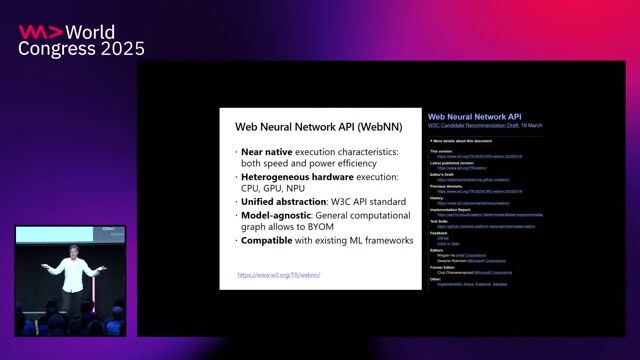
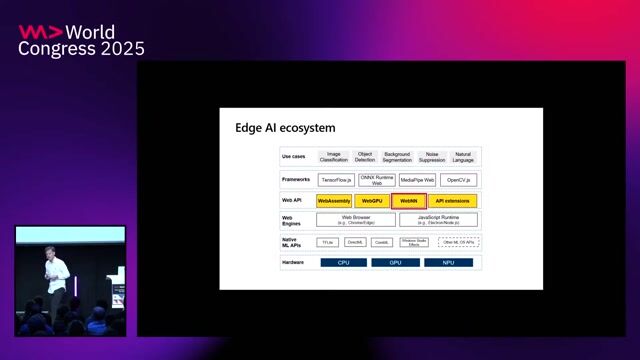
The Web Neural Network (WebNN) API provides access to dedicated Neural Processing Units (NPUs) for even faster, more efficient on-device model inference.
#5about 6 minutes
Solving model duplication with the new Prompt API
The experimental Prompt API addresses the issue of redundant model downloads by allowing websites to access a single, shared OS-level model like Gemini Nano.
#6about 3 minutes
Using the Prompt API for on-device data extraction
A demonstration shows how the Prompt API can use a local model to accurately extract structured data from unstructured text, highlighting its practical application.
#7about 2 minutes
Generating images in the browser with WebSD
WebSD brings text-to-image generation to the browser by running Stable Diffusion models locally using WebGPU, enabling creative AI tasks without cloud dependency.
#8about 1 minute
Weighing the pros and cons of local AI models
Local AI models offer superior privacy, offline availability, and low cost, but come with trade-offs like lower quality, high system requirements, and slower performance.
#9about 1 minute
The future of on-device AI in web development
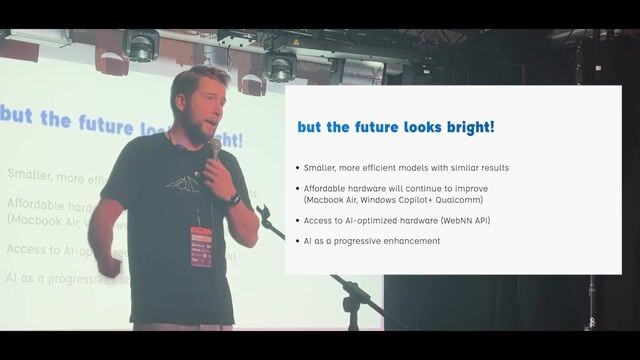
While cloud-based models are currently superior, the trend towards more compact open-source models and OS-integrated AI suggests a growing role for local AI in specialized web applications.
Related jobs
Jobs that call for the skills explored in this talk.


Matching moments
01:41 MIN
Two primary approaches for browser-based AI
Prompt API & WebNN: The AI Revolution Right in Your Browser
Unlock full access
Log in or set up an account to access this feature and more.

02:08 MIN
The future of on-device AI hardware and APIs
From ML to LLM: On-device AI in the Browser
Unlock full access
Log in or set up an account to access this feature and more.

04:31 MIN
Introducing generative AI in the browser with Chrome AI
aa
Unlock full access
Log in or set up an account to access this feature and more.
02:51 MIN
Introducing the Web Neural Network (WebNN) standard
Privacy-first in-browser Generative AI web apps: offline-ready, future-proof, standards-based
Unlock full access
Log in or set up an account to access this feature and more.
03:24 MIN
Running on-device AI in the browser with Gemini Nano
Exploring Google Gemini and Generative AI
Unlock full access
Log in or set up an account to access this feature and more.
04:04 MIN
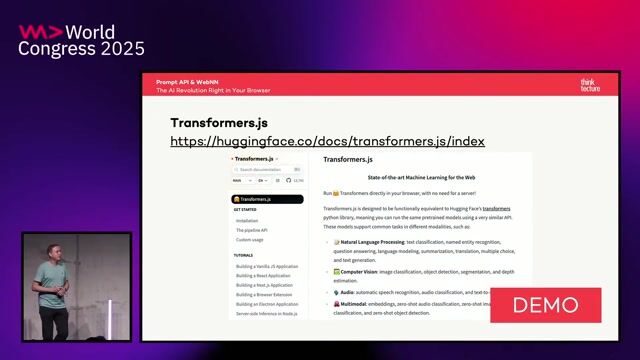
Accelerating performance with the WebNN API
Prompt API & WebNN: The AI Revolution Right in Your Browser
Unlock full access
Log in or set up an account to access this feature and more.
04:03 MIN
Leveraging hardware like the CPU, GPU, and NPU
Privacy-first in-browser Generative AI web apps: offline-ready, future-proof, standards-based
Unlock full access
Log in or set up an account to access this feature and more.
01:55 MIN
Key benefits of running AI in the browser
From ML to LLM: On-device AI in the Browser
Unlock full access
Log in or set up an account to access this feature and more.
Featured Partners
Related Videos
 30:36
30:36Prompt API & WebNN: The AI Revolution Right in Your Browser
Christian Liebel
 30:13
30:13Privacy-first in-browser Generative AI web apps: offline-ready, future-proof, standards-based
Maxim Salnikov
 27:23
27:23From ML to LLM: On-device AI in the Browser
Nico Martin
 33:51
33:51Exploring the Future of Web AI with Google
Thomas Steiner
 36:41
36:41aa
aa
 22:07
22:07WWC24 - Ankit Patel - Unlocking the Future Breakthrough Application Performance and Capabilities with NVIDIA
Ankit Patel
 29:52
29:52Your Next AI Needs 10,000 GPUs. Now What?
Anshul Jindal & Martin Piercy
 25:47
25:47Performant Architecture for a Fast Gen AI User Experience
Nathaniel Okenwa
Related Articles
View all articles


From learning to earning
Jobs that call for the skills explored in this talk.


Conrad Electronic SE
Neural Concept
Lausanne, Switzerland
DevOps
Continuous Integration
KI Group
Wiesbaden, Germany
€55-75K
Intermediate
GIT
MySQL
NoSQL
Redis
+13
RE-INvent Retail GmbH
Microservices