
Iulia Feroli
Harry Potter and the Elastic Semantic Search
#1about 3 minutes
The evolution of NLP from early models to modern LLMs
Tracing the rapid advancement of natural language processing from early models like Word2Vec to the powerful generative AI we see today.
#2about 5 minutes
How vector embeddings represent language as numbers
Vector embeddings turn words and sentences into numerical arrays, allowing computers to understand semantic relationships through mathematical operations.
#3about 7 minutes
Using vector similarity and LLMs for semantic operations
The distance between vectors in an embedding space represents semantic similarity, enabling operations like finding related concepts or answering questions.
#4about 4 minutes
Using Elasticsearch as a vector database for search
Elasticsearch serves as a vector database to store document embeddings and integrates with models from sources like Hugging Face for inference.
#5about 7 minutes
Demonstrating advanced keyword search with the Python client
The Elasticsearch Python client enables complex, multi-field queries with boolean logic to filter data based on precise criteria before adding semantic layers.
#6about 4 minutes
Enriching data with sentiment analysis pipelines
An inference pipeline can automatically apply a sentiment analysis model to all documents, adding a new field to enable filtering by positive or negative tone.
#7about 4 minutes
Implementing semantic search with embedding models
By converting all text into vectors using an embedding model, you can perform a k-NN search to find the most semantically relevant results for a query.
#8about 5 minutes
Refining results with hybrid search techniques
Hybrid search combines the power of semantic vector search with traditional keyword filters and exclusions to create highly relevant and precise results.
#9about 19 minutes
Audience Q&A on models and implementation
The speaker answers audience questions about ensuring relevance, handling out-of-vocabulary terms, updating data sources, and debugging model outputs.
Related jobs
Jobs that call for the skills explored in this talk.


Matching moments
03:01 MIN
Using LLMs for advanced codebase search and understanding
The Alpha‑Developer of Tomorrow: Building the Future of the Software Development Lifecycle
Unlock full access
Log in or set up an account to access this feature and more.
02:02 MIN
Understanding the role of embeddings and vector databases
Best practices: Building Enterprise Applications that leverage GenAI
Unlock full access
Log in or set up an account to access this feature and more.
04:52 MIN
How modern NLP uses Transformer models for search
Hybrid AI: Next Generation Natural Language Processing
Unlock full access
Log in or set up an account to access this feature and more.
03:02 MIN
Using LLMs to discover datasets and manage metadata
How E.On productionizes its AI model & Implementation of Secure Generative AI.
Unlock full access
Log in or set up an account to access this feature and more.
03:42 MIN
Using large language models as a learning tool
Google Gemini: Open Source and Deep Thinking Models - Sam Witteveen
Unlock full access
Log in or set up an account to access this feature and more.
01:57 MIN
Presenting live web scraping demos at a developer conference
Tech with Tim at WeAreDevelopers World Congress 2024
Unlock full access
Log in or set up an account to access this feature and more.
01:06 MIN
Moving beyond hype with real-world generative AI
Semantic AI: Why Embeddings Might Matter More Than LLMs
Unlock full access
Log in or set up an account to access this feature and more.
08:57 MIN
Exploring practical NLP applications at Slido
Serverless deployment of (large) NLP models
Unlock full access
Log in or set up an account to access this feature and more.
Featured Partners
Related Videos
 56:46
56:46A beginner’s guide to modern natural language processing
Jodie Burchell
 57:52
57:52Develop AI-powered Applications with OpenAI Embeddings and Azure Search
Rainer Stropek
 26:05
26:05Semantic AI: Why Embeddings Might Matter More Than LLMs
Christian Weyer
 1:00:56
Enter the Brave New World of GenAI with Vector Search
Mary Grygleski
 1:05:44
WeAreDevelopers LIVE - Vector Similarity Search Patterns for Efficiency and more
Chris Heilmann, Daniel Cranney, Raphael De Lio & Developer Advocate at Redis
 21:01
21:01Hybrid AI: Next Generation Natural Language Processing
Jan Schweiger
 34:34
34:34Vision for Websites: Training Your Frontend to See
Daniel Madalitso Phiri
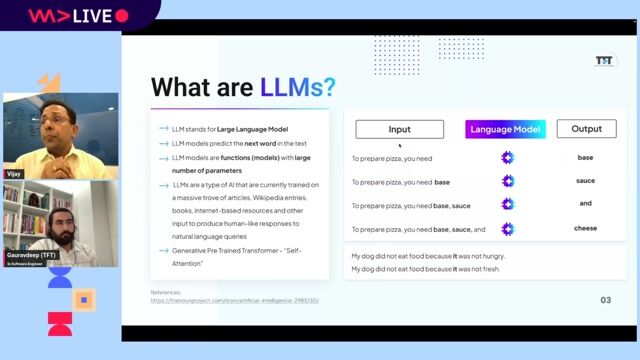 58:00
58:00Creating Industry ready solutions with LLM Models
Vijay Krishan Gupta & Gauravdeep Singh Lotey
Related Articles
View all articles
.png?w=240&auto=compress,format)


From learning to earning
Jobs that call for the skills explored in this talk.


AUTO1 Group SE
Berlin, Germany
Intermediate
Senior
ELK
Terraform
Elasticsearch


Neural Concept
Lausanne, Switzerland
Machine Learning