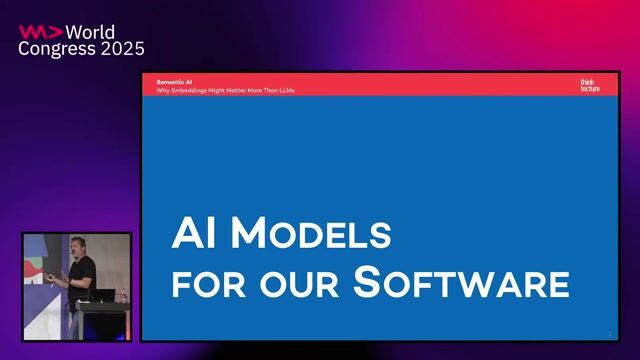
Christian Weyer
Semantic AI: Why Embeddings Might Matter More Than LLMs
#1about 1 minute
Moving beyond hype with real-world generative AI
An internal company tool serves as a practical case study for applying language and embedding models to solve real business problems.
#2about 3 minutes
Integrating AI with existing enterprise data sources
The system combines API-based data from a third-party planning tool with document-based data from a Git-based knowledge base.
#3about 4 minutes
Building language-enabled universal interfaces for software
Instead of extending traditional GUIs, a universal interface allows users to interact with systems using natural language through platforms like Slack or voice.
#4about 3 minutes
Demonstrating a multi-system AI chat interface
A live demo shows how a single chat interface can query both a knowledge base and an employee availability system, providing source links to verify information.
#5about 3 minutes
Contrasting language models and embedding models
Language models are non-deterministic and generative, while embedding models are deterministic and create vector representations for comparison and retrieval.
#6about 4 minutes
Implementing retrieval-augmented generation for documents
The RAG pattern uses embeddings and a vector database to find relevant document chunks to provide as context for an LLM's answer.
#7about 4 minutes
Using LLMs for structured data and API calls
By providing a technical schema in the prompt, a language model can be forced to generate structured, machine-readable output for reliable API integration.
#8about 4 minutes
How semantic routing directs user queries
Semantic routing uses embeddings to classify a user's intent by finding the closest cluster of example questions, directing the request to the correct backend system.
#9about 1 minute
Why embeddings are the foundation of AI systems
Embeddings are crucial not just within LLMs but also for encoding meaning and enabling core architectural patterns like semantic routing and guarding.
Related jobs
Jobs that call for the skills explored in this talk.


Matching moments
02:02 MIN
Understanding the role of embeddings and vector databases
Best practices: Building Enterprise Applications that leverage GenAI
Unlock full access
Log in or set up an account to access this feature and more.

03:34 MIN
The future of LLMs as a seamless user experience
How to Avoid LLM Pitfalls - Mete Atamel and Guillaume Laforge
Unlock full access
Log in or set up an account to access this feature and more.
01:47 MIN
Three pillars for integrating LLMs in products
Using LLMs in your Product
Unlock full access
Log in or set up an account to access this feature and more.
13:11 MIN
Q&A on embedding calculation, ethics, and tooling
Develop AI-powered Applications with OpenAI Embeddings and Azure Search
Unlock full access
Log in or set up an account to access this feature and more.
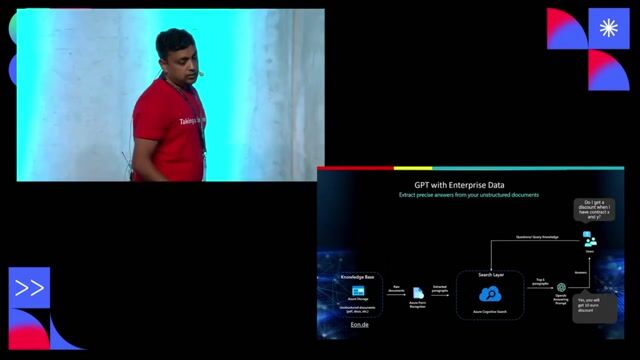
02:32 MIN
Securely connecting generative AI to enterprise data
How E.On productionizes its AI model & Implementation of Secure Generative AI.
Unlock full access
Log in or set up an account to access this feature and more.
05:18 MIN
Addressing the core challenges of large language models
Accelerating GenAI Development: Harnessing Astra DB Vector Store and Langflow for LLM-Powered Apps
Unlock full access
Log in or set up an account to access this feature and more.

01:59 MIN
Bridging the gap between language models and software
When worlds collide: How will generative AI change the way we design and build software
Unlock full access
Log in or set up an account to access this feature and more.
03:42 MIN
Using large language models as a learning tool
Google Gemini: Open Source and Deep Thinking Models - Sam Witteveen
Unlock full access
Log in or set up an account to access this feature and more.
Featured Partners
Related Videos
 24:24
24:24Best practices: Building Enterprise Applications that leverage GenAI
Damir
 27:12
27:12GenAI Unpacked: Beyond Basic
Damir
 27:11
27:11Inside the Mind of an LLM
Emanuele Fabbiani
 28:38
28:38Exploring LLMs across clouds
Tomislav Tipurić
 31:25
31:25Unveiling the Magic: Scaling Large Language Models to Serve Millions
Patrick Koss
 32:26
32:26Bringing the power of AI to your application.
Krzysztof Cieślak
 26:30
26:30Three years of putting LLMs into Software - Lessons learned
Simon A.T. Jiménez
 31:12
31:12Using LLMs in your Product
Daniel Töws
Related Articles
View all articles
.png?w=240&auto=compress,format)


From learning to earning
Jobs that call for the skills explored in this talk.


Eucon GmbH
Remote
Docker
Kubernetes
Machine Learning
Natural Language Processing
Neural Concept
Lausanne, Switzerland
Machine Learning
LINDERA GmbH
Remote
Senior
DevOps
Gitlab
Kotlin
Docker
+5
KI Group
Wiesbaden, Germany
€55-75K
Intermediate
GIT
MySQL
NoSQL
Redis
+13