Rainer Stropek
Develop AI-powered Applications with OpenAI Embeddings and Azure Search
#1about 3 minutes
Understanding embedding vectors as numerical representations
Embedding vectors convert complex concepts like text or personality into multi-dimensional numerical arrays, enabling comparison and clustering.
#2about 7 minutes
Working with the OpenAI embeddings API and cosine similarity
The OpenAI API provides an endpoint to generate a 1,536-dimensional vector for a given text, and vector similarity can be efficiently calculated using a dot product.
#3about 5 minutes
Building custom applications with the OpenAI chat API
The chat completions API allows developers to build custom applications by sending a model the entire chat history, including system prompts and user messages.
#4about 3 minutes
Implementing the Retrieval-Augmented Generation (RAG) pattern
The RAG pattern enhances LLM responses by first retrieving relevant facts from a private knowledge base using vector search and then injecting that context into the prompt.
#5about 4 minutes
Demo overview of building a school wiki assistant
A practical demonstration shows how to build a Q&A assistant for a school's private wiki using a crawler, an indexer, and a query application.
#6about 8 minutes
Step 1: Crawling and pre-processing the source data
The first step in the RAG pipeline involves building a custom crawler to extract, clean, and convert source data into a usable format like Markdown.
#7about 6 minutes
Step 2: Indexing embeddings into a vector database
An indexer application iterates through pre-processed documents, calculates their embeddings via the OpenAI API, and stores them in Azure Cognitive Search for fast retrieval.
#8about 5 minutes
Step 3: Querying the system using the RAG pattern
The query application generates an embedding for the user's question, performs a vector search to find relevant documents, and injects them into a system prompt for the LLM.
#9about 5 minutes
Live demonstration of the wiki Q&A assistant
The command-line assistant successfully answers specific questions about school policies by retrieving information from the wiki, even handling multi-language queries.
#10about 13 minutes
Q&A on embedding calculation, ethics, and tooling
The speaker answers audience questions about how embeddings are calculated, ensuring answer correctness, responsible AI development, and recommended developer tools.
Related jobs
Jobs that call for the skills explored in this talk.


Matching moments
09:22 MIN
Exploring Microsoft's Azure AI services and tools
Inside the AI Revolution: How Microsoft is Empowering the World to Achieve More
Unlock full access
Log in or set up an account to access this feature and more.
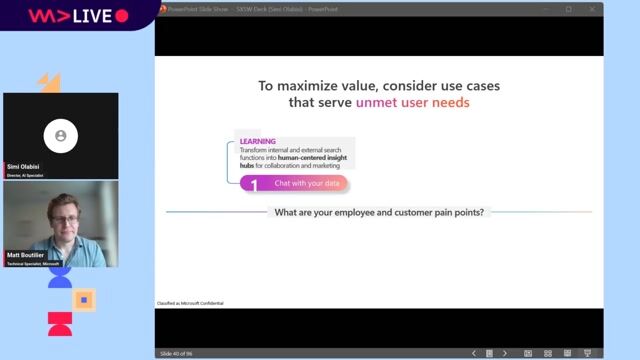
10:49 MIN
Live demo of building a chat with your data app
Inside the AI Revolution: How Microsoft is Empowering the World to Achieve More
Unlock full access
Log in or set up an account to access this feature and more.
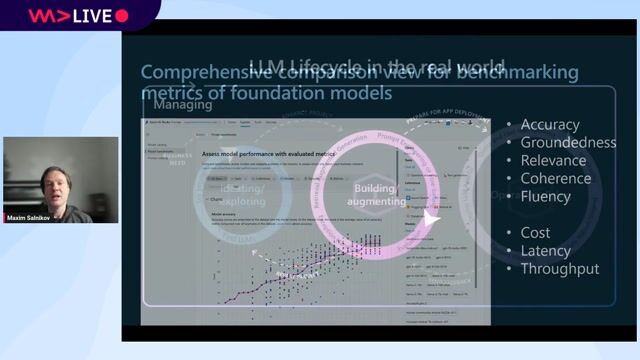
04:47 MIN
Building applications with RAG and Azure Prompt Flow
From Traction to Production: Maturing your LLMOps step by step
Unlock full access
Log in or set up an account to access this feature and more.
03:15 MIN
The new AI engineer role and the RAG pipeline
Chatbots are going to destroy infrastructures and your cloud bills
Unlock full access
Log in or set up an account to access this feature and more.
04:24 MIN
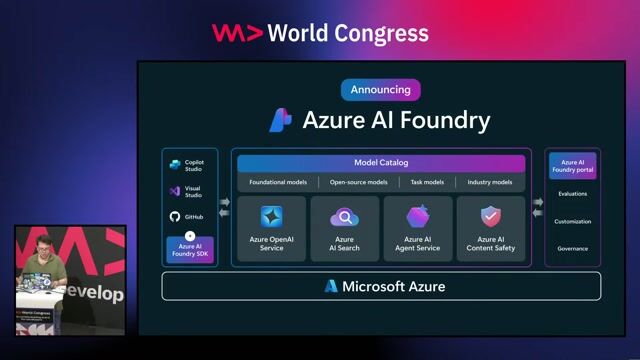
A practical walkthrough of the Azure AI Foundry playground
How Mixed Reality, Azure AI and Drones turned me into a Magician?
Unlock full access
Log in or set up an account to access this feature and more.
04:45 MIN
Understanding the core components of a GenAI stack
Building Products in the era of GenAI
Unlock full access
Log in or set up an account to access this feature and more.
06:50 MIN
Showcasing real-time AI application examples
Convert batch code into streaming with Python
Unlock full access
Log in or set up an account to access this feature and more.
03:06 MIN
Q&A on AI code security and decoupling translations
Useful AI friends for developers – building a multilingual app
Unlock full access
Log in or set up an account to access this feature and more.
Featured Partners
Related Videos
 26:25
26:25Building Blocks of RAG: From Understanding to Implementation
Ashish Sharma
 58:06
58:06From Syntax to Singularity: AI’s Impact on Developer Roles
Anna Fritsch-Weninger
 56:55
56:55Multimodal Generative AI Demystified
Ekaterina Sirazitdinova
 59:38
59:38What comes after ChatGPT? Vector Databases - the Simple and powerful future of ML?
Erik Bamberg
 1:09:49
Inside the AI Revolution: How Microsoft is Empowering the World to Achieve More
Simi Olabisi
 24:24
24:24Best practices: Building Enterprise Applications that leverage GenAI
Damir
 27:12
27:12GenAI Unpacked: Beyond Basic
Damir
 23:33
23:33Azure AI Foundry for Developers: Open Tools, Scalable Agents, Real Impact
Oliver Will
Related Articles
View all articles



From learning to earning
Jobs that call for the skills explored in this talk.


score4more GmbH
Berlin, Germany
Remote
Intermediate
DevOps
TypeScript
Data analysis
Machine Learning
+2
Amadeus FiRe AG
Remote
€45-55K
DevOps
ASP.NET
.NET Core
+1

