Ashish Sharma
Building Blocks of RAG: From Understanding to Implementation
#1about 2 minutes
Tech stack for building a RAG application
The core technologies used for the RAG implementation include Python, Groq for LLM inference, LangChain as a framework, FAISS for the vector database, and Streamlit for the UI.
#2about 1 minute
Understanding the fundamentals of large language models
Large language models are deep learning models pre-trained on vast data, using a transformer architecture with an encoder and decoder to understand and generate human-like text.
#3about 3 minutes
The rapid evolution and adoption of LLMs
The journey of LLMs has accelerated from the 2022 ChatGPT launch to widespread experimentation in 2023 and enterprise production adoption in 2024.
#4about 2 minutes
Key challenges of LLMs like hallucination
Standard LLMs face significant challenges including hallucination, unverifiable sources, and knowledge cutoffs that limit their reliability for enterprise use.
#5about 1 minute
How RAG solves LLM limitations
Retrieval-Augmented Generation addresses LLM weaknesses by retrieving relevant, up-to-date information from external data sources to provide accurate and verifiable responses.
#6about 4 minutes
The data ingestion and processing pipeline
The first stage of RAG involves loading documents, splitting them into manageable chunks, converting those chunks into numerical embeddings, and storing them in a vector database.
#7about 2 minutes
The retrieval and generation process
The second stage of RAG handles user queries by retrieving relevant chunks from the vector store, constructing a detailed prompt with that context, and sending it to the LLM for generation.
#8about 4 minutes
Visualizing the end-to-end RAG architecture
A complete RAG system processes a user's query by creating an embedding, finding similar document chunks in the vector DB, and feeding both the query and context to an LLM to generate a grounded response.
#9about 5 minutes
Demo of a RAG-powered document chatbot
A live demonstration shows a Streamlit application that allows users to upload a PDF and ask questions, receiving answers grounded in the document's content.
#10about 2 minutes
Summary and deploying RAG solutions
A recap of the RAG process is provided, along with considerations for deploying these solutions in enterprise environments using managed cloud services or open-source models.
Related jobs
Jobs that call for the skills explored in this talk.


Matching moments
02:42 MIN
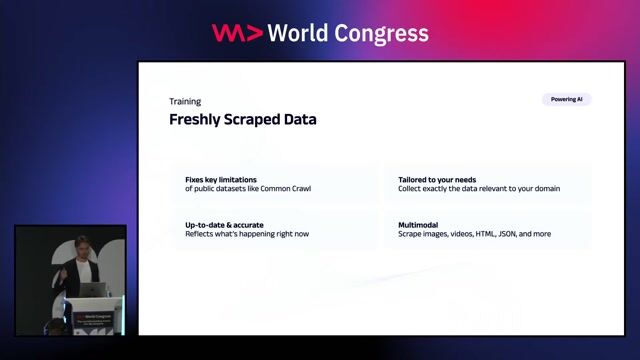
Powering real-time AI with retrieval augmented generation
Scrape, Train, Predict: The Lifecycle of Data for AI Applications
Unlock full access
Log in or set up an account to access this feature and more.
02:03 MIN
Introducing retrieval-augmented generation (RAG)
Martin O'Hanlon - Make LLMs make sense with GraphRAG
Unlock full access
Log in or set up an account to access this feature and more.
01:59 MIN
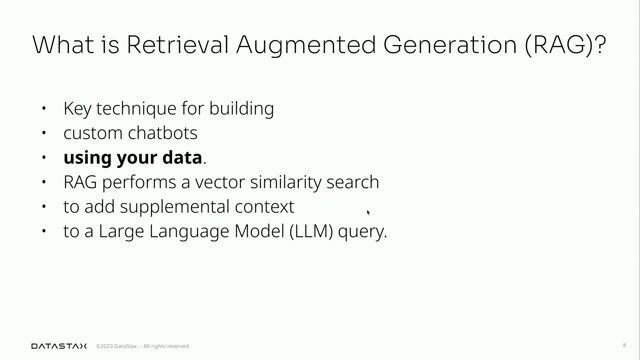
What is Retrieval Augmented Generation (RAG)?
Building Real-Time AI/ML Agents with Distributed Data using Apache Cassandra and Astra DB
Unlock full access
Log in or set up an account to access this feature and more.
02:53 MIN
Understanding Retrieval-Augmented Generation (RAG)
Graphs and RAGs Everywhere... But What Are They? - Andreas Kollegger - Neo4j
Unlock full access
Log in or set up an account to access this feature and more.
03:17 MIN
Using RAG to enrich LLMs with proprietary data
RAG like a hero with Docling
Unlock full access
Log in or set up an account to access this feature and more.
05:31 MIN
Understanding retrieval-augmented generation (RAG)
Exploring LLMs across clouds
Unlock full access
Log in or set up an account to access this feature and more.
02:28 MIN
Introducing retrieval-augmented generation to improve accuracy
Knowledge graph based chatbot
Unlock full access
Log in or set up an account to access this feature and more.
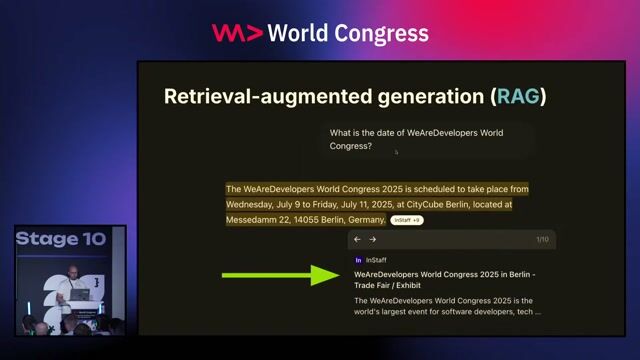
02:29 MIN
How RAG provides LLMs with up-to-date context
How to scrape modern websites to feed AI agents
Unlock full access
Log in or set up an account to access this feature and more.
Featured Partners
Related Videos
 21:17
21:17Carl Lapierre - Exploring Advanced Patterns in Retrieval-Augmented Generation
Carl Lapierre
 29:11
29:11Large Language Models ❤️ Knowledge Graphs
Michael Hunger
 58:00
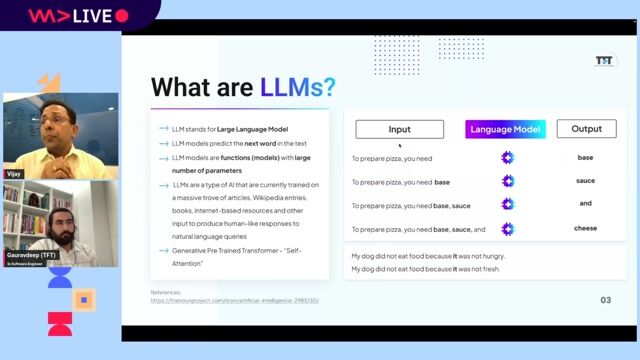
58:00Creating Industry ready solutions with LLM Models
Vijay Krishan Gupta & Gauravdeep Singh Lotey
 57:52
57:52Develop AI-powered Applications with OpenAI Embeddings and Azure Search
Rainer Stropek
 46:51
46:51Graphs and RAGs Everywhere... But What Are They? - Andreas Kollegger - Neo4j
 28:04
28:04Build RAG from Scratch
Phil Nash
 29:40
29:40Lies, Damned Lies and Large Language Models
Jodie Burchell
 28:20
28:20Building Real-Time AI/ML Agents with Distributed Data using Apache Cassandra and Astra DB
Dieter Flick
Related Articles
View all articles



From learning to earning
Jobs that call for the skills explored in this talk.


group24 AG
DevOps
Docker
Kubernetes
Continuous Integration


