Markus Dreseler
How building an industry DBMS differs from building a research one
#1about 3 minutes
Building a research database prototype versus an industry system
A research database like Hyrise prioritizes open-source experimentation, while industry systems like SAP HANA require navigating large, constantly changing codebases.
#2about 3 minutes
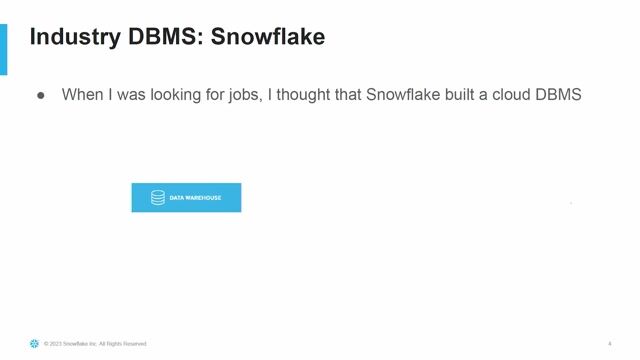
Understanding Snowflake's decoupled compute and storage architecture
Snowflake's architecture separates centralized storage from a scalable compute layer, allowing independent provisioning of resources based on customer demand.
#3about 2 minutes
Core similarities in database processes and documentation culture
Both research and industry databases follow the same fundamental query processing pipeline, and collaborative design documents replace the formal, slow feedback loop of academic papers.
#4about 3 minutes
The complexity of supporting nuanced real-world SQL features
Industry databases must support complex and often overlooked SQL features like collations, versioned time zones, and advanced functions like MATCH_RECOGNIZE that are typically ignored in research.
#5about 5 minutes
Using production metadata for data-driven performance optimization
Access to petabytes of query metadata allows for analyzing real customer workloads, using tools like perf at scale, and A/B testing optimizations, a significant advantage over academic benchmarks.
#6about 4 minutes
Implementing extensive testing strategies for production reliability
Production systems require a multi-layered testing approach, including sanitizers, query permutation testing, and re-executing historical customer queries to ensure correctness without accessing data.
#7about 2 minutes
Using feature flags for safe and gradual code rollouts
New code is protected by parameters or feature flags, enabling instant rollbacks and allowing for a gradual, controlled release from test environments to full production.
#8about 5 minutes
Handling operational challenges and infrastructure failures at scale
An engineer on-call rotation addresses customer issues and handles rare but inevitable problems like faulty cloud hardware by using health checks, retries, and a resilient metadata store.
#9about 3 minutes
Reflecting on the trade-offs between research and industry
While industry work loses the ability to make rapid, sweeping changes, it offers the significant benefit of working on real workloads and seeing a measurable, large-scale impact.
Related jobs
Jobs that call for the skills explored in this talk.


Matching moments
02:01 MIN
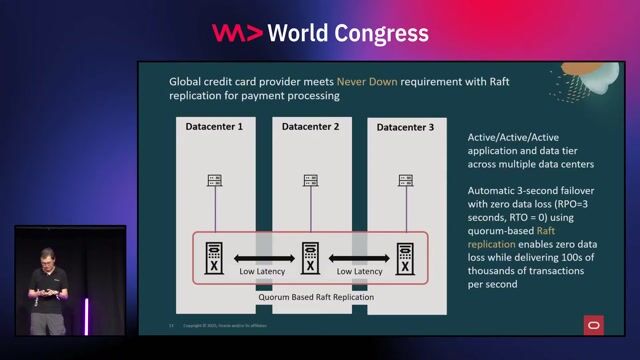
The architectural advantage of a SQL-native design
Fault Tolerance and Consistency at Scale: Harnessing the Power of Distributed SQL Databases
Unlock full access
Log in or set up an account to access this feature and more.
03:02 MIN
A DBA's journey to running SQL Server on Kubernetes
Adjusting Pod Eviction Timings in Kubernetes
Unlock full access
Log in or set up an account to access this feature and more.
01:55 MIN
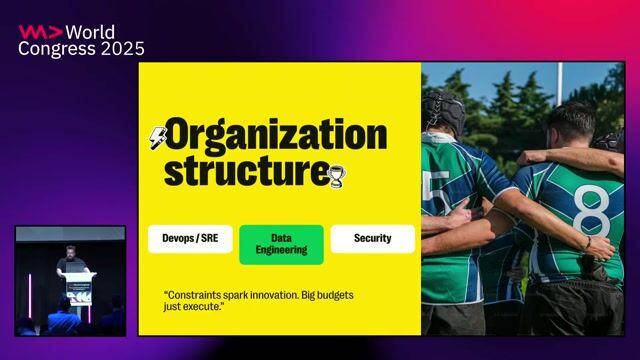
Merging data engineering and DevOps for scalability
Software Engineering Social Connection: Yubo’s lean approach to scaling an 80M-user infrastructure
Unlock full access
Log in or set up an account to access this feature and more.
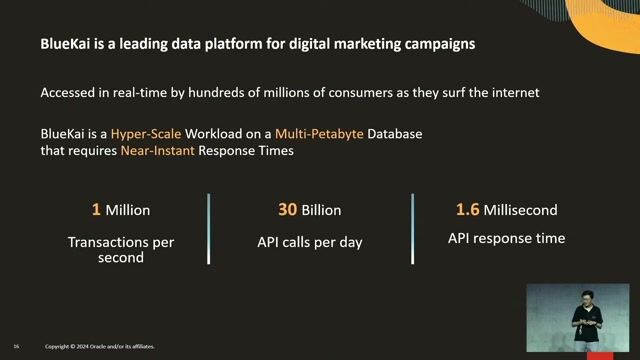
03:24 MIN
Supporting hyperscale workloads with a single database
Fault Tolerance and Consistency at Scale: Harnessing the Power of Distributed SQL Databases
Unlock full access
Log in or set up an account to access this feature and more.
02:28 MIN
Summarizing key takeaways for building hyperscale systems
From 0 to 1.000.000: How to build a serverless raffle service for hyperscale
Unlock full access
Log in or set up an account to access this feature and more.
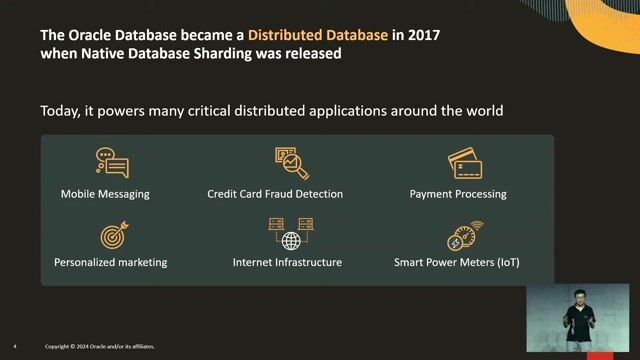
01:24 MIN
Understanding the primary use cases for distributed databases
Fault Tolerance and Consistency at Scale: Harnessing the Power of Distributed SQL Databases
Unlock full access
Log in or set up an account to access this feature and more.

03:15 MIN
The evolution from key-value stores to distributed SQL
Fault Tolerance and Consistency at Scale: Harnessing the Power of Distributed SQL Databases
Unlock full access
Log in or set up an account to access this feature and more.

15:13 MIN
Q&A on security, custom functionality, and performance
Anvil: Full Stack Web Apps With Nothing But Python
Unlock full access
Log in or set up an account to access this feature and more.
Featured Partners
Related Videos
 26:53
26:53Enjoying SQL data pipelines with dbt
Matthias Niehoff
 30:36
30:36In-Memory Computing - The Big Picture
Markus Kett
 24:22
24:22Database Magic behind 40 Million operations/s
Jürgen Pilz
 44:05
44:05Build ultra-fast In-Memory Database Apps and Microservices with Java
Markus Kett
 28:12
28:12Scaling: from 0 to 20 million users
Josip Stuhli
 29:25
29:25Modern Data Architectures need Software Engineering
Matthias Niehoff
 48:05
48:05Branch your database like your code: How schema changes and pull requests go hand in hand
Johannes Nicolai & Lilli Seyther-Besecke
 43:47
43:47Industrializing your Data Science capabilities
Dubravko Dolic & Hüdaverdi Cakir
Related Articles
View all articles.gif?w=240&auto=compress,format)


From learning to earning
Jobs that call for the skills explored in this talk.


Interhyp Gruppe
München, Germany
Intermediate
Senior
MongoDB
Terraform
PostgreSQL


Clickhouse
Remote
Intermediate
MySQL
MongoDB
PostgreSQL
Kubernetes