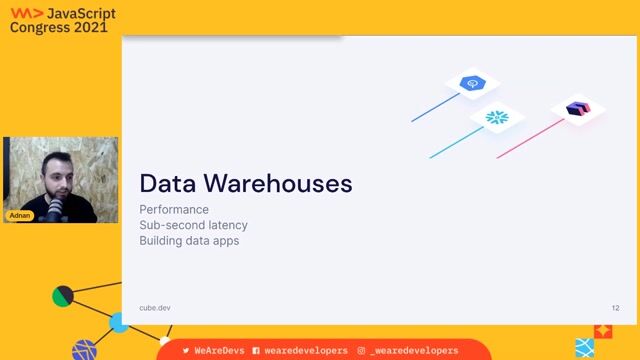
Adnan Rahic
Making Data Warehouses fast. A developer's story.
#1about 3 minutes
The developer's struggle with data warehouse latency
High latency in applications built on data warehouses creates a poor user experience and presents a significant challenge for developers.
#2about 5 minutes
Differentiating between OLAP and OLTP database workloads
Data warehouses use OLAP for complex, low-volume queries on large datasets, contrasting with OLTP's high-volume, simple transactions.
#3about 3 minutes
Understanding the key factors of query latency
User-perceived performance is impacted by network delays and data scan times, making sub-second responses a critical goal.
#4about 7 minutes
Exploring BigQuery's caching and concurrency limitations
BigQuery's cache only works for identical queries and its concurrency is capped per project, impacting real-world application performance.
#5about 4 minutes
Benchmarking BigQuery's performance under concurrent load
Load testing reveals that BigQuery maintains a consistent query latency of around two seconds regardless of user concurrency up to its hard limit.
#6about 2 minutes
Introducing Cube as a semantic analytics API layer
Cube provides a semantic layer over data warehouses, enabling caching, pre-aggregations, and access control to build fast data apps.
#7about 3 minutes
Setting up a local Cube development environment
A local Cube instance can be configured using Docker Compose to connect to BigQuery and automatically generate data schemas.
#8about 5 minutes
How pre-aggregations dramatically improve query speed
Pre-aggregations act as materialized views that store condensed query results, reducing a query's response time from seconds to milliseconds.
#9about 3 minutes
Comparing benchmark results of Cube vs direct BigQuery
Benchmarks show that using Cube's pre-aggregation layer results in a nearly five-fold performance increase over querying BigQuery directly.
#10about 8 minutes
Answering questions on Cube's architecture and use cases
The discussion covers when to implement a caching layer, how Cube improves performance, and its utility for medium-sized databases.
Related jobs
Jobs that call for the skills explored in this talk.


Matching moments
03:02 MIN
A DBA's journey to running SQL Server on Kubernetes
Adjusting Pod Eviction Timings in Kubernetes
Unlock full access
Log in or set up an account to access this feature and more.

07:21 MIN
Answering questions on data volume, challenges, and databases
Remote Driving on Plant Grounds with State-of-the-Art Cloud Technologies
Unlock full access
Log in or set up an account to access this feature and more.

03:43 MIN
Q&A on implementation details and technology choices
Challenges for omnichannel applications at ALDI: Data distribution and offline capabilities
Unlock full access
Log in or set up an account to access this feature and more.

04:13 MIN
Q&A on performance, parallelism, and organizational impact
Convert batch code into streaming with Python
Unlock full access
Log in or set up an account to access this feature and more.

15:13 MIN
Q&A on security, custom functionality, and performance
Anvil: Full Stack Web Apps With Nothing But Python
Unlock full access
Log in or set up an account to access this feature and more.
05:20 MIN
Overcoming challenges of data size and security
Web-based Information Visualization
Unlock full access
Log in or set up an account to access this feature and more.
04:17 MIN
Meeting modern application and data platform demands
Tomorrow's cloud data platforms - fully managed database-as-a-service (DBaaS)
Unlock full access
Log in or set up an account to access this feature and more.

03:18 MIN
Introducing Kusto for interactive analytics at Microsoft scale
From Tables to Graphs in Minutes: Supercharging Kusto Graph Analytics with AI-Powered Development
Unlock full access
Log in or set up an account to access this feature and more.
Featured Partners
Related Videos
 24:22
24:22Database Magic behind 40 Million operations/s
Jürgen Pilz
 42:08
42:081, 2, 3... Fastify!
Matteo Collina
 27:27
27:27Things I learned while writing high-performance JavaScript applications
Michele Riva
 28:12
28:12Scaling: from 0 to 20 million users
Josip Stuhli
 22:32
22:32Swapping Low Latency Data Storage Under High Load
George Asafev
 37:21
37:21The Data Mesh as the end of the Datalake as we know it
Mario Meir-Huber
 46:13
46:13Interactive server side components
Miško Hevery
 30:36
30:36In-Memory Computing - The Big Picture
Markus Kett
Related Articles
View all articles.gif?w=240&auto=compress,format)


From learning to earning
Jobs that call for the skills explored in this talk.


Red Bull Media House GmbH
Elsbethen, Austria
Intermediate
Java
NoSQL
Docker
Angular
Hibernate
+6


About You
Senior
MySQL
NoSQL
Vue.js
Node.js
TypeScript
+2
Scalefree Scalefree