Josip Stuhli
Scaling: from 0 to 20 million users
#1about 2 minutes
An overview of scaling a sports app to millions of users
The initial single-server architecture for a sports results app struggled with exponential user growth, leading to frequent server crashes under load.
#2about 6 minutes
Using proactive and manual caching to survive traffic spikes
Early scaling involved using Memcached with proactive caching to pre-load live data, culminating in a manual static HTML file hack to handle a massive event.
#3about 3 minutes
Moving to the cloud and implementing Varnish cache
The first cloud migration to AWS introduced Varnish for superior HTTP caching and request coalescing, alongside stateless AMIs for effective auto-scaling.
#4about 2 minutes
Migrating from MongoDB to Postgres for data reliability
After encountering data type errors and a lack of locking in MongoDB, a live migration to Postgres was performed to gain stability and analytical power.
#5about 2 minutes
Optimizing cache efficiency with a dedicated sharded layer
To solve cache inefficiency from auto-scaling, the architecture was changed to a dedicated, sharded Varnish layer in front of application servers.
#6about 2 minutes
Migrating from cloud to on-premise to reduce costs
High AWS traffic costs prompted a move back to an over-provisioned on-premise data center, drastically reducing infrastructure expenses relative to user growth.
#7about 4 minutes
Solving global latency with a distributed cache network
To improve performance for international users, a globally distributed cache was implemented with geo-routing, reducing average latency from 500ms to 80ms.
#8about 2 minutes
Adopting Kubernetes for multi-datacenter redundancy
After a provider's data center fire, a second data center was added and managed with Kubernetes to ensure high availability and simplify deployments.
#9about 1 minute
Implementing real-time updates with NATS messaging
To eliminate polling delays and deliver instant updates, a pub/sub architecture using NATS messaging was implemented for millions of concurrent client connections.
#10about 2 minutes
Managing petabyte-scale analytics data with ClickHouse
To power AI/ML models and analyze nearly a petabyte of data on-premise, ClickHouse was chosen for its high-performance analytical capabilities.
#11about 2 minutes
Key principles for building scalable and efficient infrastructure
The core lessons learned include prioritizing statelessness, aggressive caching, using queues for slow tasks, and choosing the right tool for each specific job.
Related jobs
Jobs that call for the skills explored in this talk.


Matching moments

09:36 MIN
Migrating from local hosting to a cloud architecture
Covid-19 - A crowdsourced map for checking supermarket wait times worldwide
Unlock full access
Log in or set up an account to access this feature and more.

04:06 MIN
Managing explosive growth and scaling challenges
Building a Privacy-First Social Platform at Mastodon - Andy Piper
Unlock full access
Log in or set up an account to access this feature and more.
05:25 MIN
Managing a complex mix of old and new infrastructure
Hosting a modern justice system
Unlock full access
Log in or set up an account to access this feature and more.

05:52 MIN
Q&A on shared systems and scaling productivity
Forget Developer Platforms, Think Developer Productivity!
Unlock full access
Log in or set up an account to access this feature and more.
03:40 MIN
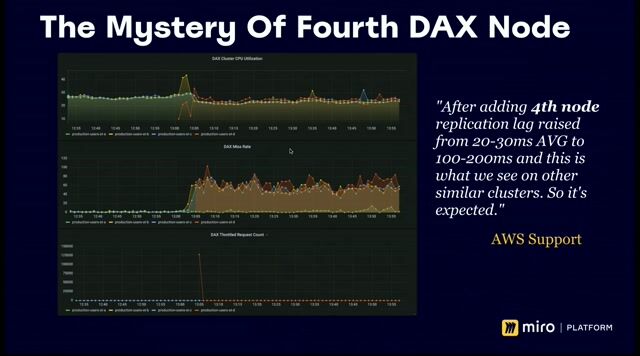
Results of the migration and Q&A
Swapping Low Latency Data Storage Under High Load
Unlock full access
Log in or set up an account to access this feature and more.
02:18 MIN
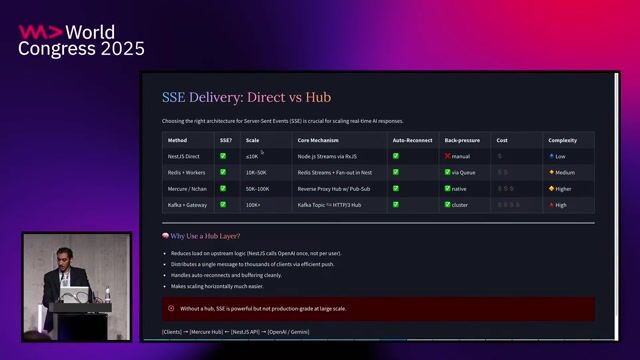
Scaling SSE applications for thousands of concurrent users
Streaming AI Responses in Real-Time with SSE in Next.js & NestJS
Unlock full access
Log in or set up an account to access this feature and more.
10:39 MIN
Q&A on migration strategy and stakeholder management
AWS Migration within 3 months
Unlock full access
Log in or set up an account to access this feature and more.
00:56 MIN
Preparing for success by architecting for flexibility
The Lifehacker's Guide to Software Architecture
Unlock full access
Log in or set up an account to access this feature and more.
Featured Partners
Related Videos
 24:22
24:22Database Magic behind 40 Million operations/s
Jürgen Pilz
 37:08
37:08AWS Migration within 3 months
Steffen Heilmann
 44:37
44:37Advanced Caching Patterns used by 2000 microservices
Natan Silnitsky
 30:36
30:36In-Memory Computing - The Big Picture
Markus Kett
 46:24
46:24The Rise of Reactive Microservices
David Leitner
 58:23
58:23Building high performance and scalable architectures for enterprises
Luka Samaržija & Ivan Sokol
 43:20
43:20Microfrontends at Scale
Josh Goldberg
 30:03
30:03From 0 to 1.000.000: How to build a serverless raffle service for hyperscale
Marco Plaul & Martin Sakowski
Related Articles
View all articles


From learning to earning
Jobs that call for the skills explored in this talk.


Peter Park System GmbH
München, Germany
Senior
Python
Docker
Node.js
JavaScript

CONTIAMO GMBH
Berlin, Germany
Senior
Python
Docker
TypeScript
PostgreSQL

doinstruct Software GmbH
Berlin, Germany
Intermediate
Senior
Node.js


AUTO1 Group SE
Berlin, Germany
Intermediate
Senior
ELK
Terraform
Elasticsearch

Peter Park System GmbH
München, Germany
Intermediate
Senior
Python
Node.js
JavaScript


iov42
Vienna, Austria
Senior
Java
Spring
Ethereum
PostgreSQL
Blockchain
+3
