
Sefik Serengil
Unboxing the DeepFace
#1about 4 minutes
Introducing the DeepFace facial recognition library
Learn about the open-source DeepFace Python library, its key features, and how to install and use it for basic face verification.
#2about 2 minutes
Understanding face verification versus face recognition
Face verification is a one-to-one comparison with O(1) complexity, while face recognition is a one-to-many search with O(n) complexity.
#3about 2 minutes
Analyzing facial attributes like age and gender
DeepFace can predict apparent age, gender, emotion, and race to help reduce search space or mitigate dataset bias.
#4about 2 minutes
Stage 1: Detecting faces with different backends
Choose from various face detectors like OpenCV for speed or RetinaFace for higher accuracy in crowded images.
#5about 2 minutes
Stages 2 & 3: Aligning and normalizing facial images
Improve accuracy by rotating images to align the eyes horizontally and cropping the facial area to remove background noise.
#6about 6 minutes
Stage 4: Creating vector embeddings with neural networks
Convolutional neural networks convert facial images into unique vector embeddings, avoiding the need to retrain the model for new identities.
#7about 3 minutes
Stage 5: Verifying identity using distance and thresholds
Calculate the distance between two vector embeddings to determine if they represent the same person by comparing it to a pre-defined threshold.
#8about 3 minutes
The challenge of scaling facial recognition to billions of images
Traditional one-to-many search is too slow for large-scale applications like those at Google or Facebook, requiring more advanced algorithms.
#9about 2 minutes
Using Approximate Nearest Neighbor for fast searching
Accelerate large-scale searches by using Approximate Nearest Neighbor (ANN) algorithms, which trade perfect accuracy for significant speed gains.
#10about 3 minutes
Choosing the right tech stack for your use case
Select key-value stores like Redis for fast verification, distributed systems like Spark for high-confidence recognition, or vector databases for ANN-powered search.
#11about 3 minutes
Key benefits of using the DeepFace library
DeepFace is a lightweight, easy-to-install, open-source library that wraps state-of-the-art models and is language-independent via its API.
#12about 13 minutes
Audience Q&A on emotion detection, 3D sensors, and bias
The speaker answers questions about measuring emotion, handling 3D data, determining thresholds, and addressing bias in training datasets.
Related jobs
Jobs that call for the skills explored in this talk.


Matching moments
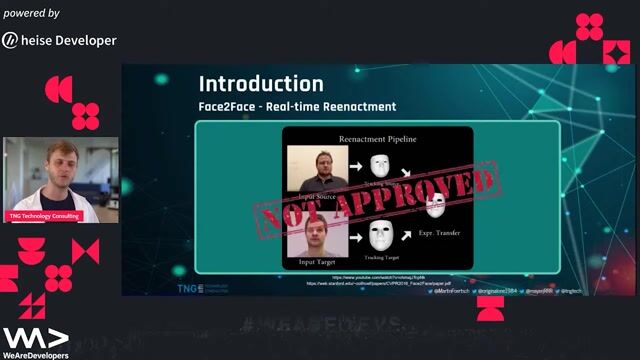
13:05 MIN
How traditional deepfakes are made with Deep Face Lab
Deepfakes in Realtime - How Neural Networks Are Changing Our World

04:34 MIN
The technical process behind creating real-time deepfakes
The AI Elections: How Technology Could Shape Public Sentiment
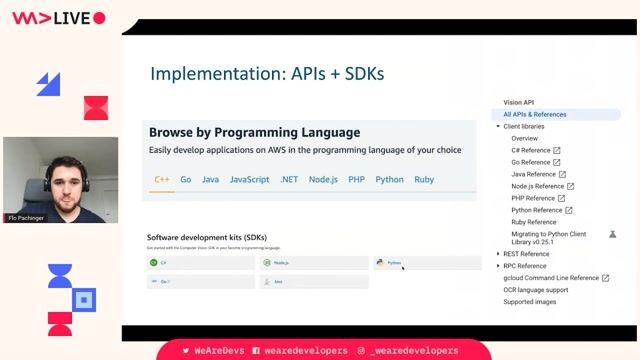
03:09 MIN
Showcasing computer vision project examples
Computer Vision from the Edge to the Cloud done easy
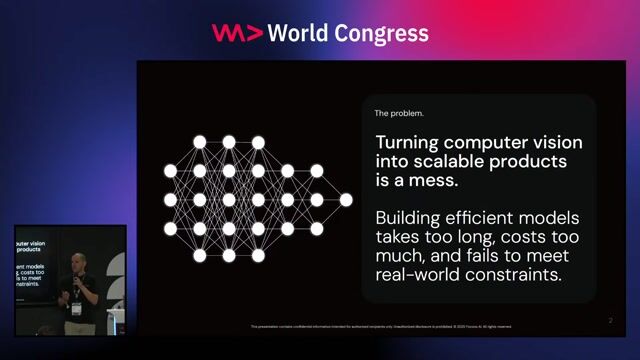
00:57 MIN
Introducing the Focoos AI developer platform
Focoos AI: Building the Future of Computer Vision
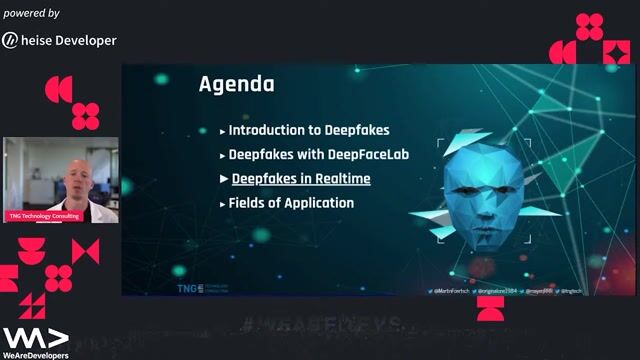
09:33 MIN
Building a real-time deepfake pipeline
Deepfakes in Realtime - How Neural Networks Are Changing Our World
03:56 MIN
Differentiating fakes from true deepfakes
Deepfakes in Realtime - How Neural Networks Are Changing Our World
03:57 MIN
Building applications like intrusion and face detection
What comes after ChatGPT? Vector Databases - the Simple and powerful future of ML?
05:17 MIN
Applying AI and database technology in FinTech
OpenAI for FinTech: Building a Stock Market Advisor Chatbot
Featured Partners
Related Videos
 46:42
46:42Deepfakes in Realtime - How Neural Networks Are Changing Our World
Thomas Endres & Martin Förtsch & Jonas Mayer
 50:37
50:37Debugging Machine Learning Code
Svetlin Penkov
 32:54
32:54The pitfalls of Deep Learning - When Neural Networks are not the solution
Adrian Spataru & Bohdan Andrusyak
 48:38
48:38Computer Vision from the Edge to the Cloud done easy
Flo Pachinger
 25:19
25:19Mastering Image Classification: A Journey with Cakes
Carly Richmonds
 27:23
27:23From ML to LLM: On-device AI in the Browser
Nico Martin
 28:51
28:51Detect Hand Pose with Vision
Milan Todorovic
 44:11
44:11Getting Started with Machine Learning
Alexandra Waldherr
Related Articles
View all articles.gif?w=240&auto=compress,format)


From learning to earning
Jobs that call for the skills explored in this talk.


Vicoland
Frankfurt, Germany
Intermediate
Node.js
Eye Vision Technology GmbH
Karlsruhe, Germany
Remote
€45K
GIT
Computer Vision
Nomitri
Berlin, Germany
DevOps
Gitlab
Docker
Ansible
Grafana
+6