
Igor Minar & Natalia Venditto
Web-Fragments: incremental micro-frontends migration approach for enterprise
#1about 3 minutes
Challenges of modernizing and scaling monolithic frontends
Large monolithic applications become outdated and difficult to scale, a problem backend teams solved with microservices and virtualization.
#2about 2 minutes
Introducing Web Fragments for frontend virtualization
Web Fragments provide the missing virtualization layer for micro-frontends, enabling true isolation and incremental migration of monoliths.
#3about 2 minutes
Avoiding fate sharing with isolated micro-frontends
True micro-frontend independence requires avoiding fate sharing, where one team's error can bring down the entire application.
#4about 3 minutes
Demo of migrating a legacy e-commerce application
A client-side rendered React monolith is incrementally migrated by replacing its catalog and cart with server-side rendered fragments.
#5about 4 minutes
How Web Fragments achieve CSS and JavaScript isolation
Web Fragments use Shadow DOM for CSS encapsulation and a hidden "reframed iframe" to create isolated JavaScript execution contexts.
#6about 2 minutes
Improving performance with server-side rendered fragments
Server-side rendered fragments can be displayed and become interactive immediately, even while the legacy application shell is still loading.
#7about 2 minutes
Debugging isolated JavaScript contexts in dev tools
Browser developer tools can target each fragment's isolated JavaScript context, and removing a fragment from the DOM completely unloads its code and memory.
#8about 4 minutes
Overcoming iframe limitations for complex UI patterns
Unlike traditional iframes, Web Fragments can render UI like modal dialogs that break out of their original boundaries without sacrificing isolation.
#9about 1 minute
A summary of the Web Fragments migration workflow
The migration process involves rebuilding a component, deploying it to an endpoint, registering it in a middleware, and adding a custom HTML tag to the host application.
#10about 3 minutes
Comparing Web Fragments to iframes and Module Federation
Web Fragments offer the isolation of iframes without the UI/UX limitations and avoid the fate-sharing and tooling lock-in of Module Federation.
#11about 3 minutes
Project status, roadmap, and future web standards
The project is in production and the roadmap includes dependency reuse, with plans to adopt future web standards like Shadow Realms to replace custom implementations.
Related jobs
Jobs that call for the skills explored in this talk.


Matching moments
33:55 MIN
Audience Q&A on practical micro-frontend challenges
Micro-frontends anti-patterns
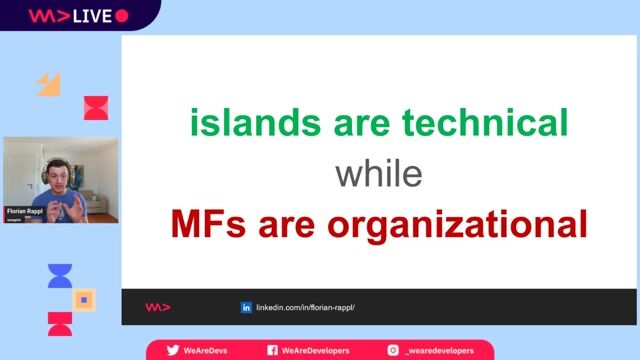
27:46 MIN
Combining micro frontends with an islands architecture
Multiple Ships to the Island - Micro Frontends & Island Architectures
00:18 MIN
The role of micro-frontends in scaling development teams
Micro-Frontends with Module Federation: Beyond the Basics

02:34 MIN
Understanding the micro frontend architectural style
Micro Frontends with Module Federation: Why and How?
00:19 MIN
The historical challenge of building micro frontends
The Microfrontend Revolution- Using Webpack 5 Module Federation with Angular

05:57 MIN
Tracing the architectural evolution to microfrontends
Microfrontends with Blazor: Welcome to the Party!
23:13 MIN
Key takeaways for building multi-version frontends
Advanced Micro Frontends: Multi-Version and Multi-Framework Scenarios
26:34 MIN
Applying the strangler fig pattern to legacy apps
Interface Contracts in Microfrontend Architectures
Featured Partners
Related Videos
 59:03
59:03Multiple Ships to the Island - Micro Frontends & Island Architectures
Florian Rappl
 24:47
24:47Advanced Micro Frontends: Multi-Version and Multi-Framework Scenarios
Manfred Steyer
 43:20
43:20Microfrontends at Scale
Josh Goldberg
 45:40
45:40Micro Frontends with Module Federation: Why and How?
Manfred Steyer
 54:39
54:39Interface Contracts in Microfrontend Architectures
Alexander Günsche
 35:17
35:17Front-End Micro Apps
Serg Hospodarets
 41:49
41:49Destructuring Frontend monoliths with MicroFrontends
Trishul Goel
 44:35
44:35Micro-Frontends with Module Federation: Beyond the Basics
Manfred Steyer
Related Articles
View all articles
.png?w=240&auto=compress,format)


From learning to earning
Jobs that call for the skills explored in this talk.


Senior Frontend Developer - Typescript / Svelte - (f/m/x)
doinstruct Software GmbH
Berlin, Germany
Senior
GIT
JavaScript
TypeScript


Frontend Web Developer (JavaScript, React)
Die Socialisten
Vienna, Austria
Senior
Jest
React
Redux
JavaScript

Frontend-Entwickler
infomax websolutions GmbH
Grassau, Germany
Intermediate
Senior
CSS
HTML
JavaScript
TypeScript


Full-Stack Web-Entwickler (w|m|d)
indurad GmbH
Aachen, Germany
Intermediate
Senior
HTML
React
Node.js
TypeScript


Senior Frontend ( Con experiencia Next.js )- hibrido Barcelona
SlashMobility
Next.js
Continuous Integration
Web Entwickler:in Next.js / React
NUUK GMBH
Hamburg, Germany
GIT
Next.js
Terraform
TypeScript
Continuous Integration