Alexander Günsche
Interface Contracts in Microfrontend Architectures
#1about 1 minute
Why incremental modernization beats a big bang rewrite
Rewriting a legacy monolith from scratch is risky and expensive, making an incremental approach better for both developers and the business.
#2about 6 minutes
Evolving from layered architecture to vertical slices
Microfrontend architecture extends backend microservice patterns to the frontend, creating autonomous, full-stack teams aligned with business domains.
#3about 4 minutes
Defining microfrontend boundaries using domain-driven design
Use principles from domain-driven design (DDD), like bounded contexts and communication patterns, to determine the right size and scope for each microfrontend.
#4about 8 minutes
Implementing communication with attributes and custom events
Microfrontends communicate indirectly by receiving data through HTML attributes and emitting data via custom events, with the host page acting as a mediator.
#5about 7 minutes
Standardizing interfaces with the open MFE specification
The Open MFE standard provides a formal way to define, document, and test microfrontend interfaces using a manifest file, similar to OpenAPI for REST APIs.
#6about 4 minutes
Applying the strangler fig pattern to legacy apps
Gradually modernize a legacy application by wrapping existing features in microfrontends or introducing new ones, slowly 'strangling' the old monolith.
#7about 1 minute
Avoiding runtime coupling with a shared UI library
To maintain autonomy and avoid runtime dependencies, teams should consume shared assets like CSS and icons from a versioned UI library at build time.
#8about 6 minutes
Architectural trade-offs and testing strategies
A frameworkless approach prioritizes migration over raw performance, and testing should focus more on integration tests than unit tests to validate cross-component flows.
#9about 7 minutes
Securing and monitoring microfrontend communications
Secure interface contracts like any other web API, and monitor component interactions by emitting analytics events to be handled by the host page to preserve encapsulation.
#10about 9 minutes
Managing shared dependencies and component nesting
Avoid runtime nesting of microfrontends and instead share common logic through versioned libraries consumed at build time, accepting code duplication as a trade-off for autonomy.
Related jobs
Jobs that call for the skills explored in this talk.


Matching moments
13:10 MIN
Audience Q&A on practical micro-frontend challenges
Micro-frontends anti-patterns
Unlock full access
Log in or set up an account to access this feature and more.
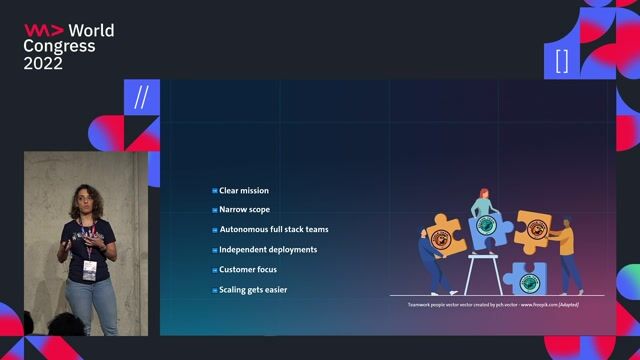
03:01 MIN
Integrating applications using a micro-frontend architecture
Building the Right Product and Building It Right: A Glimpse into Extreme Programming, Atomic Design
Unlock full access
Log in or set up an account to access this feature and more.
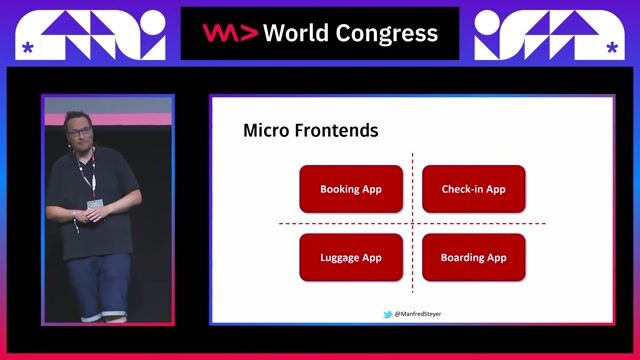
02:27 MIN
Understanding the core challenge of micro frontend integration
Native Federation: The Future of Micro Frontends and Plugin-Systems in Angular
Unlock full access
Log in or set up an account to access this feature and more.

06:11 MIN
Tracing the architectural evolution to microfrontends
Microfrontends with Blazor: Welcome to the Party!
Unlock full access
Log in or set up an account to access this feature and more.

01:25 MIN
Understanding the micro frontend architectural style
Micro Frontends with Module Federation: Why and How?
Unlock full access
Log in or set up an account to access this feature and more.
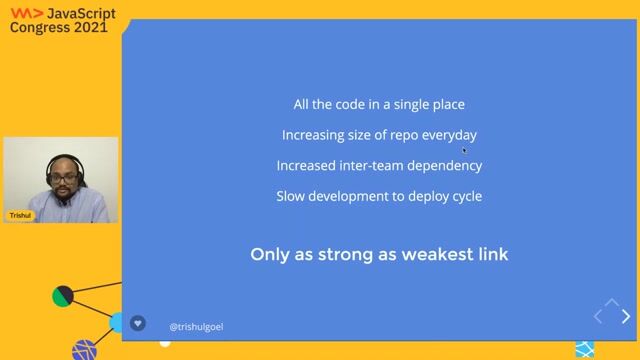
02:03 MIN
Introducing the micro-frontend architectural pattern
Destructuring Frontend monoliths with MicroFrontends
Unlock full access
Log in or set up an account to access this feature and more.
03:17 MIN
A brief history of the micro-frontend architectural pattern
Micro-frontends anti-patterns
Unlock full access
Log in or set up an account to access this feature and more.
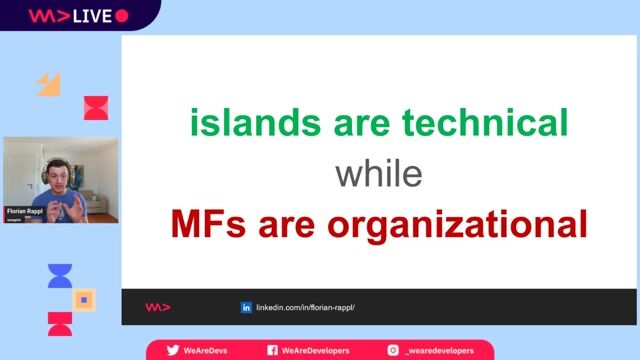
08:02 MIN
Combining micro frontends with an islands architecture
Multiple Ships to the Island - Micro Frontends & Island Architectures
Unlock full access
Log in or set up an account to access this feature and more.
Featured Partners
Related Videos
 59:03
59:03Multiple Ships to the Island - Micro Frontends & Island Architectures
Florian Rappl
 43:20
43:20Microfrontends at Scale
Josh Goldberg
 40:17
40:17Micro-frontends anti-patterns
Luca Mezzalira
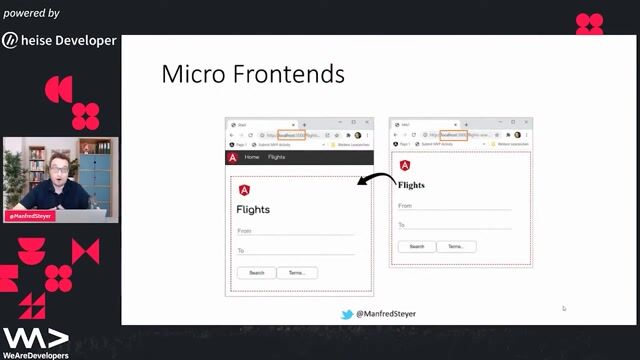 45:40
45:40Micro Frontends with Module Federation: Why and How?
Manfred Steyer
 47:05
47:05Micro-frontends anti-patterns
Luca Mezzalira
 35:17
35:17Front-End Micro Apps
Serg Hospodarets
 24:47
24:47Advanced Micro Frontends: Multi-Version and Multi-Framework Scenarios
Manfred Steyer
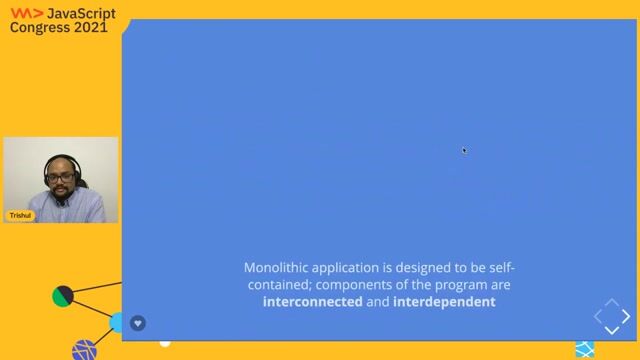 41:49
41:49Destructuring Frontend monoliths with MicroFrontends
Trishul Goel
Related Articles
View all articles
.gif?w=240&auto=compress,format)


From learning to earning
Jobs that call for the skills explored in this talk.


doinstruct Software GmbH
Berlin, Germany
Senior
GIT
JavaScript
TypeScript

infomax websolutions GmbH
Grassau, Germany
Intermediate
Senior
CSS
HTML
JavaScript
TypeScript


BMS Corporate Solutions GmbH
Düsseldorf, Germany
Intermediate
Senior
CSS
HTML
Angular
TypeScript

autoiXpert GmbH & Co. KG
Stuttgart, Germany
Senior
Node.js
Angular
MongoDB
TypeScript

indurad GmbH
Aachen, Germany
Intermediate
Senior
HTML
React
Node.js
TypeScript


Lotum media GmbH
Bad Nauheim, Germany
Senior
Node.js
JavaScript
TypeScript

Peter Park System GmbH
München, Germany
Senior
Python
Docker
Node.js
JavaScript