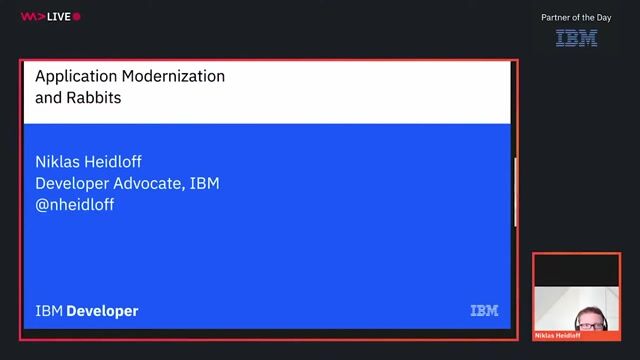
Niklas Heidloff
Application Modernization and Rabbits
#1about 3 minutes
Using a rabbit cage analogy for modernization
An analogy of expanding a rabbit cage illustrates the benefits of moving from a monolith to a microservices architecture.
#2about 2 minutes
Exploring the benefits and strategies of modernization
Modernization improves agility, user experience, and costs, with strategies ranging from retiring applications to refactoring them into microservices.
#3about 4 minutes
A 10-year-old Java e-commerce modernization example
A demonstration of a 10-year-old Java EE e-commerce application and the eight-step journey to modernize it into a containerized, microservices-based system.
#4about 3 minutes
Using IBM tools to containerize a monolith
The IBM Cloud Transformation Advisor and WebSphere Application Migration Toolkit help automate the process of moving a legacy Java application into a container.
#5about 3 minutes
Decoupling the UI and migrating to Open Liberty
The application's front-end is separated from the back-end using REST APIs, and the runtime is migrated from WebSphere to the open-source Open Liberty.
#6about 6 minutes
Applying the Strangler Pattern for microservices
The Strangler Fig Pattern is used to incrementally replace parts of the monolith, starting with the catalog service identified by the Mono2Micro tool.
#7about 3 minutes
Implementing an event-driven architecture with Kafka
Apache Kafka is used for asynchronous communication between the new catalog microservice and the remaining monolith to avoid tight coupling and synchronous calls.
#8about 3 minutes
Improving performance with reactive programming and Quarkus
Adopting reactive programming with Quarkus and the OpenJ9 JVM significantly improves application response time and memory efficiency for new microservices.
#9about 5 minutes
Modernizing the user interface with micro frontends
The monolithic front-end is broken down into independent micro frontends using Vue.js and Single SPA to enable separate deployment and development cycles.
#10about 2 minutes
Accessing the project resources and future plans
The complete open-source project is available on GitHub, with future plans to add CI/CD pipelines for Kubernetes and OpenShift deployments.
Related jobs
Jobs that call for the skills explored in this talk.


Matching moments

02:15 MIN
Understanding the challenges of application modernization
Supercharging Static Code Analysis: Konveyor AI & LLMs
Unlock full access
Log in or set up an account to access this feature and more.
02:21 MIN
The evolution from traditional Java EE to modern runtimes
2021: Familiar APIs on Kickass Runtimes #slideless
Unlock full access
Log in or set up an account to access this feature and more.
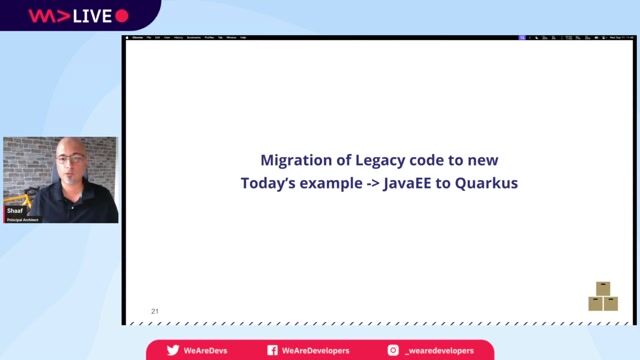
02:16 MIN
Understanding the scope of automated modernization
Application Modernization Leveraging Gen-AI for Automated Code Transformation
Unlock full access
Log in or set up an account to access this feature and more.
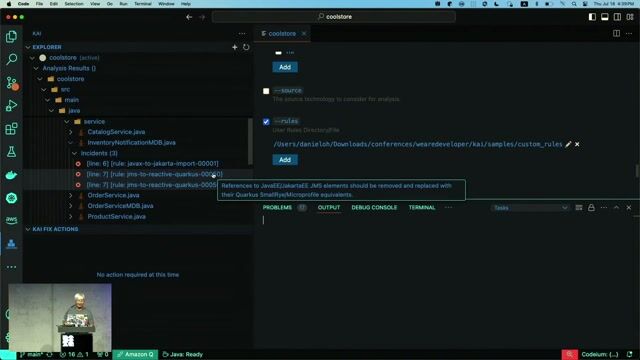
02:35 MIN
Running the fully modernized Quarkus application
Supercharging Static Code Analysis: Konveyor AI & LLMs
Unlock full access
Log in or set up an account to access this feature and more.

03:07 MIN
Challenges of modernizing and scaling monolithic frontends
Web-Fragments: incremental micro-frontends migration approach for enterprise
Unlock full access
Log in or set up an account to access this feature and more.
02:13 MIN
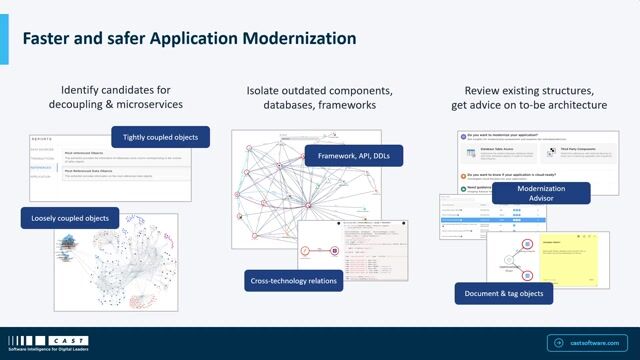
Using software intelligence to accelerate modernization
Grappling With Clunky Old Software? Start by Understanding What’s Inside!
Unlock full access
Log in or set up an account to access this feature and more.
05:41 MIN
Q&A: Gaining buy-in and modernizing legacy applications
An Architect’s guide to reducing the carbon footprint of your applications
Unlock full access
Log in or set up an account to access this feature and more.
01:59 MIN
Discovering reactive programming through a modern Quarkus project
Is reactive the new black? Imperative vs. reactive programming with Quarkus
Unlock full access
Log in or set up an account to access this feature and more.
Featured Partners
Related Videos
 41:17
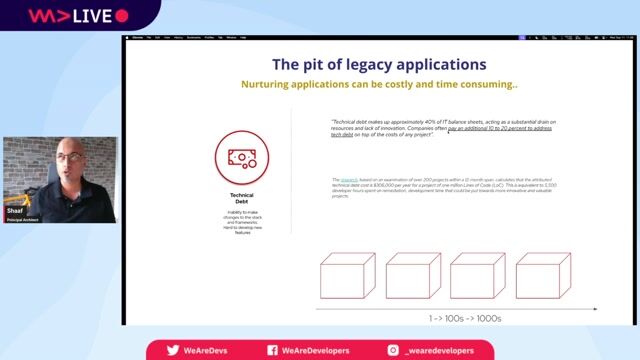
41:17Application Modernization Leveraging Gen-AI for Automated Code Transformation
Syed M Shaaf
 37:55
37:552021: Familiar APIs on Kickass Runtimes #slideless
Adam Bien
 39:16
39:16Cloud Chaos and Microservices Mayhem
Holly Cummins
 39:10
39:10Development of reactive applications with Quarkus
Niklas Heidloff
 50:06
50:06Single Server, Global Reach: Running a Worldwide Marketplace on Bare Metal in a Cloud-Dominated World
Jens Happe
 44:40
44:40Quarkus. A Bliss for developers
Alex Soto
 58:05
58:05Our journey with Spring Boot in a microservice architecture
Michael Eder & Philipp Frauenthaler
 49:30
49:30Microservices with Micronaut
Moritz Kammerer
Related Articles
View all articles.gif?w=240&auto=compress,format)

.gif?w=240&auto=compress,format)
From learning to earning
Jobs that call for the skills explored in this talk.


Red Bull Media House GmbH
Elsbethen, Austria
Intermediate
Java
NoSQL
Docker
Angular
Hibernate
+6


Callista Group
Basel, Switzerland
Senior
Apache Kafka
Microservices