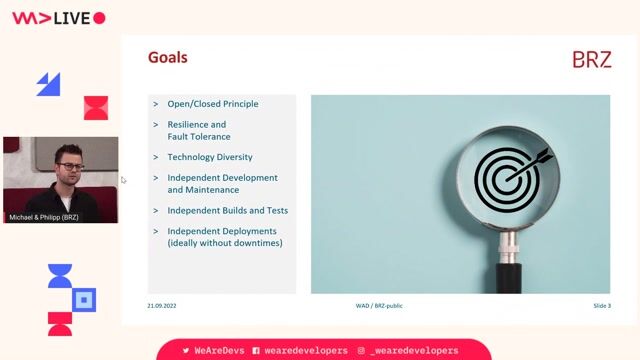
Michael Eder & Philipp Frauenthaler
Our journey with Spring Boot in a microservice architecture
#1about 3 minutes
Defining key architecture goals for a microservices system
The open-closed principle, fault tolerance, technology diversity, and independent deployment are essential goals for a robust architecture.
#2about 3 minutes
Understanding the core principles of microservice architecture
Microservices decompose the business and persistence layers into small, independent services, each with its own data store.
#3about 4 minutes
Avoiding tight coupling from shared code and dependencies
Sharing interfaces or using a common parent POM creates tight coupling that breaks independent development and builds.
#4about 3 minutes
Managing shared libraries and API versioning effectively
Common functionality should be outsourced to versioned shared libraries, and service APIs must be versioned to prevent breaking changes.
#5about 3 minutes
Designing a single entry point for data objects
Using multiple communication channels for the same data object complicates maintenance, so a single entry point simplifies logic and conversion.
#6about 5 minutes
Mitigating temporal coupling with robust backup strategies
Reduce the impact of service failures caused by temporal coupling by implementing backup strategies like default values or disabling features.
#7about 2 minutes
Improving performance and resilience with local caching
Implementing a local data cache, such as Google Guava, reduces synchronous calls to other services and improves system resilience.
#8about 2 minutes
Achieving fault tolerance through scaling and redundancy
Use platforms like Kubernetes with health checks to automatically scale and replace faulty instances of stateless services for high availability.
#9about 5 minutes
Decoupling services using asynchronous communication patterns
Asynchronous communication via a message broker increases availability and fault tolerance but requires careful handling of redelivery and monitoring.
#10about 27 minutes
Adopting an iterative mindset for architecture evolution
Building a microservice architecture is an ongoing, iterative process that requires continuous improvement and an open-minded team culture.
Related jobs
Jobs that call for the skills explored in this talk.


Matching moments

06:36 MIN
Discussing team structure, agile methods, and microservices
Remote Driving on Plant Grounds with State-of-the-Art Cloud Technologies
Unlock full access
Log in or set up an account to access this feature and more.
02:53 MIN
Overview of a modern microservice architecture
Rapid Microservice Development with Project Templates
Unlock full access
Log in or set up an account to access this feature and more.
00:56 MIN
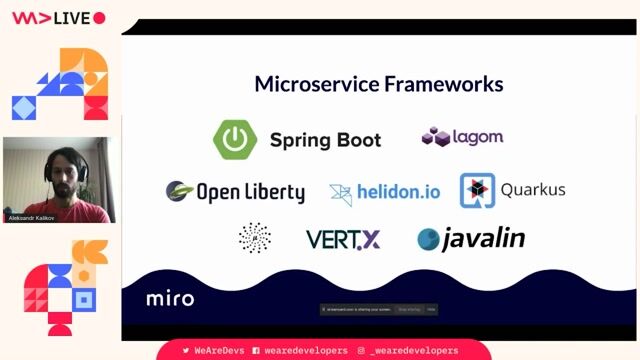
Choosing a familiar Java framework for microservices
Microservices: how to get started with Spring Boot and Kubernetes
Unlock full access
Log in or set up an account to access this feature and more.

01:39 MIN
Navigating the headwinds and barriers of microservice sprawl
Lessons from Our API Past: Evolving to a Resilient API Future
Unlock full access
Log in or set up an account to access this feature and more.

05:40 MIN
Evolving from classic microservices to event-driven design
Kafka Streams Microservices
Unlock full access
Log in or set up an account to access this feature and more.

02:05 MIN
Modernizing development with a multi-channel architecture
Enterprise-Cloud-Native - Fast-Paced Development & Deployment in a Highly Secure Banking Environment
Unlock full access
Log in or set up an account to access this feature and more.
04:14 MIN
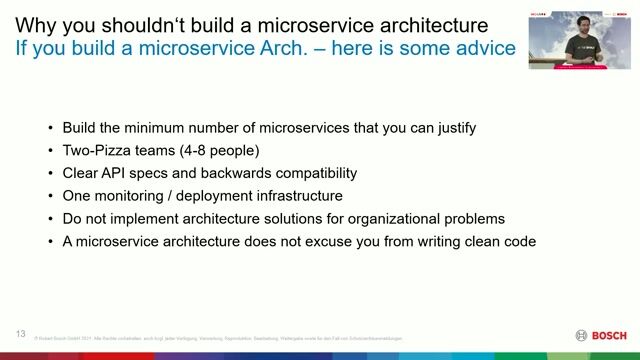
Practical advice for building a microservice architecture
Why you shouldn’t build a microservice architecture
Unlock full access
Log in or set up an account to access this feature and more.

01:13 MIN
Combining persistence strategies in a microservices world
Build ultra-fast In-Memory Database Apps and Microservices with Java
Unlock full access
Log in or set up an account to access this feature and more.
Featured Partners
Related Videos
 1:02:46
Microservices: how to get started with Spring Boot and Kubernetes
Aleksandr Kalikov
 49:30
49:30Microservices with Micronaut
Moritz Kammerer
 54:18
54:18Going reactive with Spring WebFlux
Michael Eder & Philipp Frauenthaler
 1:07:36
Bootiful Spring Boot 3
Josh Long
 52:24
52:24Slip Through the Boundaries of Legacy Systems with Kotlin and Spring WebFlux
Lukas Georgieff & Alberto Gisbert
 54:30
54:30Hibernate: How to keep calm
Philipp Frauenthaler & Gregor Lucny
 57:38
57:38Are you done yet? Mastering long-running processes in modern architectures
Bernd Ruecker
 39:16
39:16Cloud Chaos and Microservices Mayhem
Holly Cummins
Related Articles
View all articles.gif?w=240&auto=compress,format)



From learning to earning
Jobs that call for the skills explored in this talk.


BMS Corporate Solutions GmbH
Düsseldorf, Germany
Intermediate
Senior
Java
Hibernate


Vesterling Consulting GmbH
Remote
€55-110K
UML