Jens Happe
Single Server, Global Reach: Running a Worldwide Marketplace on Bare Metal in a Cloud-Dominated World
#1about 3 minutes
Scaling a global marketplace with a small team
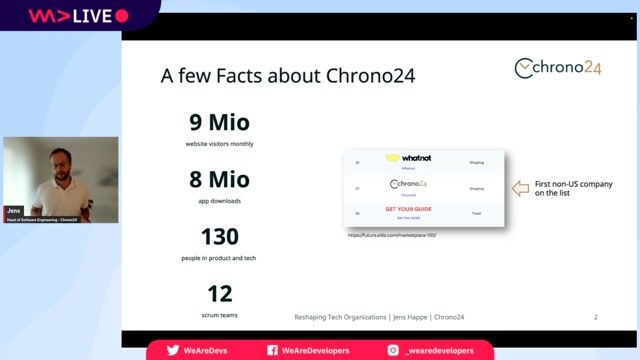
Chrono24 serves nine million monthly active users with a product and tech team of 130 people by focusing on core engineering principles.
#2about 4 minutes
Why running on bare metal is cheaper than cloud
Cloud computing introduces significant costs and operational complexity, especially with microservices, which can make debugging distributed systems incredibly difficult.
#3about 6 minutes
Adopting guiding principles for simple and boring technology
Three core principles—Keep It Simple Stupid (KISS), using boring/proven technology, and deeply understanding your tools—help reduce complexity and improve system reliability.
#4about 10 minutes
How an in-memory caching layer enables massive scale
An ultra-fast in-memory caching layer using Data Access Objects (DAOs) and slices allows a single server to handle over 43,000 read requests per minute.
#5about 4 minutes
Using a hybrid approach with targeted cloud services
Cloud services are used strategically to solve specific problems, such as S3 for image storage, Lambdas for image processing, and AWS for machine learning tasks.
#6about 4 minutes
The trade-offs between cost, simplicity, and flexibility
A bare-metal monolith offers significant cost savings and operational simplicity but suffers from a lack of flexibility and creates a single point of failure during deployments.
#7about 10 minutes
Reframing the technical debt dilemma for continuous improvement
Technical debt is not a binary choice against feature development but an opportunity to improve the system's structure while adding new functionality.
#8about 8 minutes
Evolving a monolith using domain-driven design
The Strangler Fig pattern and Domain-Driven Design (DDD) are used to incrementally refactor the monolith into a modular system with clear boundaries and ownership.
#9about 2 minutes
Key takeaways for fighting complexity in large systems
Building a scalable system requires a constant fight against complexity through clear principles, a supportive culture, and automated architectural enforcement.
Related jobs
Jobs that call for the skills explored in this talk.


Matching moments

08:41 MIN
Amazon's early monolith and database scaling challenges
Building Systems that Last
Unlock full access
Log in or set up an account to access this feature and more.

03:07 MIN
Challenges of modernizing and scaling monolithic frontends
Web-Fragments: incremental micro-frontends migration approach for enterprise
Unlock full access
Log in or set up an account to access this feature and more.

02:29 MIN
The challenge of a high-traffic monolithic system
How to Destroy a Monolith?
Unlock full access
Log in or set up an account to access this feature and more.
00:59 MIN
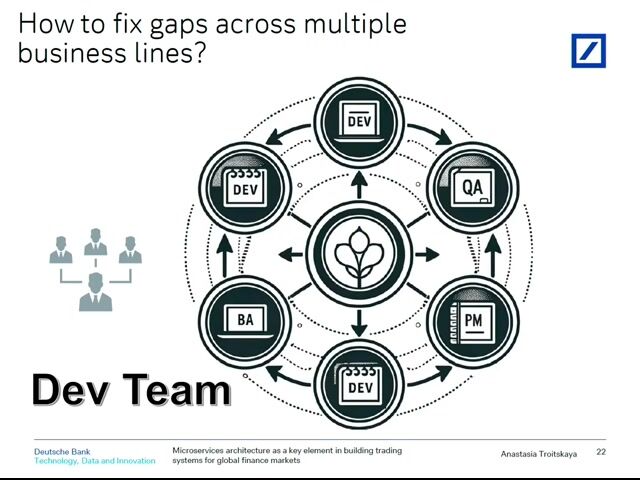
Summary of architecture for scalable trading platforms
Microservices architecture as a key element in building trading systems for global finance markets
Unlock full access
Log in or set up an account to access this feature and more.
05:01 MIN
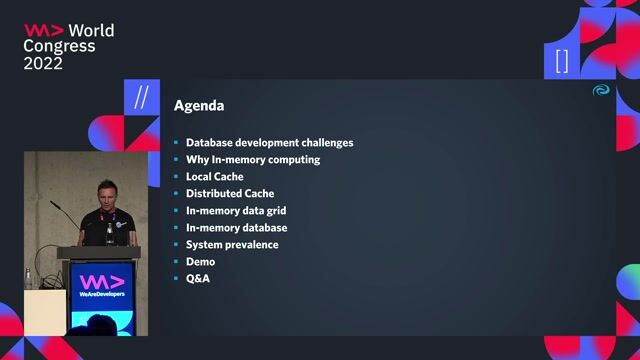
How cloud architecture evolved from monoliths to microservices
Build ultra-fast In-Memory Database Apps and Microservices with Java
Unlock full access
Log in or set up an account to access this feature and more.
05:17 MIN
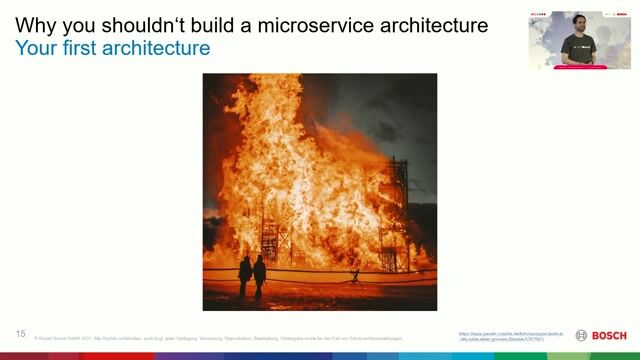
Q&A on monoliths, serverless, and specific use cases
Why you shouldn’t build a microservice architecture
Unlock full access
Log in or set up an account to access this feature and more.
03:49 MIN
From a single monolith to a service-oriented architecture
Reliable scalability: How Amazon.com scales on AWS
Unlock full access
Log in or set up an account to access this feature and more.
07:21 MIN
Understanding the problems with a monolithic architecture
Security Challenges of Breaking A Monolith
Unlock full access
Log in or set up an account to access this feature and more.
Featured Partners
Related Videos
 39:16
39:16Cloud Chaos and Microservices Mayhem
Holly Cummins
 57:38
57:38Are you done yet? Mastering long-running processes in modern architectures
Bernd Ruecker
 56:49
56:49Write tests you love, not hate
Jens Happe
 37:55
37:552021: Familiar APIs on Kickass Runtimes #slideless
Adam Bien
 42:23
42:23Effective Java Strategies and Architectures for Clouds
Adam Bien
 1:01:30
Domain-Driven Transformation—How to Bring (Back) Sustainable Architecture to Legacy and Monoliths
Henning Schwentner
 28:12
28:12Scaling: from 0 to 20 million users
Josip Stuhli
 22:24
22:24Reliable scalability: How Amazon.com scales on AWS
Florian Mair
Related Articles
View all articles.gif?w=240&auto=compress,format)


From learning to earning
Jobs that call for the skills explored in this talk.


wunschlösung GmbH
Jena, Germany
Intermediate
Senior
Java
Docker
MongoDB


wunschlösung GmbH
Jena, Germany
Intermediate
Senior
Java

Diesel Technic SE
Kirchdorf, Germany
Intermediate
Senior
Java
JavaScript


PROSOZ Herten GmbH
Herten, Germany
Junior
Intermediate
Senior
Java
Scrum
Kotlin
Microservices


immocloud GmbH
Düsseldorf, Germany
Senior
Java
Vue.js
JavaScript
TypeScript