
Daniel Espino Garcia
Dos and don'ts with react hooks. An opinionated approach
#1about 4 minutes
Understanding the internal mechanics of React hooks
Hooks enable state in functional components and are implemented as a linked list, which explains why they must be called in the same order on every render.
#2about 2 minutes
Prioritize code readability over premature performance optimization
Focus on writing clear, future-proof code instead of worrying about minor performance overhead from hooks, as these are rarely the actual application bottleneck.
#3about 2 minutes
Move constants and pure functions outside components
Improve readability and performance by defining constants and pure helper functions outside the component scope, avoiding unnecessary re-creation on each render.
#4about 2 minutes
Declare explicit dependencies instead of inferring them
Always declare direct dependencies in hooks like useEffect and useCallback to prevent subtle bugs when the code is modified later.
#5about 2 minutes
Improve clarity with intermediate variables for derived state
Create meaningful intermediate variables from props or state to represent business logic, making the code more readable and hook dependencies more precise.
#6about 2 minutes
Use useRef for data that shouldn't trigger re-renders
Store values that persist across renders but don't affect the UI, like pagination counters, in a useRef to avoid unnecessary component re-renders.
#7about 1 minute
Stabilize callbacks with the functional setState form
Use the functional update form of setState to compute new state from the previous state, which removes the state variable from dependency arrays and prevents unnecessary re-creations of callbacks.
#8about 1 minute
Calculate derived state directly instead of in useEffect
If a piece of state is calculated from props within a useEffect, it is derived state and should be computed directly during the render to avoid an extra re-render cycle.
#9about 2 minutes
Extract reusable logic into custom hooks
Encapsulate and share repeated component logic, such as handling an Android back button, by creating custom hooks for better maintainability and readability.
Related jobs
Jobs that call for the skills explored in this talk.


Matching moments
01:39 MIN
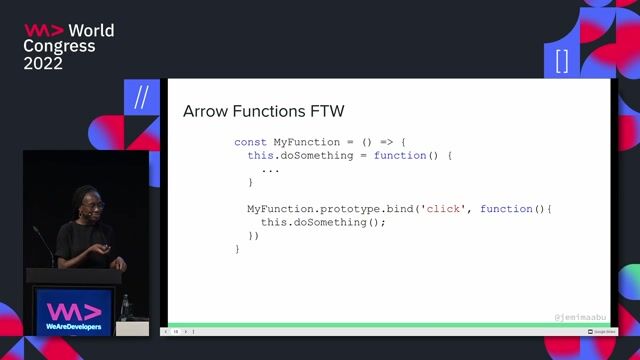
Writing functional JavaScript with React components
A Guide To Functional Programming
Unlock full access
Log in or set up an account to access this feature and more.
03:44 MIN
How hooks enable superior code reusability
State management in a world of hooks
Unlock full access
Log in or set up an account to access this feature and more.

01:23 MIN
Conclusion: Benefits of using React's built-in tools
Rethinking React State Management: The Power of Built-In Solutions
Unlock full access
Log in or set up an account to access this feature and more.

02:38 MIN
The challenge of managing local versus global state
State management in a world of hooks
Unlock full access
Log in or set up an account to access this feature and more.

03:03 MIN
Lessons on testing, hooks, and framework lock-in
Building a large, complex product from the ground up with typescript & Atomic Design:lessons learned
Unlock full access
Log in or set up an account to access this feature and more.
01:54 MIN
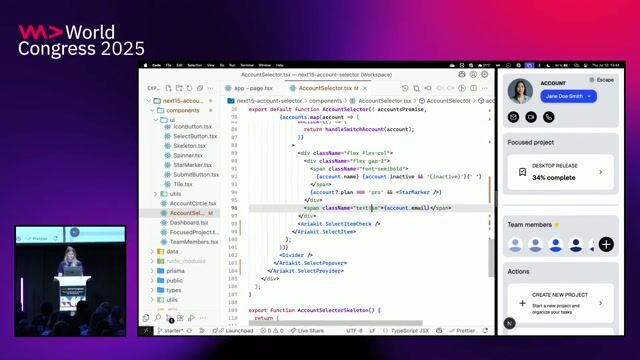
Managing async state with React 19 hooks
Building Interactive Async UI with React 19 and Ariakit
Unlock full access
Log in or set up an account to access this feature and more.
05:41 MIN
Understanding React fundamentals for the examples
How to become an AI toolsmith
Unlock full access
Log in or set up an account to access this feature and more.
04:19 MIN
Answering questions on reactivity and browser support
Under The Hood of Vue 3 Reactivity
Unlock full access
Log in or set up an account to access this feature and more.
Featured Partners
Related Videos
 23:39
23:39Rethinking React State Management: The Power of Built-In Solutions
Marc Brehmer
 28:10
28:10State management in a world of hooks
Adam Klein
 28:43
28:43Bringing back reactivity in "reactive" frontend
Michał Moroz
 21:09
21:09MVI: Minimum Viable Interface for React Components
Daniel Espino Garcia
 30:40
30:40What the heck do "declarative" and "reactive" actually mean?
André Kovac
 28:36
28:36Common Mistakes in Vue.js and How to Avoid Them
Daniel Kelly
 25:29
25:29A Guide To Functional Programming
Jemima Abu
 25:22
25:22Building Interactive Async UI with React 19 and Ariakit
Aurora Scharff
Related Articles
View all articles



From learning to earning
Jobs that call for the skills explored in this talk.


Nia Health GmbH
Berlin, Germany
Intermediate
Senior
CSS
GIT
React
TypeScript


Die Socialisten
Vienna, Austria
Senior
Jest
React
Redux
JavaScript

Schulz.codes GmbH
Darmstadt, Germany
Intermediate
Senior
React
JavaScript
TypeScript

doinstruct Software GmbH
Berlin, Germany
Senior
GIT
JavaScript
TypeScript


Optimi Solutions GmbH
Remote
GIT
TypeScript
React Native
Continuous Integration