
Adrian Schmitt
Overview of Machine Learning in Python
#1about 2 minutes
Understanding the main paradigms of machine learning
Learn the distinctions between supervised, unsupervised, semi-supervised, and reinforcement learning based on data and goals.
#2about 1 minute
Differentiating between regression and classification tasks
Supervised learning is broken down into predicting continuous variables with regression and discrete labels with classification.
#3about 3 minutes
Why data preparation is a critical first step
The principle of 'garbage in, garbage out' highlights the need to analyze and clean data before training any model.
#4about 2 minutes
Converting categorical data into numerical features
Transform non-numerical string data into a machine-readable format using label, ordinal, and one-hot encoding techniques.
#5about 2 minutes
Standardizing numerical data with scaling techniques
Handle large or small numerical values that can negatively impact training by applying scaling methods like min-max or Z-score normalization.
#6about 2 minutes
Choosing a strategy for handling missing data
Address missing values in a dataset by either deleting the affected rows/columns or using imputation to replace them.
#7about 3 minutes
Analyzing a dataset for potential bias and imbalance
A practical example using the adult census dataset demonstrates how to identify and understand biases related to age, sex, and race.
#8about 5 minutes
Splitting data for model training and evaluation
Properly divide your dataset into training and testing sets using strategies like holdout, cross-validation, and stratification to avoid data leakage.
#9about 2 minutes
Using metrics to evaluate model performance
Measure classification model success with accuracy, precision, and F1 score, and regression model success with mean absolute or squared error.
#10about 3 minutes
Understanding overfitting and the bias-variance tradeoff
Find the optimal model complexity by balancing the training error and test error to avoid underfitting or overfitting.
#11about 3 minutes
Tuning hyperparameters and selecting the right algorithm
Optimize model performance by searching for the best parameters with grid search or randomized search, and explore meta-learning for algorithm selection.
#12about 3 minutes
Introduction to decision trees and random forests
Decision trees offer a transparent, white-box model, but random forests typically provide better performance by combining multiple trees.
#13about 7 minutes
Code demo: Preprocessing and training a classifier
A step-by-step Python example shows how to preprocess data, handle missing values, and train decision tree and random forest classifiers using scikit-learn.
#14about 4 minutes
Fundamentals of neural networks and perceptrons
Explore the basic building block of neural networks, the perceptron, and see how they are combined into multi-layer perceptron (MLP) architectures.
#15about 2 minutes
Overview of deep neural networks and architectures
Go beyond simple MLPs to understand deep neural networks and specialized architectures like CNNs for images and RNNs for language.
#16about 2 minutes
Common pitfalls and solutions for neural networks
Address common issues like overfitting with techniques such as dropout and regularization, and tackle the black box problem with model explainers.
#17about 2 minutes
Q&A: Scaling machine learning for large datasets
Handle large datasets by using parallelization to train smaller models simultaneously or by leveraging pre-trained components with transfer learning.
#18about 3 minutes
Q&A: Using scikit-learn for model evaluation
Effectively compare models in scikit-learn by using the built-in metrics module and visualizing results with tools like confusion matrices.
#19about 2 minutes
Q&A: Handling imbalanced datasets during training
Correct for imbalanced target labels in a classification problem by applying oversampling to duplicate instances of the minority class.
#20about 2 minutes
Q&A: Advantages of scikit-learn over other libraries
Scikit-learn is ideal for beginners due to its ease of use and wide variety of algorithms, though specialized libraries offer deeper customization.
#21about 2 minutes
Q&A: Identifying red flags in datasets
Watch for red flags like poor quality data, excessive missing values, and sensitive information that can compromise model performance and ethics.
Related jobs
Jobs that call for the skills explored in this talk.


Matching moments

01:29 MIN
Overview of the data and machine learning tech stack
Empowering Retail Through Applied Machine Learning
Unlock full access
Log in or set up an account to access this feature and more.
03:01 MIN
Common challenges in developing machine learning applications
Data Fabric in Action - How to enhance a Stock Trading App with ML and Data Virtualization
Unlock full access
Log in or set up an account to access this feature and more.
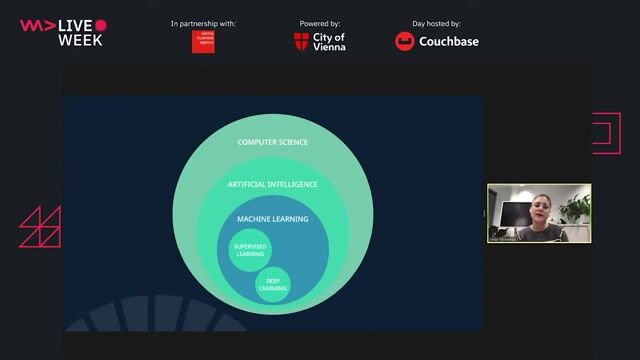
02:48 MIN
Understanding the machine learning development lifecycle
Leverage Cloud Computing Benefits with Serverless Multi-Cloud ML
Unlock full access
Log in or set up an account to access this feature and more.
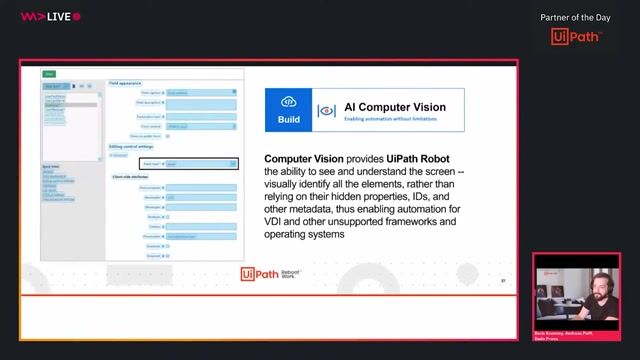
10:46 MIN
Navigating the machine learning project lifecycle
Intelligent Automation using Machine Learning
Unlock full access
Log in or set up an account to access this feature and more.
01:54 MIN
Real-world applications and key takeaways
Machine learning 101: Where to begin?
Unlock full access
Log in or set up an account to access this feature and more.
04:04 MIN
A quick refresher on AI, ML, and deep learning concepts
Introduction to Azure Machine Learning
Unlock full access
Log in or set up an account to access this feature and more.

08:20 MIN
Q&A on starting a career in machine learning
Making neural networks portable with ONNX
Unlock full access
Log in or set up an account to access this feature and more.

01:07 MIN
The hidden complexity of the machine learning lifecycle
DataForce Studio
Unlock full access
Log in or set up an account to access this feature and more.
Featured Partners
Related Videos
 29:37
29:37Detecting Money Laundering with AI
Stefan Donsa & Lukas Alber
 44:11
44:11Getting Started with Machine Learning
Alexandra Waldherr
 49:45
49:45Machine Learning for Software Developers (and Knitters)
Kris Howard
 43:26
43:26PySpark - Combining Machine Learning & Big Data
Ayon Roy
 26:25
26:25Machine learning 101: Where to begin?
Lutske De Leeuw
 32:54
32:54The pitfalls of Deep Learning - When Neural Networks are not the solution
Adrian Spataru & Bohdan Andrusyak
 58:21
58:21Data Science in Retail
Julian Joseph
 50:38
50:38Python Data Visualization @ Deepnote (w/ PyViz overview)
Radovan Kavický
Related Articles
View all articles.gif?w=240&auto=compress,format)


From learning to earning
Jobs that call for the skills explored in this talk.


Jungwild GmbH
DevOps
Docker
Kubernetes
Machine Learning
score4more GmbH
Berlin, Germany
Remote
Intermediate
DevOps
TypeScript
Data analysis
Machine Learning
+2