Julian Joseph
Data Science in Retail
#1about 3 minutes
Real-world examples of machine learning in e-commerce
Personalized recommendations on platforms like Amazon and targeted ads on Instagram are powered by machine learning algorithms.
#2about 4 minutes
Introducing audience segmentation with a sample retail dataset
A small customer dataset with features like age, income, and spending score is used to demonstrate the concept of audience segmentation.
#3about 2 minutes
Using exploratory data analysis to visualize customer patterns
Scatter plots are used to visualize relationships between variables like age, income, and spending score to reveal initial customer patterns.
#4about 3 minutes
An overview of different types of clustering algorithms
A comparison of hierarchical, distribution-based, density-based, and centroid-based clustering helps in choosing the right algorithm for a given dataset.
#5about 3 minutes
A step-by-step explanation of the K-means clustering algorithm
The K-means algorithm iteratively assigns data points to the nearest cluster centroid and recalculates centroids until the clusters stabilize.
#6about 2 minutes
Finding the optimal number of clusters with the elbow method
The elbow method helps determine the optimal number of clusters (K) by identifying the point where adding more clusters yields diminishing returns.
#7about 5 minutes
Visualizing and interpreting K-means clustering results
After running the algorithm, visualizing the clusters helps in interpreting the distinct customer segments for targeted marketing strategies.
#8about 8 minutes
Other common machine learning models used in retail
Beyond clustering, models like Market Basket Analysis, Naive Bayes for spam filtering, and Linear Regression for lifetime value prediction are widely used.
#9about 9 minutes
Scaling machine learning models from development to production
Moving a model to production involves a multi-stage pipeline including data engineering, analysis, model development, MLOps, and orchestration.
#10about 4 minutes
Exploring the different roles within a data science team
The data science field includes diverse roles such as data architect, ML engineer, AI product manager, visualization expert, and developer advocate.
#11about 2 minutes
Q&A: Using clustering and other algorithms for fraud detection
While clustering can identify anomalous patterns, other methods like sequence matching or Bayesian networks are often more suitable for fraud detection.
#12about 2 minutes
Q&A: The value of A/B testing for optimizing campaigns
A/B testing is highly valuable for optimizing user experience on websites and streaming platforms but should be applied based on specific team goals.
#13about 2 minutes
Q&A: Key soft skills for a successful data scientist
Curiosity, strong communication skills, and the ability to build rapport with cross-functional teams are crucial soft skills for data scientists.
#14about 2 minutes
Q&A: Addressing privacy and data security in ML models
Protecting user privacy involves masking or removing personally identifiable information (PII) during the data engineering stage before model training.
#15about 2 minutes
Q&A: When and how to use AutoML in your projects
AutoML is a useful tool for creating a baseline model and overcoming initial development blocks, which can then be customized for specific needs.
#16about 3 minutes
Q&A: MLOps tools for building CI/CD pipelines
Tools like Apache Airflow, Google Cloud Composer, and Dataproc are used to automate, schedule, and manage CI/CD pipelines for machine learning jobs.
Related jobs
Jobs that call for the skills explored in this talk.


Matching moments

01:54 MIN
Real-world applications and key takeaways
Machine learning 101: Where to begin?
Unlock full access
Log in or set up an account to access this feature and more.
06:41 MIN
Exploring practical AI use cases and maturity at Zalando
Navigating the AI Revolution in Software Development
Unlock full access
Log in or set up an account to access this feature and more.

01:34 MIN
Managing data security and diverse retail challenges
Coffee With Developers Michael Koitz
Unlock full access
Log in or set up an account to access this feature and more.

01:29 MIN
Overview of the data and machine learning tech stack
Empowering Retail Through Applied Machine Learning
Unlock full access
Log in or set up an account to access this feature and more.
04:56 MIN
The critical role of real-time data in modern applications
Leveraging Real time data in FSIs
Unlock full access
Log in or set up an account to access this feature and more.

05:15 MIN
How AI powers e-commerce from logistics to discovery
Intelligence Everywhere: The Future of Consumer Tech
Unlock full access
Log in or set up an account to access this feature and more.
05:23 MIN
Q&A on multi-tenant models and edge deployment
Deployed ML models need your feedback too
Unlock full access
Log in or set up an account to access this feature and more.
01:17 MIN
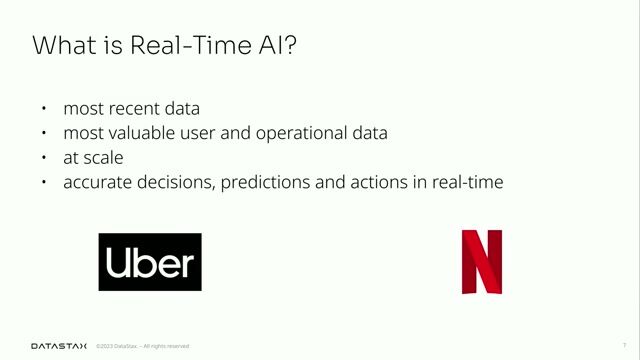
Understanding real-time AI and its applications
Building Real-Time AI/ML Agents with Distributed Data using Apache Cassandra and Astra DB
Unlock full access
Log in or set up an account to access this feature and more.
Featured Partners
Related Videos
 45:58
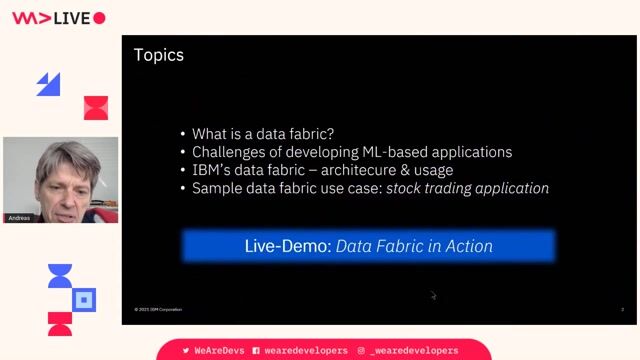
45:58Data Fabric in Action - How to enhance a Stock Trading App with ML and Data Virtualization
Andreas Christian
 57:46
57:46Overview of Machine Learning in Python
Adrian Schmitt
 22:41
22:41Empowering Retail Through Applied Machine Learning
Christoph Fassbach & Daniel Rohr
 49:45
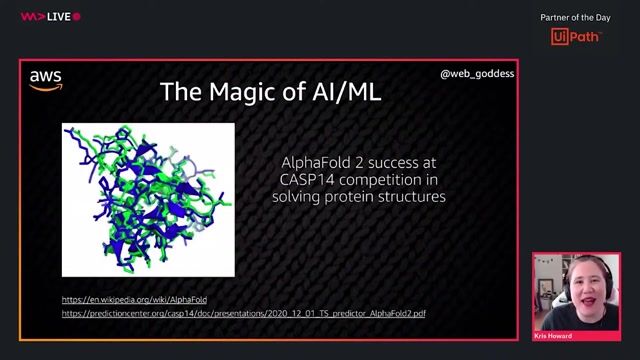
49:45Machine Learning for Software Developers (and Knitters)
Kris Howard
 29:37
29:37Detecting Money Laundering with AI
Stefan Donsa & Lukas Alber
 22:06
22:06Anomaly Detection - Using unsupervised Machine Learning for detecting anomalies in customer base
Lukas Kölbl
 47:19
47:19The state of MLOps - machine learning in production at enterprise scale
Bas Geerdink
 27:23
27:23How We Built a Machine Learning-Based Recommendation System (And Survived to Tell the Tale)
Dora Petrella
Related Articles
View all articles

.gif?w=240&auto=compress,format)

From learning to earning
Jobs that call for the skills explored in this talk.


Home Shopping Europe GmbH
Data analysis
Machine Learning
Software Architecture
Continuous Integration