Tomaz Bratanic
Knowledge graph based chatbot
#1about 2 minutes
Understanding the limitations of large language models
Standard LLMs can hallucinate, lack up-to-date information, and cannot cite sources, making them unreliable for domain-specific tasks.
#2about 2 minutes
Introducing retrieval-augmented generation to improve accuracy
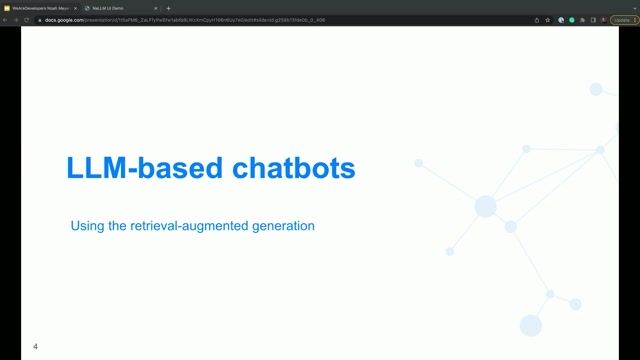
Retrieval-augmented generation (RAG) solves LLM limitations by providing relevant context from a knowledge base to ground the model's answers in facts.
#3about 2 minutes
Implementing RAG with vector similarity search on documents
Unstructured documents like PDFs are chunked, converted into vector embeddings, and stored in a vector database for similarity search against user queries.
#4about 5 minutes
Using knowledge graphs for precise, structured data retrieval
Knowledge graphs represent information as nodes and relationships, allowing an LLM to generate precise Cypher queries instead of relying on semantic search.
#5about 2 minutes
Answering complex multi-hop questions with graph queries
Knowledge graphs excel at answering multi-hop questions that require connecting multiple pieces of information, which is difficult for unstructured RAG systems.
#6about 2 minutes
Exploring real-world use cases for knowledge graphs
Knowledge graphs can power chatbots for various domains, including supply chain management, HR and skills mapping, and microservice architecture analysis.
#7about 1 minute
Building a hybrid chatbot with structured and unstructured data
A hybrid approach combines the benefits of both systems by connecting unstructured text chunks as nodes within a structured knowledge graph.
#8about 4 minutes
Demonstrating a chatbot powered by a knowledge graph
The live demo showcases a chatbot that answers questions by generating Cypher queries for structured data and summarizing connected unstructured articles.
#9about 2 minutes
Q&A on data pipelines and error handling
The Q&A covers methods for converting unstructured data into a knowledge graph using named entity extraction and how LLMs handle spelling mistakes in queries.
Related jobs
Jobs that call for the skills explored in this talk.


Matching moments
03:29 MIN
Demonstrating LLM hallucinations with a basic chatbot
Make it simple, using generative AI to accelerate learning
Unlock full access
Log in or set up an account to access this feature and more.
02:32 MIN
Securely connecting generative AI to enterprise data
How E.On productionizes its AI model & Implementation of Secure Generative AI.
Unlock full access
Log in or set up an account to access this feature and more.
03:55 MIN
Using knowledge graphs to model code structure
New AI-Centric SDLC: Rethinking Software Development with Knowledge Graphs
Unlock full access
Log in or set up an account to access this feature and more.
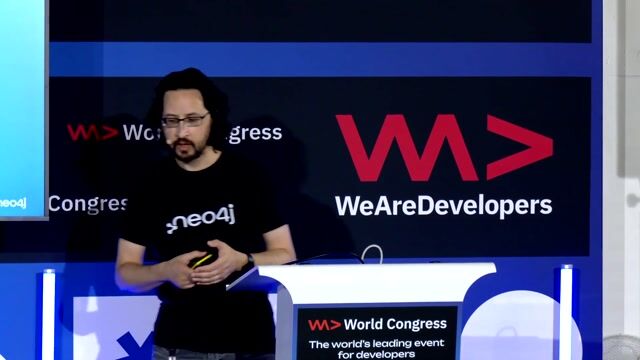
03:01 MIN
Using knowledge graphs to give LLMs a left brain
Give Your LLMs a Left Brain
Unlock full access
Log in or set up an account to access this feature and more.
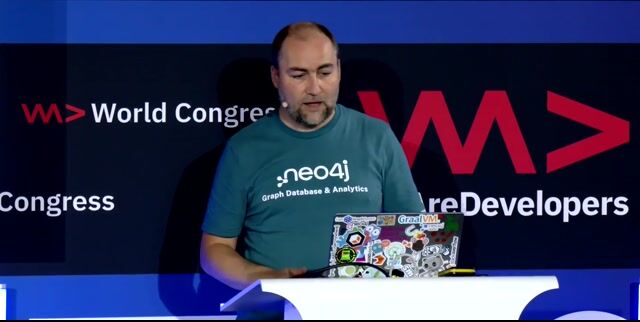
02:31 MIN
Using LLMs to build a knowledge graph from text
Large Language Models ❤️ Knowledge Graphs
Unlock full access
Log in or set up an account to access this feature and more.
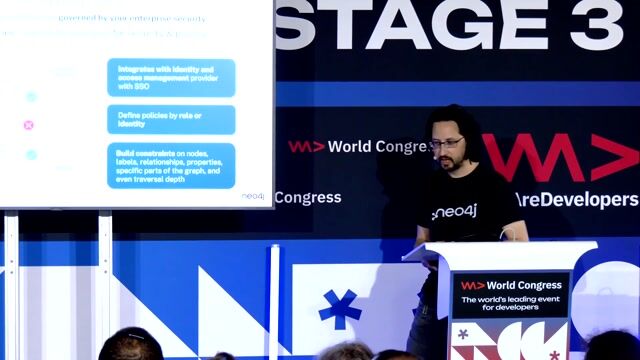
01:19 MIN
Enabling governance and explainability with knowledge graphs
Give Your LLMs a Left Brain
Unlock full access
Log in or set up an account to access this feature and more.
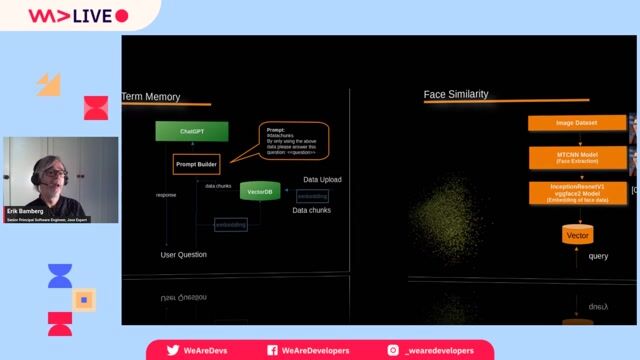
06:13 MIN
Augmenting ChatGPT with a long-term memory
What comes after ChatGPT? Vector Databases - the Simple and powerful future of ML?
Unlock full access
Log in or set up an account to access this feature and more.
03:48 MIN
Representing complex data with knowledge graphs
Large Language Models ❤️ Knowledge Graphs
Unlock full access
Log in or set up an account to access this feature and more.
Featured Partners
Related Videos
 29:11
29:11Large Language Models ❤️ Knowledge Graphs
Michael Hunger
 27:35
27:35Give Your LLMs a Left Brain
Stephen Chin
 46:51
46:51Graphs and RAGs Everywhere... But What Are They? - Andreas Kollegger - Neo4j
 29:40
29:40Lies, Damned Lies and Large Language Models
Jodie Burchell
 26:25
26:25Building Blocks of RAG: From Understanding to Implementation
Ashish Sharma
 24:42
24:42Martin O'Hanlon - Make LLMs make sense with GraphRAG
Martin O'Hanlon
 28:20
28:20Building Real-Time AI/ML Agents with Distributed Data using Apache Cassandra and Astra DB
Dieter Flick
 21:17
21:17Carl Lapierre - Exploring Advanced Patterns in Retrieval-Augmented Generation
Carl Lapierre
Related Articles
View all articles
.webp?w=240&auto=compress,format)

From learning to earning
Jobs that call for the skills explored in this talk.


Capgemini Deutschland Holding GmbH
Berlin, Germany
Senior
Neo4j
DevOps
Data analysis
Capgemini Deutschland Holding GmbH
Munich, Germany
Senior
Neo4j
DevOps
Microsoft Office
Capgemini Deutschland Holding GmbH
Hanover, Germany
Senior
Neo4j
DevOps
Microsoft Office
Capgemini Deutschland Holding GmbH
Frankfurt, Germany
Senior
Neo4j
DevOps
Data analysis
Capgemini Deutschland Holding GmbH
Hamburg, Germany
Senior
Neo4j
DevOps
Data analysis
Capgemini Deutschland Holding GmbH
Nuremberg, Germany
Senior
Neo4j
DevOps
Data analysis
Capgemini Deutschland Holding GmbH
Cologne, Germany
Senior
Neo4j
DevOps
Microsoft Office
Capgemini Deutschland Holding GmbH
Stuttgart, Germany
Senior
Neo4j
DevOps
Data analysis