Jan Weinschenker
Side-by-Side: Reactive vs non-reactive Java
#1about 6 minutes
Understanding the core principles of the reactive manifesto
Reactive systems are designed to be responsive, elastic, and resilient by using a message-driven architecture.
#2about 2 minutes
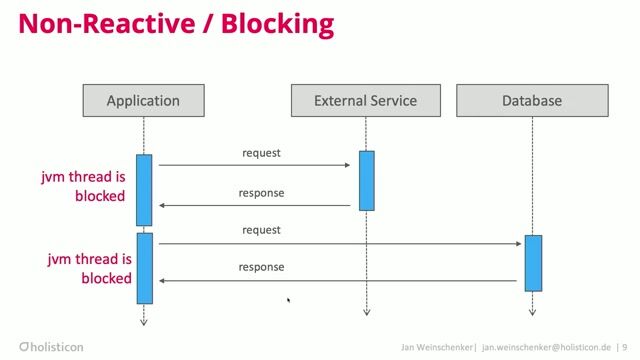
Visualizing blocking vs non-blocking request models
Sequence diagrams illustrate how non-blocking, fire-and-forget requests improve resource utilization compared to traditional blocking calls.
#3about 3 minutes
An analogy for reactive task distribution
A story about cleaning rooms illustrates how reactive programming breaks large workloads into small, independent tasks for efficient parallel execution.
#4about 2 minutes
Exploring reactive Java frameworks and adoption challenges
Despite numerous frameworks like WebFlux and RxJava, reactive programming faces a steep learning curve and debugging complexities.
#5about 3 minutes
Live code demonstration of imperative Java
A walkthrough of a standard, non-reactive Java method shows a straightforward, blocking approach to fetching and processing API data.
#6about 3 minutes
Live code demonstration of reactive Java
The same API data fetching task is implemented using a reactive, stream-based approach with Spring WebFlux and Project Reactor's Flux.
#7about 3 minutes
Understanding the unique reactive debugging experience
Debugging reactive code reveals its declarative nature, where execution is non-linear and only begins after a subscription is made.
#8about 3 minutes
Q&A on Project Loom and integration challenges
The discussion covers whether Project Loom makes reactive programming obsolete and how to handle integration with non-reactive components like JDBC.
Related jobs
Jobs that call for the skills explored in this talk.


Matching moments
01:19 MIN
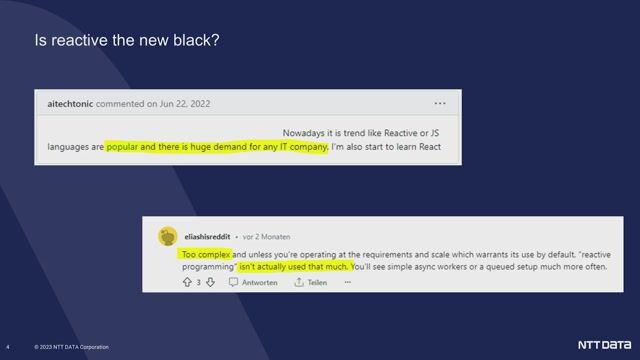
Examining the trend and debate around reactive programming
Is reactive the new black? Imperative vs. reactive programming with Quarkus
Unlock full access
Log in or set up an account to access this feature and more.
02:47 MIN
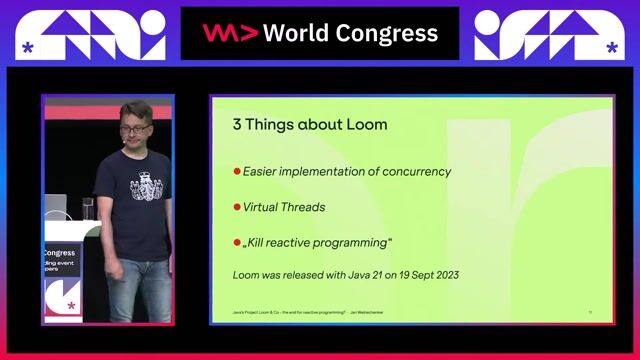
The core principles of reactive programming
Java's Project Loom & Co - the end for reactive programming?
Unlock full access
Log in or set up an account to access this feature and more.
02:51 MIN
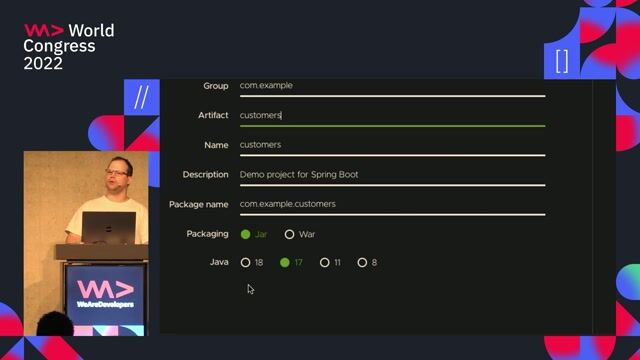
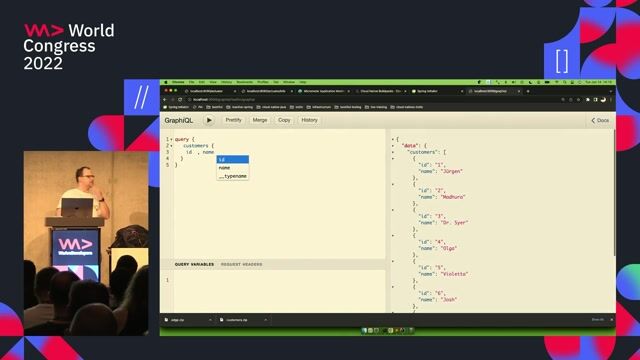
Building a reactive service with Spring Data
Kubernetes Native Java
Unlock full access
Log in or set up an account to access this feature and more.
01:12 MIN
Comparing Project Loom with reactive programming
Kubernetes Native Java
Unlock full access
Log in or set up an account to access this feature and more.

04:11 MIN
Comparing reactive and imperative code performance
Development of reactive applications with Quarkus
Unlock full access
Log in or set up an account to access this feature and more.
08:27 MIN
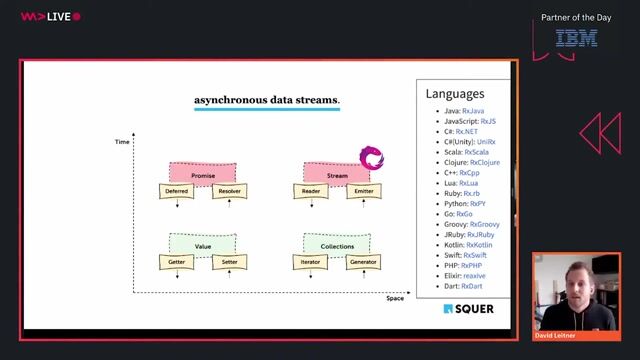
Exploring the core principles of reactive programming
Rethinking Reactive Architectures with GraphQL
Unlock full access
Log in or set up an account to access this feature and more.
01:53 MIN
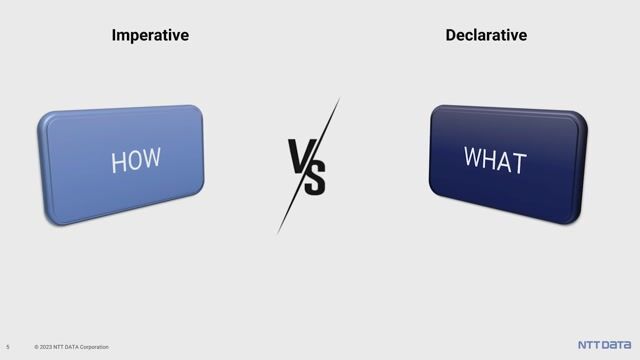
Contrasting imperative, declarative, and reactive code styles
Is reactive the new black? Imperative vs. reactive programming with Quarkus
Unlock full access
Log in or set up an account to access this feature and more.

09:05 MIN
Q&A on virtual threads, reactive programming, and Java 21
Introduction and pitfalls of Java's new concurrency model
Unlock full access
Log in or set up an account to access this feature and more.
Featured Partners
Related Videos
 54:18
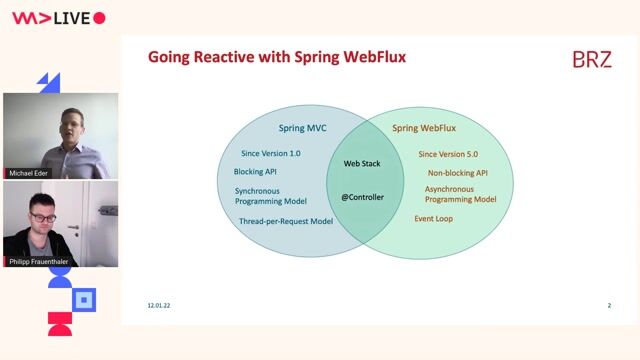
54:18Going reactive with Spring WebFlux
Michael Eder & Philipp Frauenthaler
 52:24
52:24Slip Through the Boundaries of Legacy Systems with Kotlin and Spring WebFlux
Lukas Georgieff & Alberto Gisbert
 39:10
39:10Development of reactive applications with Quarkus
Niklas Heidloff
 41:37
41:37Java with a Clojure mindset
Dan Lebrero
 55:30
55:30Java 21: The Revolution of Virtual Threads - A Deep Dive
Christian Woerz
 27:49
27:49Modern Java: This is not your father's Java anymore
Ron Veen
 37:55
37:552021: Familiar APIs on Kickass Runtimes #slideless
Adam Bien
 52:51
52:51Introduction and pitfalls of Java's new concurrency model
David Vlijmincx
Related Articles
View all articles.gif?w=240&auto=compress,format)


.gif?w=240&auto=compress,format)
From learning to earning
Jobs that call for the skills explored in this talk.


Haufe-Lexware GmbH & Co. KG
Freiburg im Breisgau, Germany
Intermediate
Senior
Java
React
TypeScript

wunschlösung GmbH
Jena, Germany
Intermediate
Senior
Java

Buhck Umweltservices GmbH & Co. KG
Reinbek, Germany
Senior
Java
React

wunschlösung GmbH
Jena, Germany
Intermediate
Senior
Java
Docker
MongoDB


BSB Bremer Software & Beratungs GmbH
Bremen, Germany
Intermediate
Senior
CSS
Java
HTML
React
JavaScript
+1


Nia Health GmbH
Berlin, Germany
Intermediate
Senior
CSS
GIT
React
TypeScript