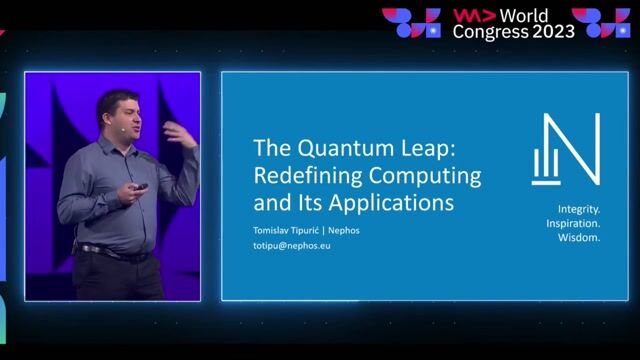
Tomislav Tipurić
The Quantum Leap: Redefining Computing and Its Applications
#1about 6 minutes
Why classical computers are reaching their physical limits
Classical computers struggle with complex global problems because Moore's Law is ending as transistors approach the atomic scale, creating a need for a new computing paradigm.
#2about 3 minutes
How quantum computers can break modern encryption
The problem of factoring large prime numbers, which is the foundation of RSA encryption, demonstrates how quantum algorithms can solve exponentially complex problems in linear time.
#3about 2 minutes
Understanding the qubit and quantum superposition
Unlike a classical bit that is either 0 or 1, a qubit can exist in a superposition of both states simultaneously, unlocking immense computational potential.
#4about 4 minutes
Manipulating qubits using quantum gates and logic
Quantum gates, analogous to classical logic gates, are used to manipulate the probabilistic states of qubits, with simulations requiring exponential amounts of classical memory.
#5about 3 minutes
Harnessing interference and quantum entanglement
Quantum computing leverages interference to amplify correct answers and cancel wrong ones, while entanglement links qubit states instantly regardless of distance.
#6about 2 minutes
The probabilistic nature of quantum measurement
Due to the no-cloning principle, measuring a qubit collapses its superposition and provides the most probable answer, not a deterministic one.
#7about 3 minutes
The industry race to build stable quantum hardware
Companies like IBM, Google, and Microsoft are developing different hardware approaches, such as superconductors and topological qubits, while battling high error rates.
#8about 5 minutes
Exploring future applications of quantum computing
Quantum computers promise to revolutionize fields like material science for better batteries, drug discovery, carbon capture, and training next-generation artificial intelligence models.
Related jobs
Jobs that call for the skills explored in this talk.


Matching moments
02:10 MIN
Why quantum computing is the successor to Moore's Law
Quantum DevOps - Quantum Application Development
Unlock full access
Log in or set up an account to access this feature and more.
03:41 MIN
Applying quantum computing to real-world problems
The Quantum Computing Future
Unlock full access
Log in or set up an account to access this feature and more.
03:05 MIN
The future of quantum hardware and learning resources
Schroedinger's cat: Thinking in- and outside the box of quantum mechanics
Unlock full access
Log in or set up an account to access this feature and more.
03:29 MIN
Exploring key use cases for quantum advantage
The Quantum Computing Future
Unlock full access
Log in or set up an account to access this feature and more.
04:48 MIN
Understanding the fundamentals of quantum computing
Quantum computing for developers: Solving optimization problems with Qiskit
Unlock full access
Log in or set up an account to access this feature and more.
01:51 MIN
Understanding the exponential leap of quantum computation
Quantum Tech: Preparing for the Next Leap
Unlock full access
Log in or set up an account to access this feature and more.
04:29 MIN
Q&A on the future and applications of quantum
What is quantum computing?
Unlock full access
Log in or set up an account to access this feature and more.
05:39 MIN
The origin and exponential power of quantum computing
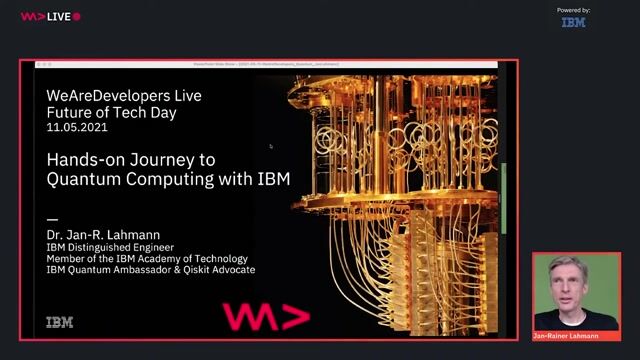
Hands-on Journey to Quantum Computing with IBM
Unlock full access
Log in or set up an account to access this feature and more.
Featured Partners
Related Videos
 30:57
30:57The Quantum Computing Future
Tomislav Tipurić, Alexander Glätzle & Jan Goetz
 31:17
31:17Quantum Computing for Classical Developers
Julian Burr
 25:46
25:46What is quantum computing?
Alex Waldherr
 28:04
28:04Going Quantum: The future of the internet ...
Alexander Pirker
 28:26
28:26Quantum Computing - The tiny and the big challenges
Alex Waldherr
 43:21
43:21Schroedinger's cat: Thinking in- and outside the box of quantum mechanics
Alexandra Waldherr
 22:44
22:44Quantum DevOps - Quantum Application Development
Ilie-Daniel Gheorghe-Pop
 33:26
33:26Hands-on Journey to Quantum Computing with IBM
Jan-Rainer Lahmann
Related Articles
View all articles.webp?w=240&auto=compress,format)


From learning to earning
Jobs that call for the skills explored in this talk.


Kipu Quantum Gmbh
Karlsruhe, Germany
Remote
Senior
Quantum Machines
Stuttgart, Germany
Intermediate
DevOps
Ansible
Terraform
Continuous Integration
QuantumDiamonds GmbH
Munich, Germany
Senior
Machine Learning
Continuous Integration