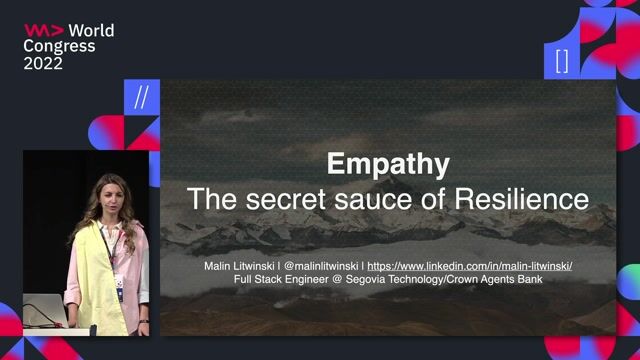
Malin Litwinski
Empathy: The secret sauce of Resilience
#1about 2 minutes
Why empathy is crucial for resilient engineering teams
An empathetic culture reduces stress and improves productivity for engineers in an industry where systems will inevitably break.
#2about 2 minutes
Understanding resilience as an investment in reliability
Resilience is the cultural investment made in a team to ensure a product remains reliable for customers, even when things go wrong in production.
#3about 5 minutes
Shifting from blame to learning in incident analysis
By treating incidents as surprises and acknowledging human imperfection, teams can move past hindsight bias and focus on learning instead of blame.
#4about 3 minutes
Moving from reactive fixes to proactive chaos engineering
Chaos engineering is a discipline for proactively experimenting on a system to build confidence, turning the reactive outage learning loop into a scheduled experiment.
#5about 7 minutes
Using frame of reference to make chaos experiments less stressful
The "bomb vs. escape room" analogy illustrates how framing chaos experiments as controlled, safe challenges separates them from real-life crises and reduces stress.
#6about 2 minutes
Adopting a mindset of acceptance and improvement
Instead of dwelling on mistakes, teams should accept the current state without blame and focus on making things better, recognizing everyone did their best.
#7about 3 minutes
Building effective teams with diverse skill sets
A resilient team needs a mix of roles like the detail-diver, big-picture painter, and mood-maker, rather than being composed solely of subject matter experts.
#8about 3 minutes
Fostering inclusion by valuing every team member's contribution
Creating an inclusive environment where new members feel safe to ask simple questions is crucial for uncovering blind spots and fostering innovation.
#9about 4 minutes
Q&A on building chaos days and managing on-call stress
The speaker answers audience questions about creating your own "escape room" chaos day, handling on-call duties, and the problem with unannounced chaos experiments.
Related jobs
Jobs that call for the skills explored in this talk.


Matching moments
03:14 MIN
Building resilience across all software stack layers
System Resilience: Surviving the Software Storm
Unlock full access
Log in or set up an account to access this feature and more.
03:59 MIN
The second-order effects of chaos engineering on culture
Building a culture from chaos
Unlock full access
Log in or set up an account to access this feature and more.
03:33 MIN
Resilience is a shared responsibility for individuals and companies
From Stress to Strength: How to Build Workplace Resilience
Unlock full access
Log in or set up an account to access this feature and more.
04:47 MIN
Building team relationships through empathy and respect
Bridging the gap between design and development
Unlock full access
Log in or set up an account to access this feature and more.
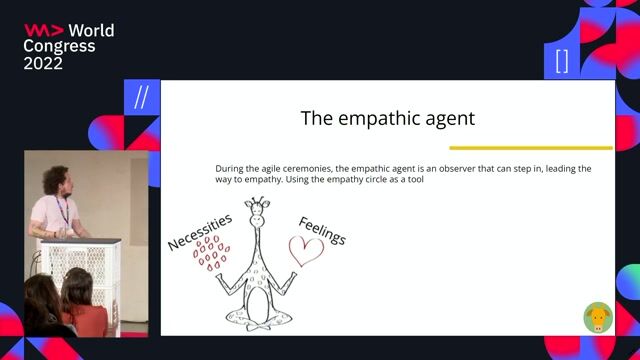
04:49 MIN
How to become an empathy agent in your team
Non-violent communication in agile teams
Unlock full access
Log in or set up an account to access this feature and more.
02:50 MIN
Q&A on tooling, support, and empathy in tech
The ABC of DX
Unlock full access
Log in or set up an account to access this feature and more.

10:22 MIN
Analyzing audience feedback on engineering culture
What makes a great Software Engineer? Challenging our Assumptions Instead of Talking about Imposter Syndrome
Unlock full access
Log in or set up an account to access this feature and more.

03:38 MIN
Understanding the core loop of chaos engineering
Building a culture from chaos
Unlock full access
Log in or set up an account to access this feature and more.
Featured Partners
Related Videos
 42:41
42:41Engineering culture: Why ownership is the secret ingredient
Eric Rabinovich
 24:00
24:00Handling incidents collaboratively is like solving a rubix cube
Nele Uhlemann
 23:34
23:34Secure Code Superstars: Empowering Developers and Surpassing Security Challenges Together
Stefania Chaplin
 55:07
55:07What makes a great Software Engineer? Challenging our Assumptions Instead of Talking about Imposter Syndrome
Irina Anastasiu
 52:36
52:36Is everything difficult, or is it just me?
Jo Franchetti
 54:36
54:36Diversity as a Growth and Happiness Factor in Agile Development
Evelyn Forstner
 26:18
26:18I broke the production
Arto Liukkonen
 59:00
59:00One size fits all! Not at all!
Ixchel Ruiz
Related Articles
View all articles
.png?w=240&auto=compress,format)


From learning to earning
Jobs that call for the skills explored in this talk.


Peter Park System GmbH
München, Germany
Senior
Python
Docker
Node.js
JavaScript


Rocken AG
Neural Concept
Lausanne, Switzerland
Machine Learning