Emma Dawson
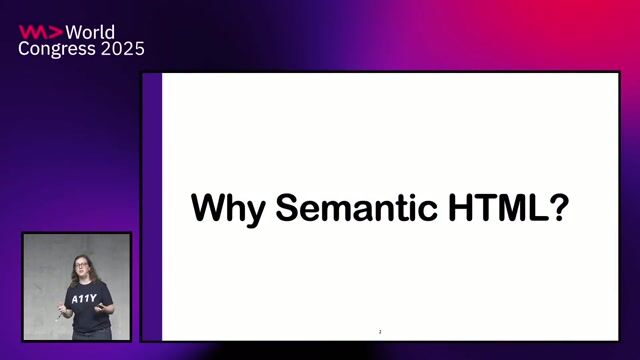
Semantic HTML means it's semantic, right? Right?
#1about 6 minutes
How browsers create the accessibility tree from HTML
Browsers parse HTML into the DOM for visual display and simultaneously create an accessibility tree to convey semantic information to assistive technologies.
#2about 2 minutes
Categorizing semantic HTML as good, bad, or ugly
Semantic HTML elements can be categorized as good (meaningful and accessible), bad (non-semantic like divs), or ugly (semantic but with accessibility caveats).
#3about 3 minutes
Making the section element accessible with ARIA labels
A section element is ignored by the accessibility tree unless it is given an accessible name via an `aria-label` or `aria-labelledby`, which promotes it to a landmark region.
#4about 2 minutes
How context affects header and footer accessibility
The header and footer elements are only exposed as landmarks to assistive technologies when they are direct children of the body element.
#5about 2 minutes
Using anchor tags for navigation and buttons for actions
Anchor tags should be used for navigation to a new page or location, while buttons should be used to perform an on-page action to meet user expectations.
#6about 2 minutes
Why text styling tags are ignored by screen readers
Semantic tags for emphasis or importance like `<em>`, `<strong>`, `<b>`, and `<i>` are not audibly announced by screen readers, requiring alternative methods to convey meaning.
#7about 3 minutes
The inconsistent screen reader support for del and ins tags
The `<del>` and `<ins>` elements, often used for pricing, have improving but still unreliable support across screen readers and browsers, which can lead to confusion.
#8about 2 minutes
Accessibility issues with hr, br, and abbr tags
Elements like `<hr>`, `<br>`, and `<abbr>` can create disruptive experiences or have unreliable support, demonstrating that browser compatibility does not equal screen reader compatibility.
#9about 1 minute
Stop fighting the browser and use elements correctly
The key takeaway is to use HTML elements for their intended semantic purpose, such as using buttons for actions instead of making divs clickable.
Related jobs
Jobs that call for the skills explored in this talk.


Matching moments
07:40 MIN
Using semantic HTML for a better accessibility tree
Accessibility in React Application
Unlock full access
Log in or set up an account to access this feature and more.
00:48 MIN
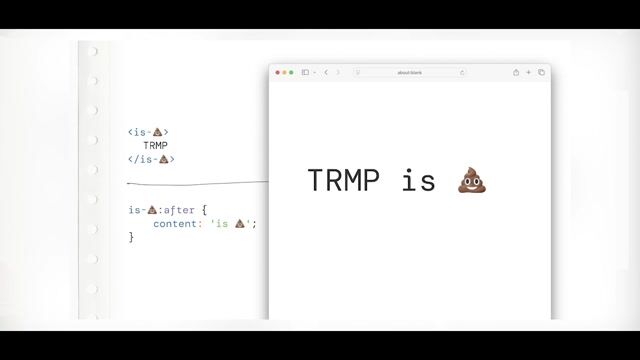
Why semantic HTML is still critically important
The Resilience of the World Wide Web
Unlock full access
Log in or set up an account to access this feature and more.
00:48 MIN
Why semantic HTML still matters for functionality
The Resilience of the World Wide Web
Unlock full access
Log in or set up an account to access this feature and more.

03:41 MIN
Solving accessibility issues with semantic HTML
Mastering Keyboard Accessibility
Unlock full access
Log in or set up an account to access this feature and more.
07:01 MIN
The importance of web accessibility as a core developer craft
WAD Live 22/01/2025: Exploring AI, Web Development, and Accessibility in Tech with Stefan Judis
Unlock full access
Log in or set up an account to access this feature and more.
04:46 MIN
Using the right tool for the right job for accessibility
Future-Proof CSS
Unlock full access
Log in or set up an account to access this feature and more.
00:59 MIN
Summary of key accessibility best practices
Making Interactions Accessible to All Users
Unlock full access
Log in or set up an account to access this feature and more.

04:08 MIN
Practical first steps for implementing web accessibility
The What, Why, Who and How of accessibility on the web
Unlock full access
Log in or set up an account to access this feature and more.
Featured Partners
Related Videos
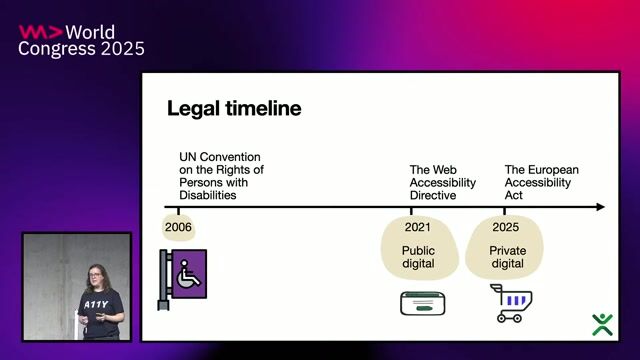 24:30
24:30Oh S***! There's a New Accessibility Law and I'm Not Ready!
Emma Dawson
 1:10:08
WeAreDevelopers LIVE - - Gaps in CSS, EU Accessibility Act and more!
Chris Heilmann & Daniel Cranney
 1:10:08
WeAreDeveloper Live: Accessibility in the EU, CSS Gaps and forms with Emma Dawson
Emma Dawson
 31:38
31:38Making Interactions Accessible to All Users
Anuradha Kumari
 29:59
29:59The What, Why, Who and How of accessibility on the web
Konstantin Tieber
 27:16
27:16Mastering Keyboard Accessibility
Tanja Ulianova
 55:32
55:32ARIA: the good parts
Hidde de Vries
 30:07
30:07Accessibility in React Application
Julia Undeutsch
Related Articles
View all articles


From learning to earning
Jobs that call for the skills explored in this talk.


Deloitte
Senior
HTML
JIRA
Figma
Confluence
Deloitte
Senior
HTML
JIRA
Figma
Confluence
TWT Group TWT Group
Remote
Senior
HTML
Typo3
DevOps
Vue.js
+7
Tech Solutions Gmbh
GIT
HTML
Vue.js
Tech Solutions Gmbh
GIT
HTML
Vue.js
Tech Solutions Gmbh
GIT
HTML
Vue.js