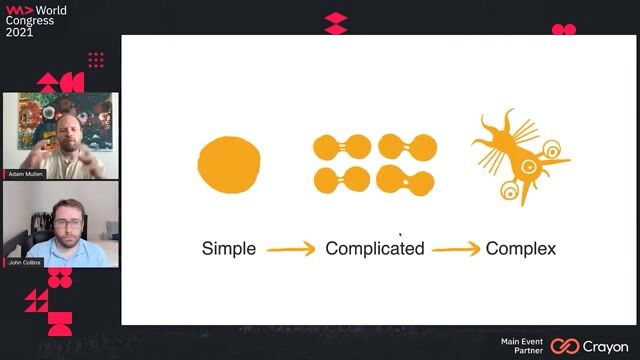
Adam Mullen & John Collins
Monoliths: A love story
#1about 4 minutes
The challenges of scaling a monolithic architecture
Rapid team growth in a single codebase leads to development friction, increased complexity, and slower delivery times.
#2about 4 minutes
The problems with a growing monolithic codebase
As a monolith grows, development slows down due to the need for extensive communication and alignment across many teams.
#3about 4 minutes
Why strict code ownership is a flawed solution
Assigning strict code ownership creates walled gardens, knowledge silos, and dependencies that hinder collaboration and slow down development.
#4about 4 minutes
How engineering culture shapes system architecture
According to Conway's Law, your organization's communication patterns will ultimately determine your software architecture, making cultural change a prerequisite for technical change.
#5about 4 minutes
Shifting from code ownership to inner sourcing
Move from a mindset of protective ownership to one of collective maintenance by allowing people to go to the work and adopting an inner-sourcing model.
#6about 4 minutes
Scoping change initiatives for maximum impact
Choose meaningful, visible projects that can be completed within a few sprints to ensure they are large enough to matter but small enough to manage risk.
#7about 3 minutes
Applying the scientific method to organizational change
Treat improvements as experiments by forming a clear hypothesis, testing it, analyzing the resulting data, and iterating based on what you learn.
#8about 4 minutes
Practical tips for implementing sustainable changes
Ensure success by making small, iterative changes, prioritizing easy rollbacks, and investing in documentation and code quality to support future work.
#9about 3 minutes
Focusing on modularity over architectural labels
Instead of debating monoliths versus microservices, focus on decoupling code and improving team collaboration to build a more modular and maintainable system.
#10about 3 minutes
Q&A: Documentation, team size, and onboarding
The discussion covers managing documentation through the definition of done, the ideal team size of four to six engineers, and using a buddy system for onboarding.
Related jobs
Jobs that call for the skills explored in this talk.


Matching moments
01:55 MIN
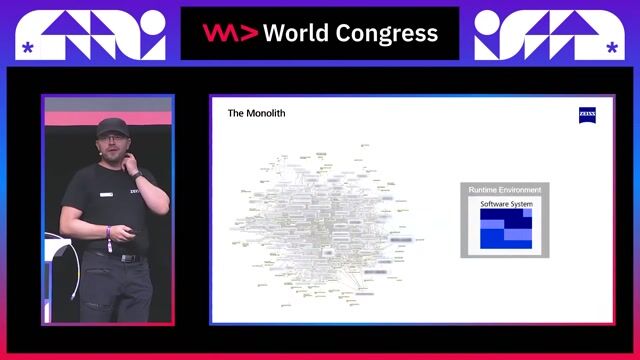
Why traditional monoliths get a bad reputation
Modulith Instead of Monolith - Pragmatically Towards Microservices
Unlock full access
Log in or set up an account to access this feature and more.

02:34 MIN
The flawed debate between monoliths and microservices
Microservices? Monoliths? An Annoying Discussion!
Unlock full access
Log in or set up an account to access this feature and more.

03:07 MIN
Challenges of modernizing and scaling monolithic frontends
Web-Fragments: incremental micro-frontends migration approach for enterprise
Unlock full access
Log in or set up an account to access this feature and more.
05:52 MIN
Q&A on shared systems and scaling productivity
Forget Developer Platforms, Think Developer Productivity!
Unlock full access
Log in or set up an account to access this feature and more.
02:46 MIN
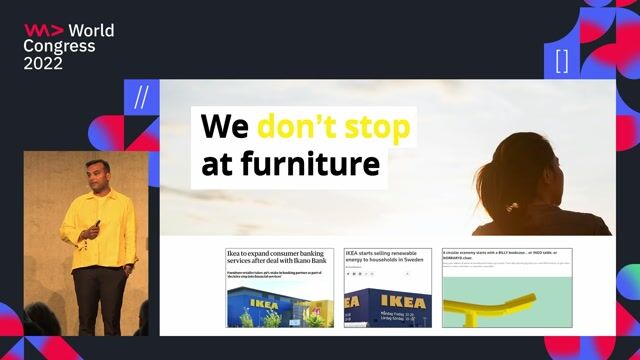
Transforming technology and internal ways of working
IKEA Story: Transforming an Iconic Retail Brand
Unlock full access
Log in or set up an account to access this feature and more.
02:15 MIN
Tracing the architectural shift to micro frontends
Front-End Micro Apps
Unlock full access
Log in or set up an account to access this feature and more.

00:50 MIN
Q&A: When to build a monolith application
Strategies to accelerate SaaS Application Development
Unlock full access
Log in or set up an account to access this feature and more.

08:41 MIN
Amazon's early monolith and database scaling challenges
Building Systems that Last
Unlock full access
Log in or set up an account to access this feature and more.
Featured Partners
Related Videos
 42:02
42:02Move fast with Software Architecture
Simon Lasselsberger
 46:24
46:24The Rise of Reactive Microservices
David Leitner
 27:32
27:32Why you shouldn’t build a microservice architecture
Michael Eisenbart
 43:13
43:13It’s all about the domain, honey ! Experiences from 15 years of Domain-Driven Design
Carola Lilienthal
 58:23
58:23Building high performance and scalable architectures for enterprises
Luka Samaržija & Ivan Sokol
 43:20
43:20Microfrontends at Scale
Josh Goldberg
 46:48
46:48Seven Myths, Three Reasons, One Goal
Stefan Priebsch
 28:12
28:12Scaling: from 0 to 20 million users
Josip Stuhli
Related Articles
View all articles.gif?w=240&auto=compress,format)


From learning to earning
Jobs that call for the skills explored in this talk.


Peter Park System GmbH
München, Germany
Senior
Python
Docker
Node.js
JavaScript

CONTIAMO GMBH
Berlin, Germany
Senior
Python
Docker
TypeScript
PostgreSQL


iov42
Vienna, Austria
Senior
Java
Spring
Ethereum
PostgreSQL
Blockchain
+3


Ostrom
Intermediate
NestJS
Node.js
TypeScript
React Native