Robert Lehmann
Planet-Scale Dashboards
#1about 3 minutes
The challenge of creating monitoring dashboards from scratch
Monitoring is often an afterthought, leading to painful incident response without the necessary dashboards for troubleshooting.
#2about 3 minutes
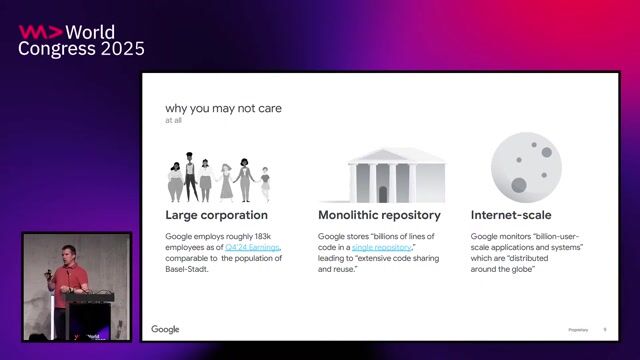
Understanding Google's unique observability scaling challenges
Google's massive scale, global distribution, and monorepo architecture created a unique need for a scalable, reusable monitoring solution.
#3about 5 minutes
Building reusable dashboards with templated dimensions
Replace hardcoded values in queries with template variables, called dimensions, to create a single dashboard that can be reused for any service.
#4about 6 minutes
Solving dashboard discovery with scopes and traits
Address the problem of too many dashboards by having users select a "scope" (e.g., a service), which then uses discovered "traits" to show only relevant dashboards.
#5about 2 minutes
Modeling different entities with scope types
Introduce "scope types" to create namespaces for different kinds of monitorable entities, such as servers, databases, or machine learning models.
#6about 4 minutes
Why infrastructure as code is not the right solution
Static provisioning with infrastructure-as-code or dashboards-as-code is insufficient because it lacks dynamic runtime information and creates a stale second source of truth.
#7about 3 minutes
Improving performance at scale with query variants
Use pre-aggregated metrics and define multiple query "variants" within a graph, allowing the system to automatically select the most performant query based on the user's drill-down level.
#8about 1 minute
Visualizing dependencies with a service graph
Leverage the scope and dependency information to build a service graph that helps engineers quickly navigate between related systems during an incident.
#9about 1 minute
Key takeaways for building planet-scale dashboards
A summary of the core principles: use dimensions for reusability, traits for discovery, scope types for genericity, and variants for performance.
Related jobs
Jobs that call for the skills explored in this talk.


Matching moments
02:21 MIN
Adopting an "as code" approach for dashboards
Monitoring as Code - Managing your dashboards at scale
Unlock full access
Log in or set up an account to access this feature and more.
06:29 MIN
Overcoming observability challenges with a unified platform
All your telemetry data from any source in one place
Unlock full access
Log in or set up an account to access this feature and more.
05:35 MIN
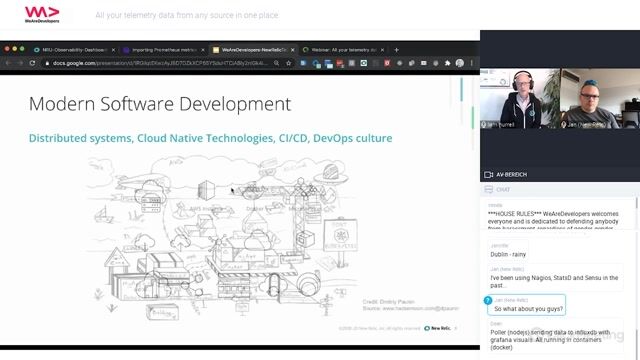
Moving from basic monitoring to full system observability
All your telemetry data from any source in one place
Unlock full access
Log in or set up an account to access this feature and more.
01:40 MIN
How engineers handle production errors and monitoring
DevOps at Netflix
Unlock full access
Log in or set up an account to access this feature and more.
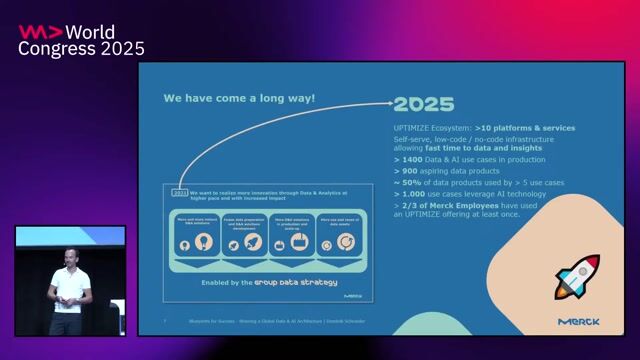
01:31 MIN
Addressing the challenges of scaling a global data platform
Blueprints for Success: Steering a Global Data & AI Architecture
Unlock full access
Log in or set up an account to access this feature and more.
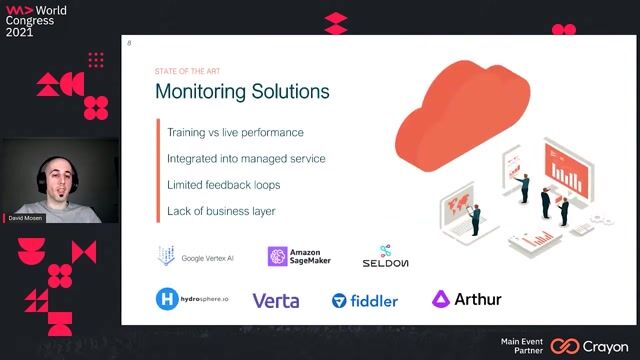
04:17 MIN
Evaluating the state of current monitoring solutions
Deployed ML models need your feedback too
Unlock full access
Log in or set up an account to access this feature and more.

04:30 MIN
Building a cost-effective hybrid observability platform
Software Engineering Social Connection: Yubo’s lean approach to scaling an 80M-user infrastructure
Unlock full access
Log in or set up an account to access this feature and more.
03:48 MIN
Navigating the overwhelming explosion of observability tools
Telemetry without the 'Tool Tax'
Unlock full access
Log in or set up an account to access this feature and more.
Featured Partners
Related Videos
 32:47
32:47Monitoring as Code - Managing your dashboards at scale
Gabriel Labachelerie
 46:24
46:24The Rise of Reactive Microservices
David Leitner
 27:19
27:19Modularity: Let's dig deeper
Pratishtha Pandey
 19:44
19:44Blueprints for Success: Steering a Global Data & AI Architecture
Dominik Schneider
 24:00
24:00Handling incidents collaboratively is like solving a rubix cube
Nele Uhlemann
 26:45
26:45How to Destroy a Monolith?
Babette Wagner
 28:30
28:30Empowering Developer Innovation - Balancing Speed, Security, and Scale
Amir Friedman, Martin Reynolds & Yair Etziony
 15:26
15:26New AI-Centric SDLC: Rethinking Software Development with Knowledge Graphs
Gregor Schumacher, Sujay Joshy & Marcel Gocke
Related Articles
View all articles



From learning to earning
Jobs that call for the skills explored in this talk.


AUTO1 Group SE
Berlin, Germany
Intermediate
Senior
ELK
Terraform
Elasticsearch

iits-consulting GmbH
Munich, Germany
Intermediate
Go
Docker
DevOps
Kubernetes


Remote
Intermediate
Linux
Network administration
Devoteam
Remote
Senior
Terraform
Apache Kafka
Data analysis
Continuous Integration
adconova GmbH
Docker
Terraform
Kubernetes
Elasticsearch
Microsoft Office
+2
Scalefree Scalefree