Jodie Burchell
Lies, Damned Lies and Large Language Models
#1about 2 minutes
Understanding the dual nature of large language models
LLMs can generate both creative, coherent text and factually incorrect "hallucinations," posing a significant challenge for real-world applications.
#2about 4 minutes
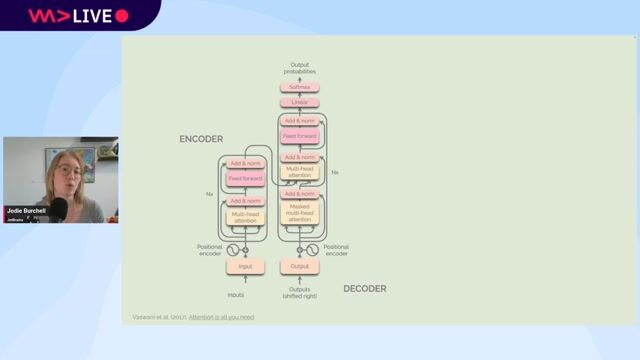
The architecture and evolution of LLMs
The combination of the scalable Transformer architecture and massive text datasets enables models like GPT to develop "parametric knowledge" as they grow in size.
#3about 3 minutes
How training data quality influences model behavior
The quality of web-scraped datasets like Common Crawl, even after filtering, directly contributes to model hallucinations by embedding misinformation.
#4about 2 minutes
Differentiating between faithfulness and factuality hallucinations
Hallucinations are categorized as either faithfulness errors, which contradict a given source text, or factuality errors, which stem from incorrect learned knowledge.
#5about 3 minutes
Using the TruthfulQA dataset to measure misinformation
The TruthfulQA dataset provides a benchmark for measuring an LLM's tendency to repeat common misconceptions and conspiracy theories across various categories.
#6about 6 minutes
A practical guide to benchmarking LLM hallucinations
A step-by-step demonstration shows how to use Python, LangChain, and Hugging Face Datasets to run the TruthfulQA benchmark on a model like GPT-3.5 Turbo.
#7about 4 minutes
Exploring strategies to reduce LLM hallucinations
Key techniques to mitigate hallucinations include careful prompt crafting, domain-specific fine-tuning, output evaluation, and retrieval-augmented generation (RAG).
#8about 4 minutes
A deep dive into retrieval-augmented generation
RAG reduces hallucinations by augmenting prompts with relevant, up-to-date information retrieved from a vector database of document embeddings.
#9about 2 minutes
Overcoming challenges with advanced RAG techniques
Naive RAG can fail due to poor retrieval or generation, but advanced methods like Rowan selectively apply retrieval to significantly improve factuality.
Related jobs
Jobs that call for the skills explored in this talk.


Matching moments

02:29 MIN
Understanding the problem of LLM hallucinations
Martin O'Hanlon - Make LLMs make sense with GraphRAG
Unlock full access
Log in or set up an account to access this feature and more.
02:55 MIN
Addressing the key challenges of large language models
Large Language Models ❤️ Knowledge Graphs
Unlock full access
Log in or set up an account to access this feature and more.
01:27 MIN
Why web data is essential for training large language models
How to scrape modern websites to feed AI agents
Unlock full access
Log in or set up an account to access this feature and more.

05:49 MIN
Explaining how large language models work and why they hallucinate
Innovating Developer Tools with AI: Insights from GitHub Next
Unlock full access
Log in or set up an account to access this feature and more.
05:18 MIN
Addressing the core challenges of large language models
Accelerating GenAI Development: Harnessing Astra DB Vector Store and Langflow for LLM-Powered Apps
Unlock full access
Log in or set up an account to access this feature and more.
06:47 MIN
Understanding the risks of large language models
Inside the Mind of an LLM
Unlock full access
Log in or set up an account to access this feature and more.
02:20 MIN
Understanding the limitations of large language models
Knowledge graph based chatbot
Unlock full access
Log in or set up an account to access this feature and more.
03:29 MIN
Demonstrating LLM hallucinations with a basic chatbot
Make it simple, using generative AI to accelerate learning
Unlock full access
Log in or set up an account to access this feature and more.
Featured Partners
Related Videos
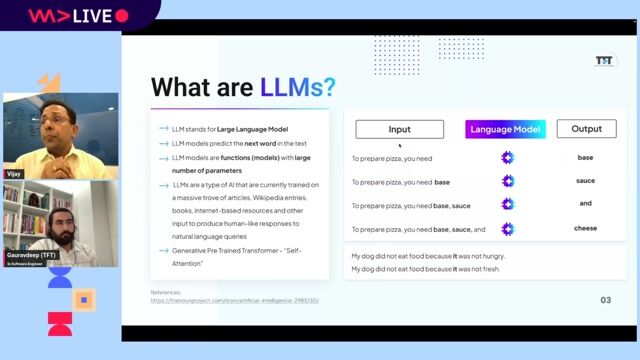 58:00
58:00Creating Industry ready solutions with LLM Models
Vijay Krishan Gupta & Gauravdeep Singh Lotey
 47:28
47:28What do language models really learn
Tanmay Bakshi
 23:50
23:50Data Privacy in LLMs: Challenges and Best Practices
Aditi Godbole
 29:11
29:11Large Language Models ❤️ Knowledge Graphs
Michael Hunger
 24:42
24:42Martin O'Hanlon - Make LLMs make sense with GraphRAG
Martin O'Hanlon
 42:26
42:26How to Avoid LLM Pitfalls - Mete Atamel and Guillaume Laforge
Meta Atamel & Guillaume Laforge
 27:11
27:11Inside the Mind of an LLM
Emanuele Fabbiani
 31:50
31:50Unlocking the Power of AI: Accessible Language Model Tuning for All
Cedric Clyburn & Legare Kerrison
Related Articles
View all articles.png?w=240&auto=compress,format)


.png?w=240&auto=compress,format)
From learning to earning
Jobs that call for the skills explored in this talk.


Nomitri
Berlin, Germany
DevOps
Gitlab
Docker
Ansible
Grafana
+6
Eucon GmbH
Remote
Docker
Kubernetes
Machine Learning
Natural Language Processing