Marton Kodok
Cloud Run- the rise of serverless and containerization
#1about 2 minutes
Understanding the serverless model and its common challenges
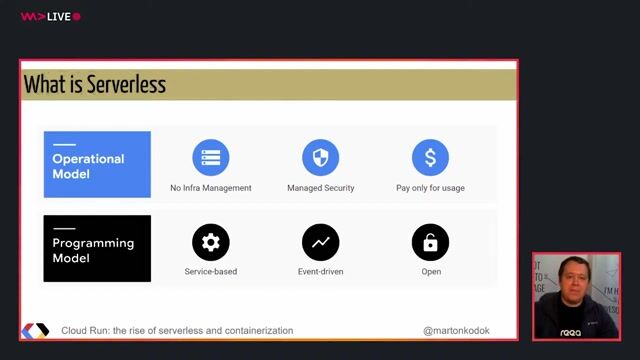
Serverless offers an operational model with no infrastructure management and a pay-for-usage cost model, but common pain points include cold starts and vendor lock-in.
#2about 1 minute
Bringing the benefits of serverless to containerized applications
Cloud Run combines the flexibility of containers with the operational benefits of serverless, allowing you to deploy applications to production in seconds.
#3about 1 minute
Comparing Cloud Run to Cloud Functions and App Engine
Unlike source-based options like Cloud Functions or App Engine, Cloud Run is container-based, offering greater flexibility for HTTP services and async jobs.
#4about 5 minutes
Deploying a simple Node.js application using gcloud CLI
A live demonstration shows how to deploy a containerized "Hello World" application from a local folder to a public HTTPS endpoint using a single gcloud command.
#5about 3 minutes
Breaking down the pay-per-use billing model
Cloud Run's pricing is based on CPU, memory, and request count, with billing calculated in 100-millisecond increments for the duration of active requests.
#6about 2 minutes
Using custom dependencies and binaries in your application
Cloud Run allows you to package any dependency, library, or binary within your container, providing more flexibility than traditional function-as-a-service platforms.
#7about 2 minutes
Managing deployments with traffic splitting and revisions
Cloud Run supports safe, gradual rollouts by allowing you to split traffic between different immutable revisions of your service.
#8about 1 minute
Achieving application portability and avoiding vendor lock-in
By using the standard container format, Cloud Run ensures your application is portable and can be deployed anywhere, from on-premise to other cloud vendors.
#9about 4 minutes
Practical strategies for minimizing and managing cold starts
Reduce cold start latency by using lean base images, warming up a global cache on the first request, and configuring minimum instances to keep containers on standby.
#10about 3 minutes
Understanding autoscaling behavior and its potential risks
Services can scale from zero to thousands of instances automatically, which is powerful but creates a risk of high costs from uncontrolled retries or unwanted traffic.
#11about 5 minutes
Configuring concurrency to optimize cost and performance
Adjusting the number of concurrent requests per container instance is a key lever for balancing performance and cost, as higher concurrency requires fewer running instances.
#12about 1 minute
Using a load balancer for multi-region deployments
Deploy the same service to multiple regions and use a global load balancer to automatically route users to the closest instance, reducing latency.
#13about 4 minutes
Deploying a WebSocket application using buildpacks
A live demo shows how to deploy a real-time whiteboard application using WebSockets, leveraging buildpacks to automatically create a container without a Dockerfile.
#14about 4 minutes
Automating deployments with a custom Cloud Build pipeline
A demonstration of a `cloudbuild.yaml` file shows how to define multi-step build, push, and deploy pipelines for more complex CI/CD automation.
#15about 2 minutes
A summary of Cloud Run's key features and benefits
Cloud Run offers a simple developer experience, auto-scaling, built-in redundancy, and support for modern protocols like HTTP/2, WebSockets, and gRPC.
Related jobs
Jobs that call for the skills explored in this talk.


Matching moments
07:47 MIN
How serverless containers improved flexibility and performance
Serverless landscape beyond functions
Unlock full access
Log in or set up an account to access this feature and more.
04:40 MIN
An examination of Google Cloud Platform container solutions
Containers in the cloud - State of the Art in 2022
Unlock full access
Log in or set up an account to access this feature and more.
12:57 MIN
Deploying agentic applications with serverless compose on GCP
Compose the Future: Building Agentic Applications, Made Simple with Docker
Unlock full access
Log in or set up an account to access this feature and more.
03:24 MIN
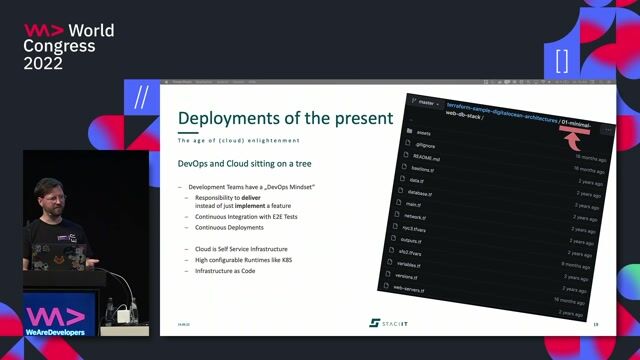
The future of cloud is abstraction and developer experience
The Future of Cloud is Abstraction - Why Kubernetes is not the Endgame for STACKIT
Unlock full access
Log in or set up an account to access this feature and more.

01:15 MIN
Hosting options across cloud and on-premise environments
Say goodbye to building boring APIs with Azure Data API Builder
Unlock full access
Log in or set up an account to access this feature and more.
04:17 MIN
Understanding the evolution of cloud compute models
Fun with PaaS – How to use Cloud Foundry and its uniqueness in creative ways
Unlock full access
Log in or set up an account to access this feature and more.
03:45 MIN
A technical overview of AWS container services
Containers in the cloud - State of the Art in 2022
Unlock full access
Log in or set up an account to access this feature and more.
01:22 MIN
The surprising rise of serverless backend technology
Web development best practices in 2021
Unlock full access
Log in or set up an account to access this feature and more.
Featured Partners
Related Videos
 43:39
43:39Reusing apps between teams and environments through Containers
Adrian Kosmaczewski
 28:03
28:03Containers in the cloud - State of the Art in 2022
Federico Fregosi
 16:38
16:38Develop, test and run a communications application in a serverless cloud
Filippos Kyprianou & Maksym Mednikov
 1:01:02
Serverless: Past, Present and Future
Oliver Arafat
 23:19
23:19End the Monolith! Lessons learned adopting Serverless
Nočnica Fee
 43:36
43:36Cloud-nativeApplications- What’s the buzz about
Jens Eickmeyer
 39:58
39:58Leverage Cloud Computing Benefits with Serverless Multi-Cloud ML
Linda Mohamed
 46:06
46:06CD2CF - Continuous Deployment to Cloud Foundry
Dominik Kress
Related Articles
View all articles
.webp?w=240&auto=compress,format)


From learning to earning
Jobs that call for the skills explored in this talk.


iits-consulting GmbH
Munich, Germany
Intermediate
Go
Docker
DevOps
Kubernetes

Friedrich Kicherer GmbH & Co. KG
Ellwangen (Jagst), Germany
Junior
Intermediate
Senior
GIT
Docker
JavaScript


