David Vlijmincx
Introduction and pitfalls of Java's new concurrency model
#1about 7 minutes
Understanding Java's traditional platform threads
Traditional platform threads are resource-intensive because they map directly to OS threads, leading to memory limitations and the need for pooling with executor services.
#2about 2 minutes
Introducing lightweight virtual threads in Java 21
Virtual threads are a lightweight, JVM-managed alternative to platform threads that avoid expensive OS calls and use resizable heap memory for their stacks.
#3about 2 minutes
Comparing memory usage of platform vs virtual threads
A comparison shows that while memory usage is similar for a small number of threads, virtual threads use significantly less memory at scale, avoiding out-of-memory errors.
#4about 5 minutes
How to create and manage virtual threads
Virtual threads can be created using the Thread.startVirtualThread() static method, a builder pattern, or the new newVirtualThreadPerTaskExecutor which simplifies lifetime management.
#5about 5 minutes
How virtual threads work with carrier threads
Virtual threads run on a pool of platform threads called carrier threads, and are mounted or unmounted during blocking operations to keep the carrier threads busy.
#6about 2 minutes
Common pitfalls when using virtual threads
Avoid common pitfalls such as expecting faster single-thread performance, using them for long-running CPU-bound tasks, or pooling them, as they are designed to be cheap and disposable.
#7about 6 minutes
The problem structured concurrency solves
Unlike unstructured concurrency which can lead to leaked threads and wasted resources, structured concurrency ensures the lifetime of child threads is confined to a specific code block.
#8about 4 minutes
Implementing a race policy with ShutdownOnSuccess
The ShutdownOnSuccess policy in StructuredTaskScope is used to race multiple tasks and retrieve the result of the first one that completes successfully, canceling the others.
#9about 3 minutes
Implementing an all-or-nothing policy with ShutdownOnFailure
The ShutdownOnFailure policy ensures that all forked tasks must complete successfully; if any task fails, all other running tasks are immediately canceled.
#10about 6 minutes
Creating a custom structured task scope policy
Developers can extend StructuredTaskScope and override the handleComplete method to implement custom shutdown logic based on specific business criteria from task results.
#11about 1 minute
Key takeaways for adopting virtual threads
To get started, developers primarily need to use Thread.startVirtualThread() for single tasks or the newVirtualThreadPerTaskExecutor for managing multiple tasks.
#12about 9 minutes
Q&A on virtual threads, reactive programming, and Java 21
The speaker answers audience questions about replacing Project Reactor, migrating existing applications, using thread-locals, and other new features in Java 21.
Related jobs
Jobs that call for the skills explored in this talk.


Matching moments
03:59 MIN
Understanding the new virtual threads model
Modern Java: This is not your father's Java anymore
Unlock full access
Log in or set up an account to access this feature and more.
07:13 MIN
How virtual threads solve the concurrency problem
Java 21: The Revolution of Virtual Threads - A Deep Dive
Unlock full access
Log in or set up an account to access this feature and more.
02:05 MIN
Understanding the goals of Java's Project Loom
Java's Project Loom & Co - the end for reactive programming?
Unlock full access
Log in or set up an account to access this feature and more.
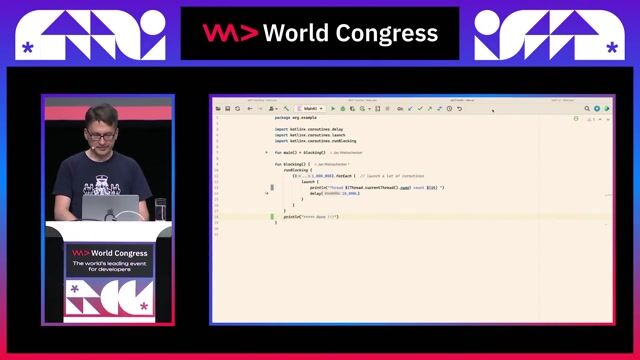
02:24 MIN
Solving blocking issues with Project Loom's virtual threads
Java's Project Loom & Co - the end for reactive programming?
Unlock full access
Log in or set up an account to access this feature and more.
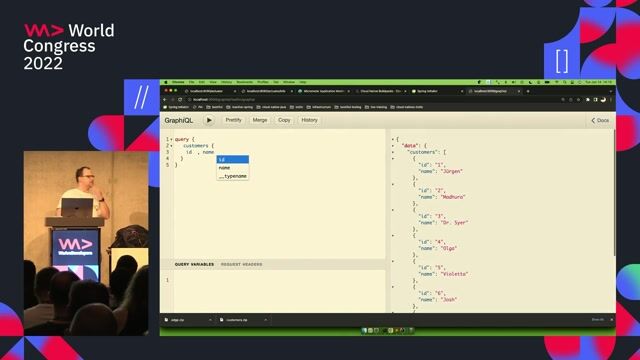
01:12 MIN
Comparing Project Loom with reactive programming
Kubernetes Native Java
Unlock full access
Log in or set up an account to access this feature and more.
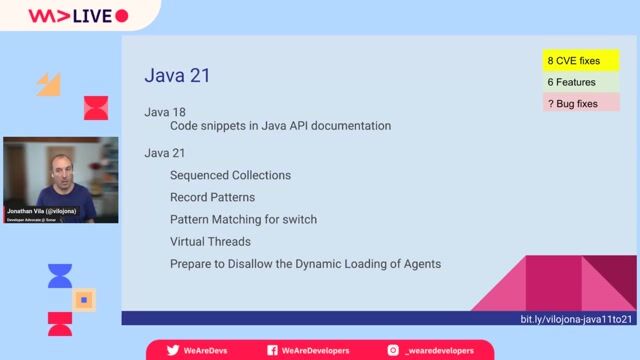
03:16 MIN
What's new in the Java 21 LTS release
Beam Me Up, Java! Unraveling the Warp-Speed Evolution: A Journey through Java LTS Versions 11 to 21
Unlock full access
Log in or set up an account to access this feature and more.

01:32 MIN
Conclusion on Project Loom's impact on reactive programming
Java's Project Loom & Co - the end for reactive programming?
Unlock full access
Log in or set up an account to access this feature and more.

02:57 MIN
Understanding the problem of blocked threads in concurrency
Java's Project Loom & Co - the end for reactive programming?
Unlock full access
Log in or set up an account to access this feature and more.
Featured Partners
Related Videos
 55:30
55:30Java 21: The Revolution of Virtual Threads - A Deep Dive
Christian Woerz
 27:49
27:49Modern Java: This is not your father's Java anymore
Ron Veen
 57:45
57:45Beam Me Up, Java! Unraveling the Warp-Speed Evolution: A Journey through Java LTS Versions 11 to 21
Jonathan Vila
 41:37
41:37Java with a Clojure mindset
Dan Lebrero
 45:30
45:30Best of Java 15 and beyond—my favorite features
Michael Inden
 1:11:05
The Cool Thing about Cool Things in Java 16 & 17 LTS
Mohamed Taman
 37:55
37:552021: Familiar APIs on Kickass Runtimes #slideless
Adam Bien
 23:58
23:58Java's Project Loom & Co - the end for reactive programming?
Jan Weinschenker
Related Articles
View all articles.gif?w=240&auto=compress,format)
.gif?w=240&auto=compress,format)


From learning to earning
Jobs that call for the skills explored in this talk.


wunschlösung GmbH
Jena, Germany
Intermediate
Senior
Java

wunschlösung GmbH
Jena, Germany
Intermediate
Senior
Java
Docker
MongoDB


iov42
Vienna, Austria
Senior
Java
Spring
Ethereum
PostgreSQL
Blockchain
+3


