
Christian Woerz
Route from Java to Kotlin
#1about 3 minutes
Introduction to Kotlin and its Java interoperability
Kotlin is a mature, multi-paradigm language that is fully interoperable with Java libraries and is used in production by major companies.
#2about 5 minutes
Defining variables and working with strings in Kotlin
Learn Kotlin's basic syntax for variables using `var` and `val`, how type inference simplifies code, and how to use string templates for concatenation.
#3about 5 minutes
Using expressions instead of statements for cleaner code
Kotlin treats control flow structures like `if-else`, `try-catch`, and the powerful `when` block as expressions that return a value, eliminating temporary variables.
#4about 7 minutes
Writing concise functions with named and default arguments
Simplify function definitions using expression bodies for single-line returns and avoid method overloading by using named and default arguments.
#5about 5 minutes
Iterating with loops, ranges, and collections
Use Kotlin's intuitive syntax for `for` loops with ranges (`..`, `until`, `downTo`) and iterate over immutable lists with index destructuring.
#6about 8 minutes
Achieving null safety with nullable types and operators
Prevent null pointer exceptions by using Kotlin's type system, which distinguishes between nullable and non-nullable types, along with the safe call (`?.`) and Elvis (`?:`) operators.
#7about 5 minutes
Applying functional programming with lambdas and collections
Define and use lambdas with a concise syntax, leveraging the implicit `it` parameter and trailing lambda syntax for clean collection operations like `filter`.
#8about 4 minutes
Extending existing classes with extension functions
Add new functionality to any existing class, including final Java classes, without using inheritance by defining extension functions.
#9about 4 minutes
Understanding classes, data classes, and operator overloading
Use `data class` to automatically generate `equals`, `hashCode`, and `toString`, and learn how operator overloading can create more readable code for types like `BigDecimal`.
#10about 11 minutes
Audience Q&A on Kotlin features and learning resources
The speaker answers audience questions about Kotlin's relationship to Scala, the potential dangers of operator overloading, and recommended learning resources.
Related jobs
Jobs that call for the skills explored in this talk.


Matching moments

02:48 MIN
An introduction to Kotlin and its Java interoperability
Moving from Java to Kotlin
Unlock full access
Log in or set up an account to access this feature and more.
05:04 MIN
Achieving interoperability between Java and Kotlin code
Why Kotlin is the better Java and how you can start using it
Unlock full access
Log in or set up an account to access this feature and more.
05:51 MIN
A high-level comparison of Kotlin and Java
Why Kotlin is the better Java and how you can start using it
Unlock full access
Log in or set up an account to access this feature and more.
04:41 MIN
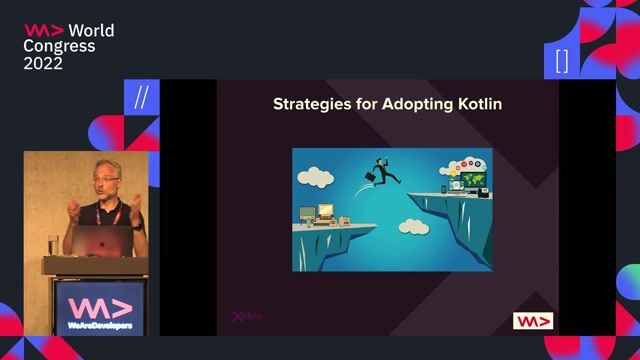
A practical guide to gradual Kotlin adoption
Moving from Java to Kotlin
Unlock full access
Log in or set up an account to access this feature and more.
02:25 MIN
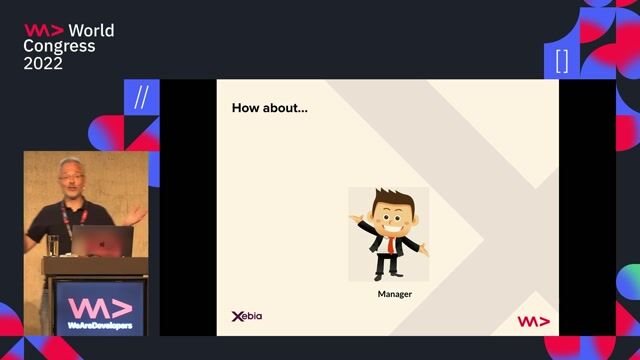
Making the business case for adopting Kotlin
Moving from Java to Kotlin
Unlock full access
Log in or set up an account to access this feature and more.
03:57 MIN
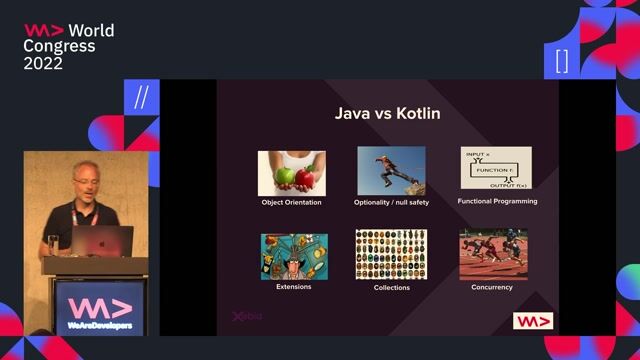
Modern object orientation with Kotlin data classes
Moving from Java to Kotlin
Unlock full access
Log in or set up an account to access this feature and more.
04:04 MIN
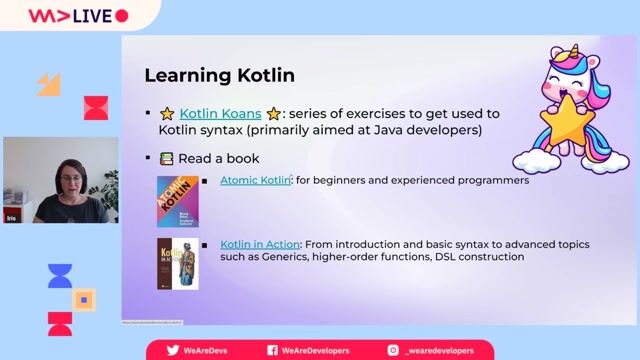
Practical resources for getting started with Kotlin
Why Kotlin is the better Java and how you can start using it
Unlock full access
Log in or set up an account to access this feature and more.

00:35 MIN
An introduction to building a friendly SDK for an API
Building a Friendly Kotlin SDK to Connect to JetBrains Space
Unlock full access
Log in or set up an account to access this feature and more.
Featured Partners
Related Videos
 28:22
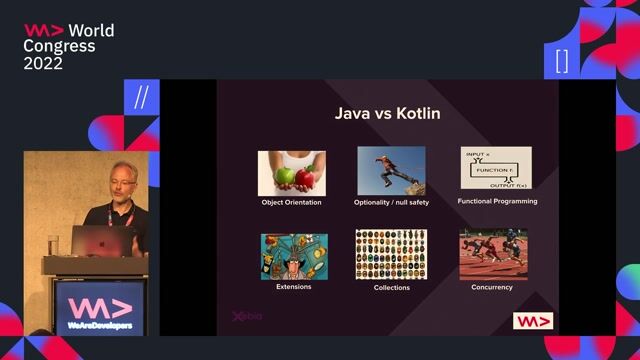
28:22Moving from Java to Kotlin
Urs Peter
 58:11
58:11Why Kotlin is the better Java and how you can start using it
Iris Hunkeler
 38:07
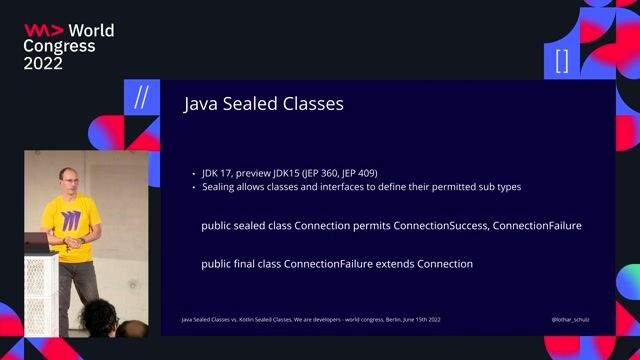
38:07Java Sealed Classes vs. Kotlin Sealed Classes #Slideless
Lothar Schulz
 52:24
52:24Slip Through the Boundaries of Legacy Systems with Kotlin and Spring WebFlux
Lukas Georgieff & Alberto Gisbert
 45:30
45:30Best of Java 15 and beyond—my favorite features
Michael Inden
 41:37
41:37Java with a Clojure mindset
Dan Lebrero
 55:30
55:30Java 21: The Revolution of Virtual Threads - A Deep Dive
Christian Woerz
 37:55
37:552021: Familiar APIs on Kickass Runtimes #slideless
Adam Bien
Related Articles
View all articles
.gif?w=240&auto=compress,format)

.gif?w=240&auto=compress,format)
From learning to earning
Jobs that call for the skills explored in this talk.


Uniwunder GmbH
Dresden, Germany
Intermediate
Senior
Java
Kotlin

PROSOZ Herten GmbH
Herten, Germany
Junior
Intermediate
Senior
Java
Scrum
Kotlin
Microservices


Amadeus FiRe AG
Remote
€60-70K
Kotlin
Unit testing
Continuous Integration