Timo Zander
In the Dawn of the AI: Understanding and implementing AI-generated images
#1about 3 minutes
The rise of advanced AI text-to-image synthesis
AI models like OpenAI's DALL-E 2 can now generate photorealistic and culturally specific images directly from natural language prompts.
#2about 4 minutes
How generative adversarial networks (GANs) work
GANs use a two-player system where a generator creates fake images and a discriminator judges them against real ones, forcing both to improve.
#3about 2 minutes
The mathematical foundation of the GAN training process
The training process is a min-max game governed by a value function, where the discriminator maximizes accuracy and the generator minimizes it by creating better fakes.
#4about 3 minutes
Overcoming mode collapse for diverse outputs
Mode collapse, where the generator produces limited variety, can be fixed by introducing a similarity check that penalizes a lack of diversity in outputs.
#5about 3 minutes
Fixing non-convergence and vanishing gradient issues
Address training deadlocks with a two-timescale update rule and solve the vanishing gradient problem by replacing sigmoid activation functions with ReLU.
#6about 4 minutes
Using progressive GANs for high-resolution image generation
Progressive GANs achieve high-resolution results by starting with a low-resolution image and gradually fading in new layers to increase detail during training.
#7about 3 minutes
Creating controllable landscapes with GauGAN
GauGAN allows users to control image generation by providing a segmentation map for layout and a style image to set the overall mood and color palette.
#8about 8 minutes
The future and ethical challenges of AI image generation
The Q&A session explores the societal impact of AI-generated images, including deepfake detection, AI safety, AI-powered editing, and legal ownership.
Related jobs
Jobs that call for the skills explored in this talk.


Matching moments
06:14 MIN
Core concepts and ethical considerations of generative AI
Langchain4J - An Introduction for Impatient Developers
Unlock full access
Log in or set up an account to access this feature and more.
08:14 MIN
Using GANs to improve deepfake image quality
Deepfakes in Realtime - How Neural Networks Are Changing Our World
Unlock full access
Log in or set up an account to access this feature and more.
01:50 MIN
Deconstructing the recent hype around generative AI
AI: Superhero or Supervillain? How and Why with Scott Hanselman
Unlock full access
Log in or set up an account to access this feature and more.
05:35 MIN
Understanding how generative AI models create content
The shadows that follow the AI generative models
Unlock full access
Log in or set up an account to access this feature and more.
04:05 MIN
Understanding the fundamental shift to generative AI
Your Next AI Needs 10,000 GPUs. Now What?
Unlock full access
Log in or set up an account to access this feature and more.
04:06 MIN
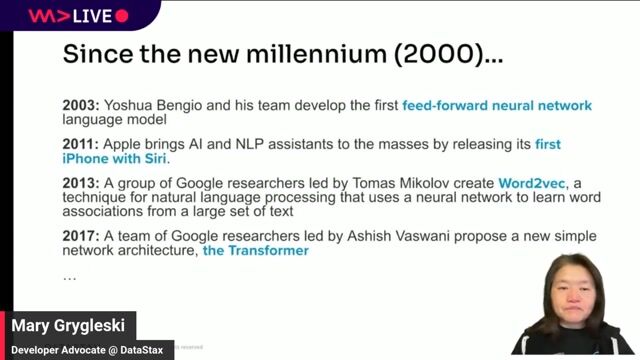
The recent evolution of generative AI models
Enter the Brave New World of GenAI with Vector Search
Unlock full access
Log in or set up an account to access this feature and more.
04:03 MIN
Understanding the rapid evolution of generative AI tools
HR ROBO SAPIENS: Decoding AI Agents and Workflow Automation for Modern Recruitment
Unlock full access
Log in or set up an account to access this feature and more.
02:27 MIN
Key technologies behind DALL·E and generative models
DALL·E Flow: when neural search meets generative art
Unlock full access
Log in or set up an account to access this feature and more.
Featured Partners
Related Videos
 46:42
46:42Deepfakes in Realtime - How Neural Networks Are Changing Our World
Thomas Endres & Martin Förtsch & Jonas Mayer
 30:02
30:02The AI Elections: How Technology Could Shape Public Sentiment
Martin Förtsch & Thomas Endres
 56:55
56:55Multimodal Generative AI Demystified
Ekaterina Sirazitdinova
 29:27
29:27Your imaginations is (no longer) the limit: how Generative AI empowers people to be creative
David Estevez
 29:54
29:54AI'll Be Back: Generative AI in Image, Video, and Audio Production
Fabian Pottbäcker, Thomas Endres & Martin Foertsch
 29:26
29:26GenAI after the Hype: Transforming Organizations with GenAI-based Agents
Alexander Birke & Silke Eggert
 28:30
28:30The shadows that follow the AI generative models
Cheuk Ho
 28:55
28:55DALL·E Flow: when neural search meets generative art
Han Xiao
Related Articles
View all articles

.png?w=240&auto=compress,format)

From learning to earning
Jobs that call for the skills explored in this talk.


BMW AG
Senior
PyTorch
Tensorflow
Computer Vision
Natural Language Processing
Conrad Electronic SE