Matteo Collina
1, 2, 3... Fastify!
#1about 4 minutes
The philosophy and community behind Fastify
Fastify was built with an open, community-first governance model to ensure long-term maintenance and growth.
#2about 3 minutes
Setting up a basic server with logging
A live demo shows how to set up a minimal Fastify server, add a basic route, and enable structured JSON logging with Pino.
#3about 2 minutes
Refactoring the application for testability
The server startup logic is separated from the application configuration into a `build` function to make the app testable in isolation.
#4about 3 minutes
Writing unit tests with tap and app.inject
Learn how to write tests for Fastify routes using the `tap` framework and the `app.inject` method to simulate HTTP requests without a network socket.
#5about 4 minutes
Structuring routes with plugins and autoload
Organize your application by splitting routes into separate files, registering them as plugins, and using `fastify-autoload` to automatically load them.
#6about 9 minutes
Implementing schema-based request validation
Use JSON schema with `fluent-json-schema` to automatically validate incoming request bodies, headers, and query parameters for improved security and reliability.
#7about 2 minutes
Generating API documentation with Swagger
Add the `fastify-swagger` plugin to your application to automatically generate an interactive Swagger UI for your API endpoints.
#8about 3 minutes
Understanding Fastify's internal architecture and lifecycle
A look at the core components like the router and validator, the plugin encapsulation model, and the sequence of hooks in the request lifecycle.
#9about 2 minutes
Exploring key features and ecosystem plugins
An overview of other important Fastify features including first-class logging, fast JSON serialization, Express compatibility, and AWS Lambda support.
#10about 7 minutes
Comparing Fastify with NestJS and Express
A Q&A discussion covers how Fastify's plugin model supports microservices, its differences from opinionated frameworks like NestJS, and when to migrate from Express.
#11about 2 minutes
Discussing TypeScript support and developer tooling
The final Q&A confirms that TypeScript is a first-class citizen in the Fastify ecosystem, despite the core being written in JavaScript for performance.
Related jobs
Jobs that call for the skills explored in this talk.


Matching moments
13:10 MIN
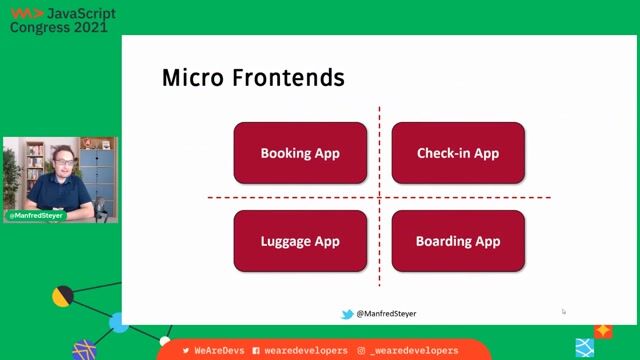
Audience Q&A on practical micro-frontend challenges
Micro-frontends anti-patterns
Unlock full access
Log in or set up an account to access this feature and more.
04:53 MIN
The four pillars of high-performance JavaScript
Things I learned while writing high-performance JavaScript applications
Unlock full access
Log in or set up an account to access this feature and more.
05:13 MIN
The rise of modern frameworks and cloud platforms
Web development: where are we, and where are we going?
Unlock full access
Log in or set up an account to access this feature and more.
02:27 MIN
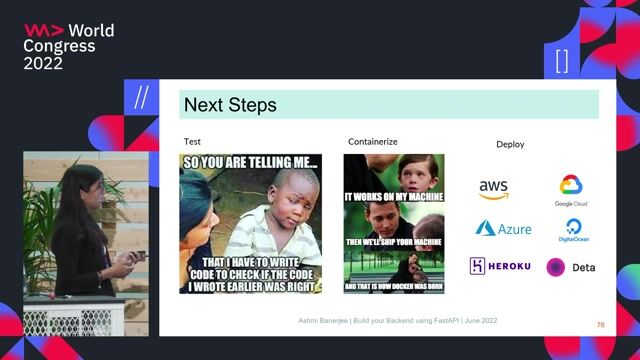
Recap and audience questions on FastAPI
Build your backend using FastAPI
Unlock full access
Log in or set up an account to access this feature and more.

01:57 MIN
The two primary approaches for improving frontend performance
To New Frontiers: The Future of Frontend Development
Unlock full access
Log in or set up an account to access this feature and more.

12:29 MIN
Navigating JavaScript fatigue and framework evolution
WeAreDevelopers LIVE - Whats Nuxt and Next for app development, 20 years AJAX and more
Unlock full access
Log in or set up an account to access this feature and more.
05:25 MIN
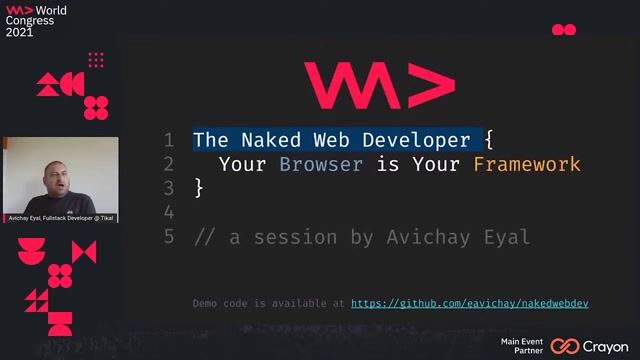
The case for framework-free web development
The Naked Web Developer: Your Browser Is Your Framework
Unlock full access
Log in or set up an account to access this feature and more.
02:20 MIN
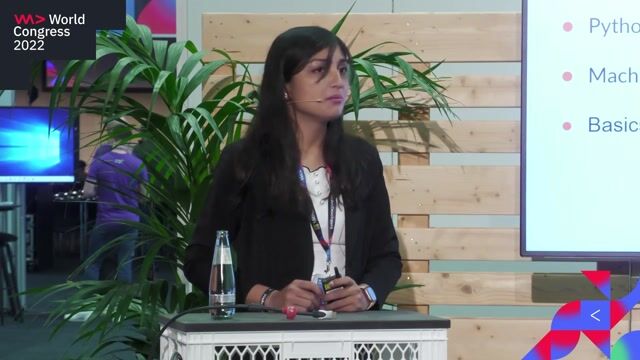
Prerequisites and agenda for the FastAPI talk
Build your backend using FastAPI
Unlock full access
Log in or set up an account to access this feature and more.
Featured Partners
Related Videos
 46:46
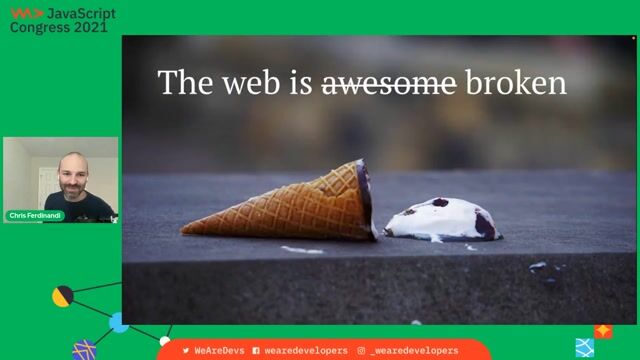
46:46The Lean Web
Chris Ferdinandi
 27:27
27:27Things I learned while writing high-performance JavaScript applications
Michele Riva
 24:08
24:08Node.js: More Threads Than You Think
Matteo Collina
 42:46
42:46The Naked Web Developer: Your Browser Is Your Framework
Avichay Eyal
 44:35
44:35Micro-Frontends with Module Federation: Beyond the Basics
Manfred Steyer
 30:42
30:42One Framework To Rule Them All: Faster Websites With Astro
Eddy Vinck
 43:41
43:41Building for the Edge - Crafting a Next-Gen Framework
Daniel Roe
 26:00
26:00To New Frontiers: The Future of Frontend Development
Rainer Hahnekamp
Related Articles
View all articles



From learning to earning
Jobs that call for the skills explored in this talk.


Peter Park System GmbH
München, Germany
Senior
Python
Docker
Node.js
JavaScript

doinstruct Software GmbH
Berlin, Germany
Intermediate
Senior
Node.js

autoiXpert GmbH & Co. KG
Stuttgart, Germany
Senior
Node.js
Angular
MongoDB
TypeScript


ELFIN Engineering and Solutions GmbH
€60-68K
Vue.js
Node.js
TypeScript
Software Architecture
+1
TechBiz Global GmbH
Berlin, Germany
Remote
Docker
Node.js
Continuous Integration
TechBiz Global GmbH
Cologne, Germany
Remote
Docker
Node.js
Continuous Integration