Gil Zilberfeld
How to TDD in legacy code
#1about 6 minutes
Why standard TDD fails in complex legacy code
Real-world code complexity and dependencies make the simple red-green-refactor cycle difficult and risky without existing tests.
#2about 3 minutes
A modified TDD process for existing codebases
A four-step approach is introduced, involving characterization tests and pre-refactoring before applying the standard TDD cycle.
#3about 7 minutes
Using characterization tests to create a safety net
Characterization tests are written to capture the current behavior of a system, including its bugs, providing a baseline for safe refactoring.
#4about 6 minutes
A step-by-step guide to fixing a bug
A bug is fixed by first writing a failing test, making the minimal code change to pass, and then refactoring both production and test code for clarity.
#5about 6 minutes
Pre-refactoring code to prepare for new features
Before adding new functionality, the code is refactored using techniques like guard clauses and switch statements to make the insertion point clear and simple.
#6about 3 minutes
Adding a new feature with the TDD cycle
After preparing the codebase, a new feature is added by writing a failing test and then implementing the minimal code required to make it pass.
#7about 5 minutes
Core principles for safe and fast development
The key takeaways are minimizing risk, separating new functionality from cleanup, and consistently leaving the code better than you found it.
#8about 9 minutes
Q&A on BDD and testing untestable code
The discussion covers the role of BDD and how to handle untestable code using tools like approval tests or snapshot testing to capture system behavior.
Related jobs
Jobs that call for the skills explored in this talk.


Matching moments
02:02 MIN
Practical strategies for testing legacy applications
Testing .NET applications a Tool box for every developer
Unlock full access
Log in or set up an account to access this feature and more.
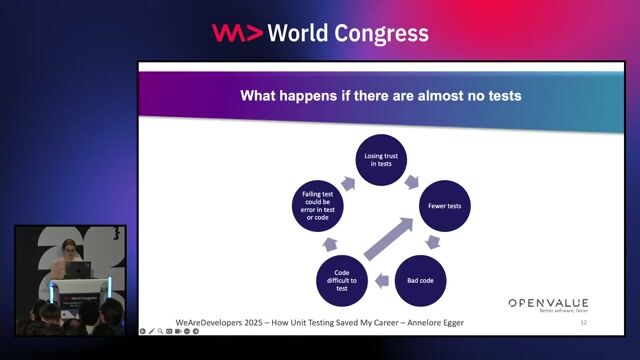
02:52 MIN
The vicious cycle of untestable legacy code
How Unit Testing Saved My Career
Unlock full access
Log in or set up an account to access this feature and more.
07:27 MIN
Why developers avoid unit testing JavaScript
Yes, You Need to Unit Test your JavaScript. Here's How.
Unlock full access
Log in or set up an account to access this feature and more.

05:29 MIN
Why legacy code is so difficult to understand
Seven Myths, Three Reasons, One Goal
Unlock full access
Log in or set up an account to access this feature and more.
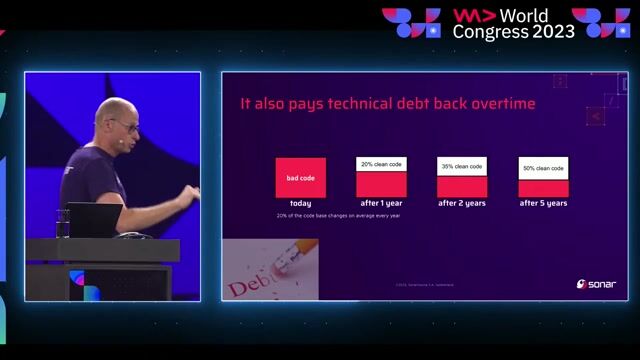
01:18 MIN
How "Clean as You Code" organically improves legacy code
The Clean as You Code Imperative
Unlock full access
Log in or set up an account to access this feature and more.
04:01 MIN
Adopting TDD as a design tool, not just a testing method
Treat yourself - A tale about dog training and test-driven development
Unlock full access
Log in or set up an account to access this feature and more.

03:05 MIN
The pervasive challenge of working with legacy software
Grappling With Clunky Old Software? Start by Understanding What’s Inside!
Unlock full access
Log in or set up an account to access this feature and more.
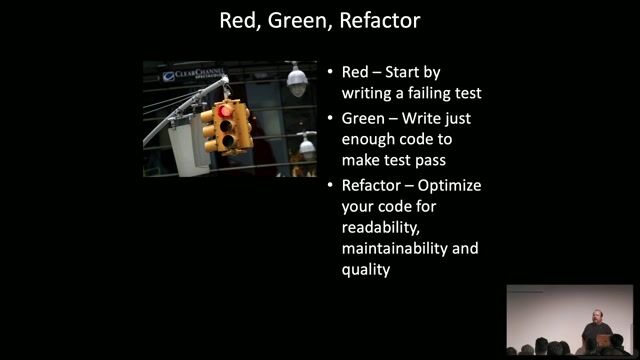
04:53 MIN
Applying the red-green-refactor TDD cycle
Yes, You Need to Unit Test your JavaScript. Here's How.
Unlock full access
Log in or set up an account to access this feature and more.
Featured Partners
Related Videos
 1:00:10
Yes, You Need to Unit Test your JavaScript. Here's How.
James Bender
 43:19
43:19Treat yourself - A tale about dog training and test-driven development
Mirjam Aulbach
 42:34
42:34How To Test A Ball of Mud
Ryan Latta
 1:42:16
Test Driven Development with JavaScript
Sascha Depold & Parinaz Roghany
 56:49
56:49Write tests you love, not hate
Jens Happe
 30:55
30:55Why you must use TDD now!
Alex Banul
 20:33
20:33Breaking the Bug Cycle: TDD for the Win
Nadeen Hussein
 44:59
44:59Let's get visual - Visual testing in your project
Ramona Schwering
Related Articles
View all articles


.gif?w=240&auto=compress,format)
From learning to earning
Jobs that call for the skills explored in this talk.


doinstruct Software GmbH
Berlin, Germany
Senior
GIT
JavaScript
TypeScript


TechBiz Global GmbH
Cologne, Germany
Remote
Docker
Node.js
Continuous Integration
TechBiz Global GmbH
Berlin, Germany
Remote
Docker
Node.js
Continuous Integration
TechBiz Global GmbH
Brussels, Belgium
Remote
Docker
Node.js
Continuous Integration
TechBiz Global GmbH
Düsseldorf, Germany
Remote
Docker
Node.js
Continuous Integration
TechBiz Global GmbH
Mons, Belgium
Remote
Docker
Node.js
Continuous Integration
TechBiz Global GmbH
Mittenwalde, Germany
Remote
Docker
Node.js
Continuous Integration