Marc Backes
Under The Hood of Vue 3 Reactivity
#1about 1 minute
Understanding the core concept of reactivity
Reactivity is explained as an automated observer pattern that listens for changes and notifies the system to update where needed.
#2about 2 minutes
Exploring the core technologies behind Vue 3 reactivity
Vue 3's reactivity system is built on native JavaScript features like Proxies, Set, Map, WeakMap, and Reflect.
#3about 3 minutes
Using ES6 proxies to intercept object operations
ES6 Proxies wrap a target object, allowing you to intercept operations like property access (get) and modification (set) using a handler.
#4about 3 minutes
Structuring dependency tracking with maps and sets
A nested data structure using WeakMap, Map, and Set is used to efficiently store dependencies from target objects to their properties and effects.
#5about 4 minutes
The roles of the track and trigger functions
The `track` function registers an effect as a dependency, while the `trigger` function executes all registered effects when a property changes.
#6about 7 minutes
Implementing a manual observer pattern from scratch
A simple observer pattern is built using `track` and `trigger` functions, demonstrating the need for manual calls to update state.
#7about 8 minutes
Automating tracking and triggering with proxy traps
The manual `track` and `trigger` calls are automated by placing them inside the `get` and `set` traps of an ES6 Proxy handler.
#8about 5 minutes
Refactoring proxy logic into a reusable reactive function
The proxy creation logic is encapsulated within a `reactive` function to easily convert any plain JavaScript object into a reactive proxy.
#9about 4 minutes
Managing effect scope with an active effect wrapper
An `activeEffect` variable and a wrapper function are used to ensure that dependencies are only tracked for the effect that is currently executing.
#10about 4 minutes
Connecting the custom reactivity engine to the DOM
The custom-built reactivity engine is used to automatically update the DOM in response to state changes, demonstrated with buttons and a color picker.
#11about 4 minutes
Answering questions on reactivity and browser support
The speaker addresses audience questions regarding React's hook-based approach, preventing duplicate effect registrations, and Vue 3's lack of support for IE11.
Related jobs
Jobs that call for the skills explored in this talk.


Matching moments
02:59 MIN
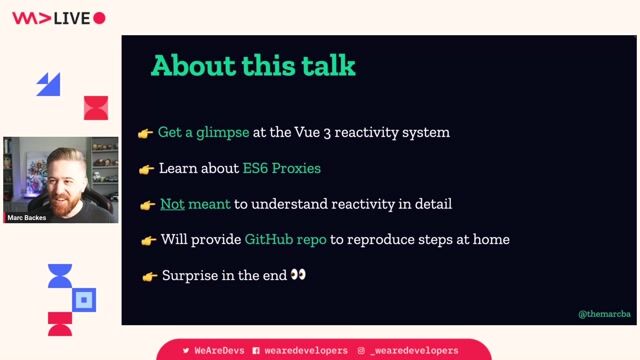
Understanding the core principles of reactivity
Under The Hood Of Vue 3 Reactivity
Unlock full access
Log in or set up an account to access this feature and more.
02:24 MIN
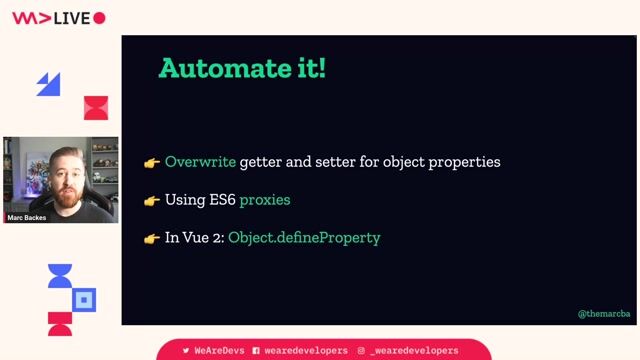
Using ES6 Proxies to intercept data access
Under The Hood Of Vue 3 Reactivity
Unlock full access
Log in or set up an account to access this feature and more.

02:31 MIN
Introducing petite-vue for lightweight reactivity
petite-vue - Progressively enhancing every application?
Unlock full access
Log in or set up an account to access this feature and more.
11:24 MIN
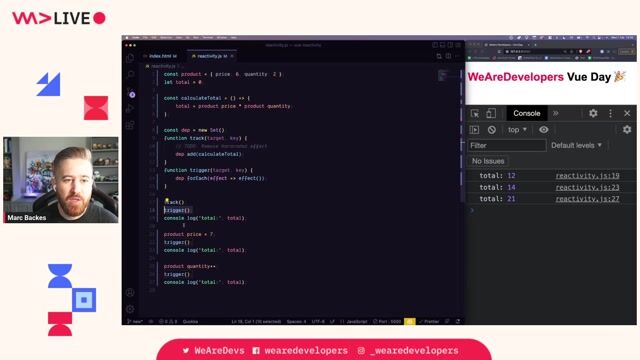
Building a reactive function with ES6 Proxies
Under The Hood Of Vue 3 Reactivity
Unlock full access
Log in or set up an account to access this feature and more.
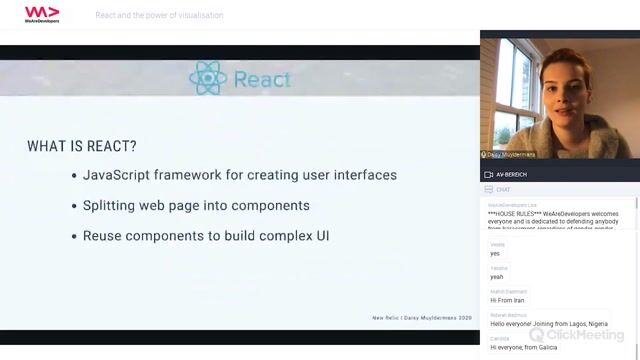
03:09 MIN
Understanding the core concepts of React
React and the power of visualisation
Unlock full access
Log in or set up an account to access this feature and more.
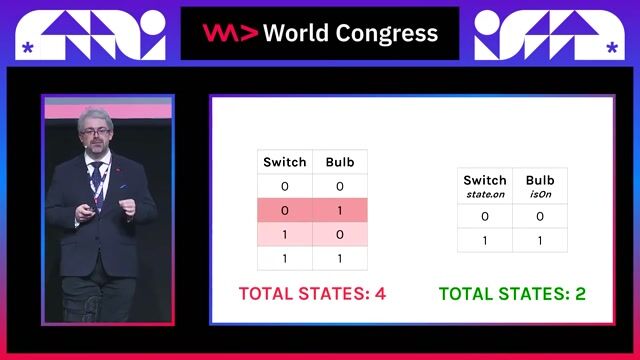
02:13 MIN
How popular JavaScript libraries implement reactivity
Bringing back reactivity in "reactive" frontend
Unlock full access
Log in or set up an account to access this feature and more.
03:54 MIN
Motivation for a modern Three.js library for Vue
TresJS a new declarative ThreeJS as Vue components
Unlock full access
Log in or set up an account to access this feature and more.
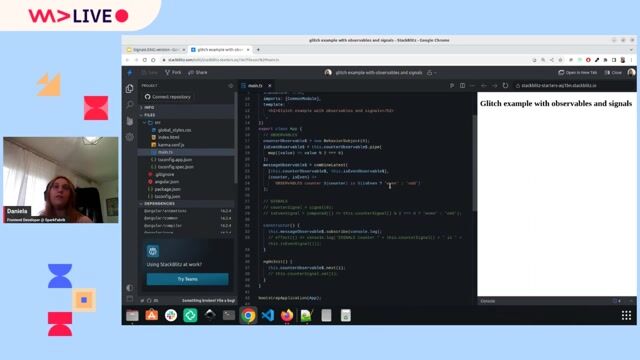
07:42 MIN
Defining true reactivity in modern frameworks
Angular Signals: what's all the fuss about?
Unlock full access
Log in or set up an account to access this feature and more.
Featured Partners
Related Videos
 54:44
54:44Under The Hood Of Vue 3 Reactivity
Marc Backes
 44:11
44:11Vue3 practical development
Mikhail Kuznetcov
 44:31
44:31Vuejs and TypeScript- Working Together like Peanut Butter and Jelly
Rob Richardson
 30:40
30:40What the heck do "declarative" and "reactive" actually mean?
André Kovac
 44:40
44:40petite-vue - Progressively enhancing every application?
Alexander Lichter
 41:43
41:43Modern Web Development with Nuxt3
Alexander Lichter
 41:22
41:22Building Better with Nuxt 3
Daniel Roe
 28:36
28:36Common Mistakes in Vue.js and How to Avoid Them
Daniel Kelly
Related Articles
View all articles


From learning to earning
Jobs that call for the skills explored in this talk.


Die Socialisten
Vienna, Austria
Senior
Jest
React
Redux
JavaScript


APRIORI - business solutions AG
Remote
Svelte
Vue.js
Microsoft Office
Continuous Integration
punkt.genau Personalberatung GmbH
Remote
Intermediate
GIT
HTML
Vue.js
Zebresel - Deine Agentur für d igitale Medien.
GIT
HTML
Vue.js
Node.js