Daniel Graff & Andreas Wittmann
Developing an AI.SDK
#1about 3 minutes
The complexity of AI in safety-critical automotive software
AI introduces a new dimension of complexity to automotive software, requiring both an AI.SDK for development and an AI Runtime for in-car execution.
#2about 5 minutes
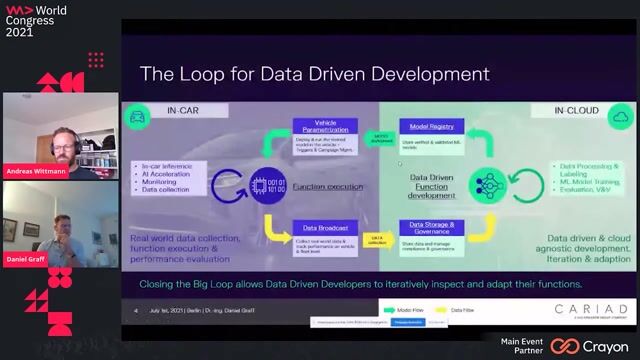
Overview of the data-driven development lifecycle for cars
The end-to-end machine learning loop involves cloud-based data processing, training, and optimization, followed by in-car deployment, inference, and monitoring.
#3about 7 minutes
The role of the AI runtime in the VW.OS
The AI Runtime Environment abstracts hardware and manages optimized model inference within the centralized Volkswagen Operating System (VW.OS).
#4about 1 minute
Comparing platform-dependent and independent model deployment strategies
Models can be deployed as a standard format like ONNX for on-device compilation or as a pre-compiled binary from the cloud for direct execution.
#5about 3 minutes
Why a unified AI.SDK is essential for automotive development
An AI.SDK provides a standardized and abstracted way to develop applications, tackling the challenges of AI safety and a heterogeneous hardware landscape.
#6about 6 minutes
Standardizing data preparation and management in the AI.SDK
The data preparation component of the SDK standardizes pre-processing, ensures data consistency, and enriches metadata to enable traceability and active learning.
#7about 4 minutes
Evaluating model performance and robustness with dedicated libraries
The AI.SDK includes components for performance evaluation and adversarial robustness checks, using a dedicated DNN test metric library for standardization.
#8about 2 minutes
Productionizing models through compression and hardware-aware optimization
The productionization step uses techniques like compression, quantization, and neural architecture search to reduce model size and improve inference time on target hardware.
#9about 6 minutes
Skills and challenges of working with automotive AI
Working in automotive AI requires a mix of software, hardware, and statistics skills to tackle challenges like massive data volumes and embedded system constraints.
#10about 2 minutes
Tooling, hiring, and how to get involved
The team uses standard MLOps tools like TensorFlow, PyTorch, and MLflow on the Azure cloud and is actively hiring for open positions.
Related jobs
Jobs that call for the skills explored in this talk.


Matching moments
04:36 MIN
Introducing the CARIAD and Bosch automated driving alliance
Code to Road in < 12 hours
Unlock full access
Log in or set up an account to access this feature and more.
06:20 MIN
Introducing CARIAD as Volkswagen's dedicated software company
Agile work at CARIAD – Creating a customer web application for controlling the vehicle
Unlock full access
Log in or set up an account to access this feature and more.

04:05 MIN
How CARIAD is tackling major automotive industry shifts
What non-automotive Machine Learning projects can learn from automotive Machine Learning projects
Unlock full access
Log in or set up an account to access this feature and more.

05:15 MIN
Implementing responsible AI with governance and sandboxing
WWC24 - Beyond the Hype: Real-World AI Strategies Panel
Unlock full access
Log in or set up an account to access this feature and more.
06:16 MIN
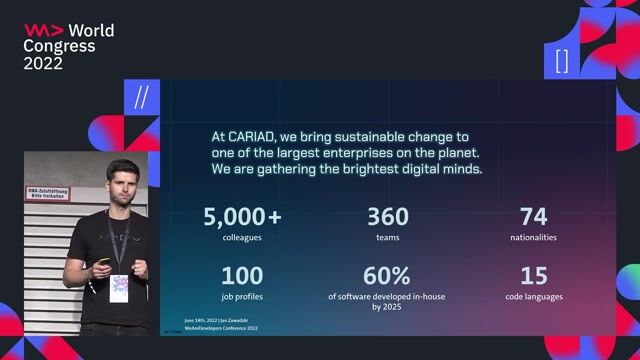
Building an AI-ready architecture for autonomous driving
What non-automotive Machine Learning projects can learn from automotive Machine Learning projects
Unlock full access
Log in or set up an account to access this feature and more.

01:29 MIN
Introducing Cariad and its unified software platform
Finding the unknown unknowns: intelligent data collection for autonomous driving development
Unlock full access
Log in or set up an account to access this feature and more.

03:17 MIN
Using AI to boost developer productivity at Mercedes-Benz
WWC24 - Beyond the Hype: Real-World AI Strategies Panel
Unlock full access
Log in or set up an account to access this feature and more.

04:28 MIN
A software developer's perspective on building AI prototypes
Bringing the power of AI to your application.
Unlock full access
Log in or set up an account to access this feature and more.
Featured Partners
Related Videos
 24:07
24:07WWC24 - Beyond the Hype: Real-World AI Strategies Panel
Mike Butcher, Jürgen Müller, Katrin Lehmann & Tobias Regenfuss
 30:49
30:49AI beyond the code: Master your organisational AI implementation.
Marin Niehues
 48:01
48:01What non-automotive Machine Learning projects can learn from automotive Machine Learning projects
Jan Zawadzki
 52:10
52:10Intelligent Data Selection for Continual Learning of AI Functions
Nico Schmidt
 31:23
31:23Automated Driving - Why is it so hard to introduce
Sayed Bouzouraa
 26:55
26:55How Machine Learning is turning the Automotive Industry upside down
Jan Zawadzki
 1:18:27
How to develop an autonomous car end-to-end: Robotic Drive and the mobility revolution
Ulrich Wurstbauer & Mohamed Nassar
 19:24
19:24Finding the unknown unknowns: intelligent data collection for autonomous driving development
Liang Yu
Related Articles
View all articles



From learning to earning
Jobs that call for the skills explored in this talk.


Vicoland
Frankfurt, Germany
Intermediate
Node.js
DTS Systeme GmbH
Docker
Kubernetes
Microservices
Machine Learning
Software Architecture