Liam Hurrell & Jan Kunzmann
Implementing smoke testing and proactive monitoring in production
#1about 3 minutes
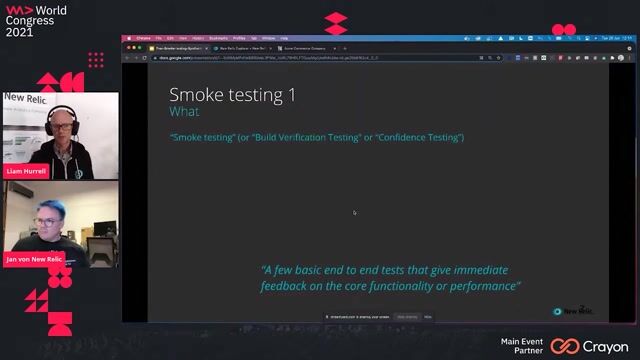
Defining smoke testing for critical functionality
Smoke testing provides rapid, cost-effective feedback on critical application functionality by running a wide but shallow set of end-to-end tests.
#2about 5 minutes
The importance of continuous testing in production
Running automated tests continuously against the production environment, not just staging, provides ultimate confidence in site reliability and protects core business workflows.
#3about 8 minutes
Implementing smoke tests in your deployment lifecycle
Integrate smoke tests to run immediately after deployments and at regular intervals using automated, cloud-based solutions for consistent feedback.
#4about 4 minutes
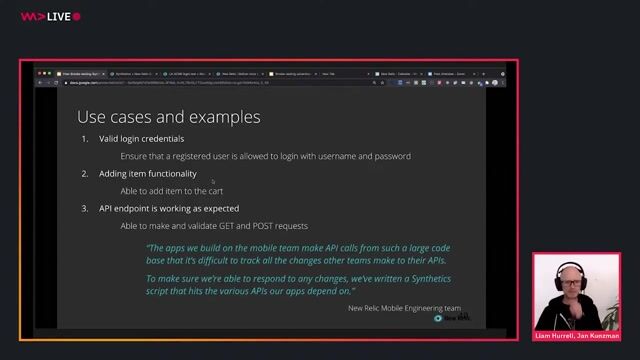
Identifying critical user flows for smoke testing
Focus tests on essential user journeys such as login, registration, adding items to a cart, and verifying both internal and third-party API endpoints.
#5about 4 minutes
Automating web tests with synthetic monitoring
Synthetic monitoring uses automated scripts from global locations to proactively test availability, functionality, and performance before users are impacted.
#6about 15 minutes
Creating availability and performance monitors
Set up basic ping monitors to check endpoint availability and simple browser monitors to capture detailed performance waterfalls for key pages.
#7about 17 minutes
Writing a scripted API test with Node.js
Use a Node.js environment to write custom scripts that make HTTP requests to API endpoints and assert that the responses are valid.
#8about 14 minutes
Simulating user journeys with scripted browser tests
Build end-to-end user simulations with Selenium-based scripts that navigate pages, find elements, and perform actions like clicking buttons.
#9about 6 minutes
Using no-code tools to create test scripts
Accelerate test creation by using a step-by-step builder in the UI or by recording user interactions with the Selenium IDE browser extension.
#10about 6 minutes
Visualizing test results with dashboards and reports
Use a query language like NRQL to build dashboards that track success rates and error types, and configure alert policies to get notified of failures.
Related jobs
Jobs that call for the skills explored in this talk.


Matching moments
08:08 MIN
Introduction to proactive monitoring and smoke testing
Proactive monitoring and smoke testing in your production environment
Unlock full access
Log in or set up an account to access this feature and more.
03:25 MIN
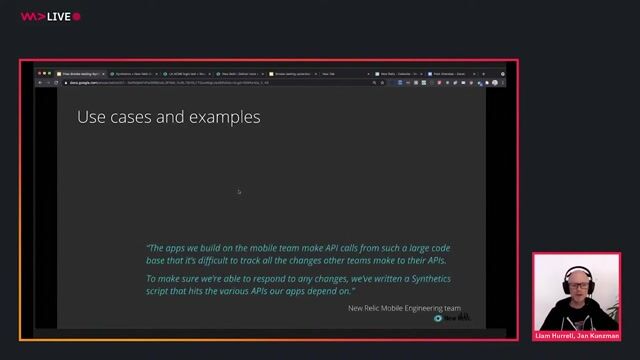
Practical use cases for smoke testing applications
Proactive monitoring and smoke testing in your production environment
Unlock full access
Log in or set up an account to access this feature and more.
04:38 MIN
Using New Relic Synthetics for automated testing
Proactive monitoring and smoke testing in your production environment
Unlock full access
Log in or set up an account to access this feature and more.
11:21 MIN
Automating reactive performance testing in your CI/CD pipeline
Frontend Performance Testing in practice
Unlock full access
Log in or set up an account to access this feature and more.
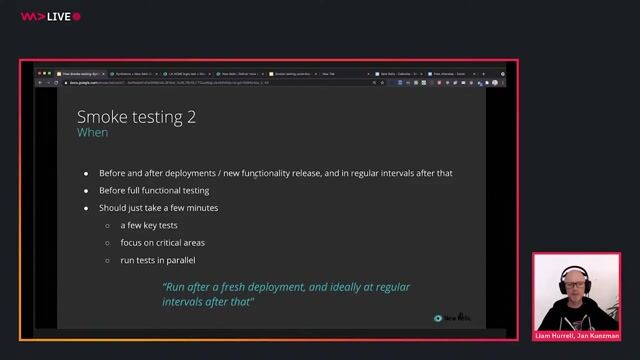
02:08 MIN
Comparing manual and automated smoke testing approaches
Proactive monitoring and smoke testing in your production environment
Unlock full access
Log in or set up an account to access this feature and more.
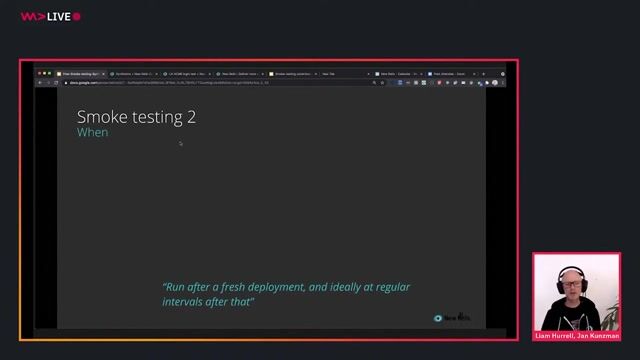
03:40 MIN
Determining the right time to run smoke tests
Proactive monitoring and smoke testing in your production environment
Unlock full access
Log in or set up an account to access this feature and more.
02:40 MIN
An overview of proactive, reactive, and passive testing
Frontend Performance Testing in practice
Unlock full access
Log in or set up an account to access this feature and more.
04:16 MIN
Using end-to-end tests for performance monitoring
Measure and improve frontend performance by using test automation
Unlock full access
Log in or set up an account to access this feature and more.
Featured Partners
Related Videos
 1:27:59
Proactive monitoring and smoke testing in your production environment
Liam Hurrel
 43:07
43:07How not to test
Golo Roden
 42:34
42:34How To Test A Ball of Mud
Ryan Latta
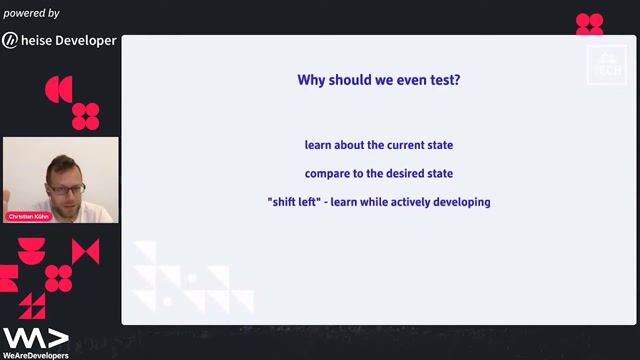 47:22
47:22Continuous testing - run automated tests for every change!
Christian Kühn
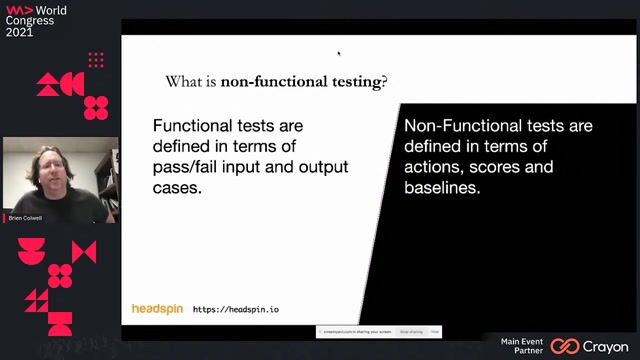 47:37
47:37Using non-functional testing to guide user interface, backend services, voice interface, and media development
Brien Colwell
 25:38
25:38Measure and improve frontend performance by using test automation
Ramona Schwering
 1:42:16
Test Driven Development with JavaScript
Sascha Depold & Parinaz Roghany
 36:50
36:50Frontend Performance Testing in practice
Jonas Kröger
Related Articles
View all articles

.webp?w=240&auto=compress,format)
.gif?w=240&auto=compress,format)
From learning to earning
Jobs that call for the skills explored in this talk.


TechBiz Global GmbH
Cologne, Germany
Remote
Docker
Node.js
Continuous Integration
TechBiz Global GmbH
Mons, Belgium
Remote
Docker
Node.js
Continuous Integration
TechBiz Global GmbH
Brussels, Belgium
Remote
Docker
Node.js
Continuous Integration
TechBiz Global GmbH
Liège, Belgium
Remote
Docker
Node.js
Continuous Integration
TechBiz Global GmbH
Berlin, Germany
Remote
Docker
Node.js
Continuous Integration
TechBiz Global GmbH
Ulm, Germany
Remote
Docker
Node.js
Continuous Integration