Merrill Lutsky
Evaluating AI models for code comprehension
#1about 2 minutes
The challenge of reviewing exponentially growing AI-generated code
The rapid increase in AI-generated code creates a significant bottleneck in the software development lifecycle, particularly in the code review stage.
#2about 3 minutes
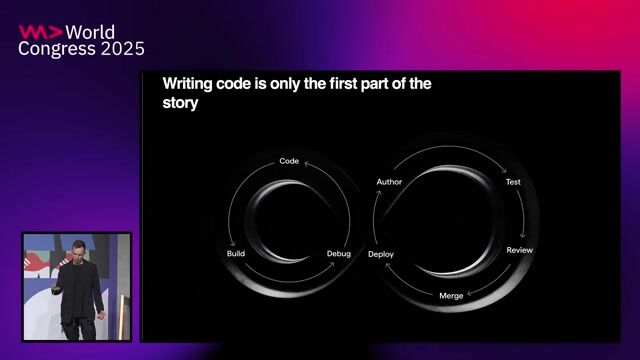
How AI code generation strains the developer outer loop
While AI accelerates code writing (the inner loop), it overwhelms the critical outer loop processes of testing, reviewing, and deploying code.
#3about 1 minute
Introducing Diamond, an AI agent for automated code review
Graphite's AI agent, Diamond, acts as an always-on senior engineer within GitHub to summarize, prioritize, and review every code change.
#4about 3 minutes
Using comment acceptance rate to measure AI review quality
The primary metric for a successful AI reviewer is the acceptance rate of its comments, as every high-signal comment should result in a code change.
#5about 1 minute
Why evaluations are the key lever for LLM performance
Unlike traditional machine learning, optimizing large language models relies heavily on a robust evaluation process rather than other levers like feature engineering.
#6about 2 minutes
A methodology for evaluating AI code comprehension models
Models are evaluated against a large dataset of pull requests using two core metrics: matched comment rate for recall and unmatched comment rate for noise.
#7about 3 minutes
A comparative analysis of GPT-4.0, Opus, and Gemini
A detailed comparison reveals that models like GPT-4.0 excel at precision while Gemini has the best recall, but no single model wins on all metrics.
#8about 2 minutes
Evaluating Sonnet models and the problem of AI noise
Testing reveals that Sonnet 4.0 generates the most noise, making it less suitable for high-signal code review compared to its predecessors.
#9about 2 minutes
Why Sonnet 3.7 offers the best balance for code review
Sonnet 3.7 is the chosen model because it provides the optimal blend of strong reasoning, high recall of important issues, and low generation of noisy comments.
#10about 3 minutes
The critical role of continuous evaluation for new models
The key to leveraging AI effectively is to constantly re-evaluate new models, as shown by preliminary tests on GR four which revealed significant performance gaps.
Related jobs
Jobs that call for the skills explored in this talk.


Matching moments
02:01 MIN
Comparing LLM performance and planning next steps
Build Your First AI Assistant in 30 Minutes: No Code Workshop
Unlock full access
Log in or set up an account to access this feature and more.
02:27 MIN
An overview of an AI-powered code reviewer
How we built an AI-powered code reviewer in 80 hours
Unlock full access
Log in or set up an account to access this feature and more.

05:28 MIN
The limitations and potential of AI models
Coffee with Developers - Cassidy Williams -
Unlock full access
Log in or set up an account to access this feature and more.
02:24 MIN
Prototyping a basic AI code review agent
The Limits of Prompting: ArchitectingTrustworthy Coding Agents
Unlock full access
Log in or set up an account to access this feature and more.
04:17 MIN
Analyzing the developer productivity funnel for GenAI tools
The State of GenAI & Machine Learning in 2025
Unlock full access
Log in or set up an account to access this feature and more.
04:02 MIN
Q&A on AI limitations and practical application
How to become an AI toolsmith
Unlock full access
Log in or set up an account to access this feature and more.
01:37 MIN
Understanding the limitations and challenges of AI documentation
AI-Powered Code Documentation: Simplify the Complex
Unlock full access
Log in or set up an account to access this feature and more.
02:12 MIN
Favorite AI development tools at leading tech companies
Engineering Productivity: Cutting Through the AI Noise
Unlock full access
Log in or set up an account to access this feature and more.
Featured Partners
Related Videos
 28:07
28:07How we built an AI-powered code reviewer in 80 hours
Yan Cui
 24:05
24:05The Limits of Prompting: ArchitectingTrustworthy Coding Agents
Nimrod Kor
 15:26
15:26New AI-Centric SDLC: Rethinking Software Development with Knowledge Graphs
Gregor Schumacher, Sujay Joshy & Marcel Gocke
 27:07
27:07Bringing AI Model Testing and Prompt Management to Your Codebase with GitHub Models
Sandra Ahlgrimm & Kevin Lewis
 41:06
41:06From Monolith Tinkering to Modern Software Development
Lars Gentsch
 30:24
30:24ChatGPT: Create a Presentation!
Markus Walker
 42:38
42:38Innovating Developer Tools with AI: Insights from GitHub Next
Krzystof Czieslak
 04:17
04:17Leapter: The Reinvention of Software Development? A Future Built On AI Generated Code.
Robert Werner
Related Articles
View all articles


.png?w=240&auto=compress,format)
From learning to earning
Jobs that call for the skills explored in this talk.


Gemma Analytics
score4more GmbH
Berlin, Germany
Remote
Intermediate
DevOps
TypeScript
Data analysis
Machine Learning
+2