
Stephen Cooper
A Practical Guide to Reducing Bundle Size
#1about 3 minutes
Why bundle size is important for user experience
Reducing bundle size leads to faster load times and a better user experience, which can also improve SEO rankings through better web vitals.
#2about 1 minute
Understanding tree shaking and dead code elimination
Tree shaking is a form of dead code elimination that removes unused code from the final bundle by analyzing the application's import graph.
#3about 4 minutes
Managing side effects to enable tree shaking
Bundlers avoid removing code with potential side effects, but you can use the `sideEffects: false` property in `package.json` to signal that unused imports are safe to drop.
#4about 2 minutes
Using pure annotations for advanced tree shaking
The `/*#__PURE__*/` annotation tells the bundler that a function call is side-effect-free, allowing it to be removed if its return value is unused.
#5about 3 minutes
How decorators and static properties break tree shaking
Code patterns like decorators and static class properties can create top-level references that prevent bundlers from identifying and removing unused code.
#6about 1 minute
Avoiding barrel files to improve tree shaking
Re-exporting modules from a single "barrel" file (`index.js`) can prevent tree shaking because it forces the bundler to evaluate all exports.
#7about 2 minutes
The importance of testing your bundle size
Small code changes can unexpectedly break tree shaking, so it's crucial to continuously test bundle size using tools like `size-limit` in your CI/CD pipeline.
#8about 1 minute
Debugging bundle size with source map explorer
When tests fail, tools like `source-map-explorer` and `sonder` help visualize the contents of your bundle to identify what code is being incorrectly included.
#9about 2 minutes
How class properties can prevent minification
Minifiers cannot shorten public or TypeScript-private class property names because they could be accessed externally, preserving their full string length in the bundle.
#10about 2 minutes
Using native private fields for better minification
Using native JavaScript private fields (with `#`) allows minifiers to safely mangle property names, but requires targeting modern ES versions to avoid polyfills.
#11about 4 minutes
Advanced patterns for optimizing minification
Further reduce bundle size by replacing verbose error messages with codes, passing class properties as function arguments, and inlining temporary variables.
#12about 1 minute
Comparing build tools and compression methods
The choice of build tool involves a trade-off between build speed and final bundle size, and selecting a modern compression algorithm like Brotli can provide additional savings.
Related jobs
Jobs that call for the skills explored in this talk.


Matching moments
04:21 MIN
Reducing JavaScript's impact with smaller bundles
Sustainable me. A tale of good design.
Unlock full access
Log in or set up an account to access this feature and more.
03:05 MIN
Executing JavaScript and optimizing the bundle
The Journey of a Pixel in a React Application
Unlock full access
Log in or set up an account to access this feature and more.
03:06 MIN
Reducing bundle size by replacing heavy dependencies
Challenges of building React and React Native apps
Unlock full access
Log in or set up an account to access this feature and more.
04:09 MIN
Shrinking asset size with modern formats and analysis
Sleek, Swift, and Sustainable: Optimizations every web developer should consider
Unlock full access
Log in or set up an account to access this feature and more.

01:57 MIN
The two primary approaches for improving frontend performance
To New Frontiers: The Future of Frontend Development
Unlock full access
Log in or set up an account to access this feature and more.
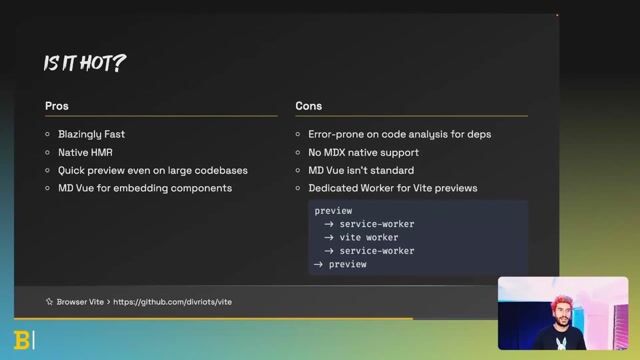
05:01 MIN
How production builds remain highly optimized
The Eternal Sunshine of the Zero Build Pipeline
Unlock full access
Log in or set up an account to access this feature and more.

01:39 MIN
How bundling reveals ESM's performance advantage
Oh CommonJS! Why are you mESMing with me?
Unlock full access
Log in or set up an account to access this feature and more.
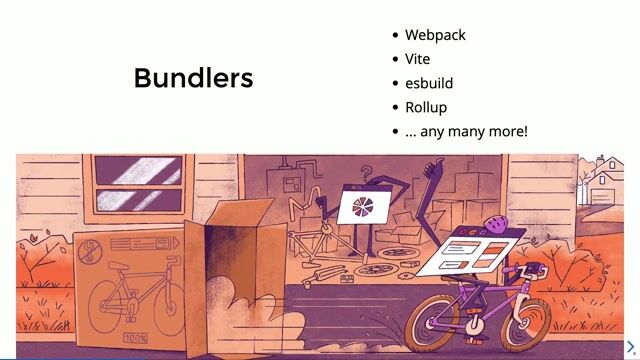
04:17 MIN
How bundlers work and why they are necessary
Tree Shaking the Bytes Away
Unlock full access
Log in or set up an account to access this feature and more.
Featured Partners
Related Videos
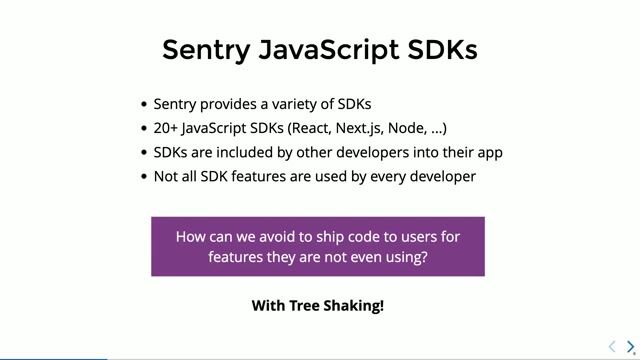 27:40
27:40Tree Shaking the Bytes Away
Francesco Novy
 53:16
53:16How Your Bundle Size Affects The Climate
Roy Derks
 50:10
50:10The Eternal Sunshine of the Zero Build Pipeline
M4dz
 46:46
46:46The Lean Web
Chris Ferdinandi
 21:06
21:06The Dependency Cookbook - Recipes for Micro Frontend success
Lucas Braeschke & Stefan Bley
 09:23
09:2311 Tips for Greener Code
Kent Simonsen
 41:49
41:49Destructuring Frontend monoliths with MicroFrontends
Trishul Goel
 50:28
50:28Angular tips/tricks you can use from tomorrow on
Benedikt Starzengruber
Related Articles
View all articles



From learning to earning
Jobs that call for the skills explored in this talk.


doinstruct Software GmbH
Berlin, Germany
Senior
GIT
JavaScript
TypeScript


ELFIN Engineering and Solutions GmbH
€60-68K
Vue.js
Node.js
TypeScript
Software Architecture
+1
Tech Solutions Gmbh
GIT
HTML
Vue.js
Tech Solutions Gmbh
GIT
HTML
Vue.js
Tech Solutions Gmbh
GIT
HTML
Vue.js
TechBiz Global GmbH
Brussels, Belgium
Remote
Docker
Node.js
Continuous Integration
TechBiz Global GmbH
Mons, Belgium
Remote
Docker
Node.js
Continuous Integration