
Ankit Patel, Matt White, Philipp Schmid, Lucie-Aimée Kaffee & Andreas Blattmann
Open Source AI, To Foundation Models and Beyond
#1about 3 minutes
Defining the different categories of open source AI
The Linux Foundation's framework categorizes open source AI into open science, open tooling, and open models based on completeness and licensing.
#2about 4 minutes
Balancing open source principles with business sustainability
Companies navigate different licensing strategies, like permissive Apache 2.0 versus non-commercial licenses, to sustain development while contributing to the community.
#3about 2 minutes
Why policy should incentivize open sharing in AI
Effective policy should encourage the open sharing of models and data to improve efficiency and safety, rather than accidentally penalizing transparency.
#4about 3 minutes
How open source models accelerate AI innovation
Open models foster rapid innovation and competition, enabling the community to build upon existing work and create a powerful feedback loop for developers.
#5about 7 minutes
Moving beyond leaderboards in AI model evaluation
Relying solely on public benchmarks is flawed due to contamination, so developers should use a mix of public, private, and personalized evaluation sets for specific use cases.
#6about 2 minutes
Incorporating humanities and culture into AI benchmarks
Creating more robust and less biased AI requires collaborating with experts in fields like philosophy to develop benchmarks that reflect diverse cultural values.
#7about 6 minutes
Debunking common myths about open source AI
Common misconceptions are addressed, clarifying that openness enhances safety, AI has academic open roots, and true progress requires more than just open weights.
Related jobs
Jobs that call for the skills explored in this talk.


Matching moments
06:11 MIN
Open source models ensure a competitive AI ecosystem
Decoding Trends: Strategies for Success in the Evolving Digital Domain
Unlock full access
Log in or set up an account to access this feature and more.

06:45 MIN
The future of open source licensing and incentives
Open Source: The Engine of Innovation in the Digital Age
Unlock full access
Log in or set up an account to access this feature and more.

04:04 MIN
Navigating AI regulation and open source
The AI Hype Filter: What’s Real, What’s Investable, What’s Noise?
Unlock full access
Log in or set up an account to access this feature and more.
03:36 MIN
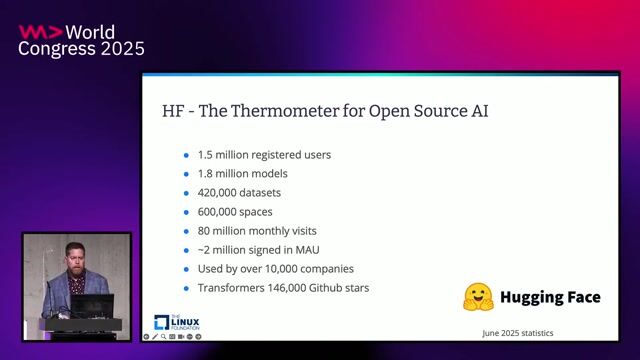
Navigating the challenges of defining open source AI
The Open Future of AI: Beyond Open Weights
Unlock full access
Log in or set up an account to access this feature and more.
03:19 MIN
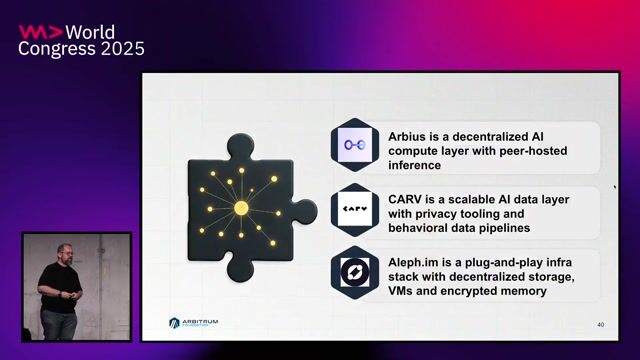
Exploring open source and decentralized AI alternatives
How to Decipher User Uncertainty with GenAI and Vector Search
Unlock full access
Log in or set up an account to access this feature and more.

00:59 MIN
Conclusion and the future of open source AI
Self-Hosted LLMs: From Zero to Inference
Unlock full access
Log in or set up an account to access this feature and more.

03:46 MIN
The impact of open source models like DeepSeek
Graphs and RAGs Everywhere... But What Are They? - Andreas Kollegger - Neo4j
Unlock full access
Log in or set up an account to access this feature and more.
02:32 MIN
The rise of self-hosted open source AI models
Self-Hosted LLMs: From Zero to Inference
Unlock full access
Log in or set up an account to access this feature and more.
Featured Partners
Related Videos
 35:16
35:16How AI Models Get Smarter
Ankit Patel
 23:04
23:04The Open Future of AI: Beyond Open Weights
Matt White
 27:53
27:53Open Source: The Engine of Innovation in the Digital Age
Maxim Fateev, Jo Franchetti, Ankit Patel & Ivan Burazin
 24:07
24:07WWC24 - Beyond the Hype: Real-World AI Strategies Panel
Mike Butcher, Jürgen Müller, Katrin Lehmann & Tobias Regenfuss
 41:06
41:06Panel: How AI is changing the world of work
Pascal Reddig, TJ Griffiths, Fabian Schmidt, Oliver Winzenried & Matthias Niehoff & Mirko Ross
 26:25
26:25Bringing AI Everywhere
Stephan Gillich
 28:05
28:05A walkthrough on Responsible AI Frameworks and Case Studies
Toju Duke
 28:30
28:30The shadows that follow the AI generative models
Cheuk Ho
Related Articles
View all articles



From learning to earning
Jobs that call for the skills explored in this talk.


score4more GmbH
Berlin, Germany
Remote
Intermediate
DevOps
TypeScript
Data analysis
Machine Learning
+2
SBI GmbH
Eschborn, Germany
DevOps
Gitlab
Pandas
Docker
PyTorch
+8